DUBAI: The Arab coalition said they destroyed five Houthi mines in the Red Sea, Saudi state TV Al-Ekhbariya reported.
The Sadaf mines are manufactured by Iran, the report added.
To continue reading, please click here.
Source: arabnews.com

We cover piracy, armed robbery at sea, IUU fishing, maritime cyber security and maritime security issues.
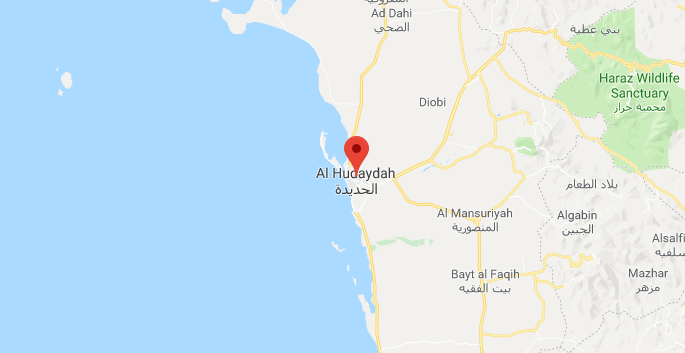
DUBAI: The Arab coalition said they destroyed five Houthi mines in the Red Sea, Saudi state TV Al-Ekhbariya reported.
The Sadaf mines are manufactured by Iran, the report added.
To continue reading, please click here.
Source: arabnews.com

Saeed Al-Batati
AL-MUKALLA: Iran-backed Houthi’s use of naval mines and bomb boats, and the group’s resistance to maintaining the Safer tanker are serious threatens to international maritime traffic and ecological life in the Red Sea, senior Yemeni officials warned on Monday.
The officials repeated concerns about the collapse of the tanker, urging the international community to act now to avert a major disaster in the Red Sea.
To continue reading, please click here.
Source: arabnews.com

KARACHI – The Pakistan Maritime Security Agency (PMSA) arrested four drug traffickers and seized huge quantity of drugs during an operation conducted in open sea.
Addressing a news conference at the PMSA headquarters, Commander and Director (Public Relations) Usman Amjad of the Agency said that the PMSA intercepted a suspicious vessel in open sea, and during its checking recovered 1,372 kg of hashish on board and arrested four accused.
To continue reading, please click here.
Source: nation.com.pk

By Tola Adenubi
Suspected maritime pirates on Monday kidnapped five Ghanaians from the Ghanaian flagged general cargo vessel AM DELTA with IMO number 9015929 at 35 nautical miles off the Agbano Terminals in the Niger Delta area.
In an advisory notice issued on Monday to nearby vessels by both the United Kingdom-based maritime consultancy firm, Dryad Global, and the Italian maritime consultancy firm, Praesidium International; the Ghanaian flagged vessel was boarded by six to seven pirates on the 16th of November 2020 at 44 nautical miles South Brass.
To continue reading, please click here.
Source: tribuneonlineng.com

On Friday, 14 crewmembers were kidnapped from a Chinese heavy-lift ship off the coast of Sao Tome.
According to security consultancy Dryad Global, the heavy lift ship Zhen Hua 7 was boarded by pirates at a position about 80 nm to the northeast of Sao Tome, in the Gulf of Guinea. The ship was drifting at the time of the boarding. 14 out of her 27 crewmembers were kidnapped, and all of the victims are Chinese nationals, according to Dryad.
To continue reading, please click here.
Source: maritime-executive.com

Associated Press reported on Friday 13th November that Saudi officials had been quoted as saying that they had intercepted and thwarted an apparent attempt to disrupt oil supplies at an Aramco oil distribution centre in the Red Sea.
The report cites a Saudi Press Agency report which said:
“Coalition Navy Forces detected this evening (Wednesday, 11 November 2020) an attempt by the terrorist Houthi militia to carry out a hostile, terrorist act in Southern Red Sea using (2) bomb-laden Unmanned Surface Vehicles (USVs) launched from Hodeida Governorate.
“The USVs, which pose a threat to regional and international security, Sea Lines of Communication and International Trade, were destroyed.”
The deployment of remote controlled ‘boat bombs’ is not a new one and al Houthis have demonstrated their effectiveness in the past. However, this is the second incident of SVBIED in recent weeks and should concern all shipping which transits the region.
Media Release
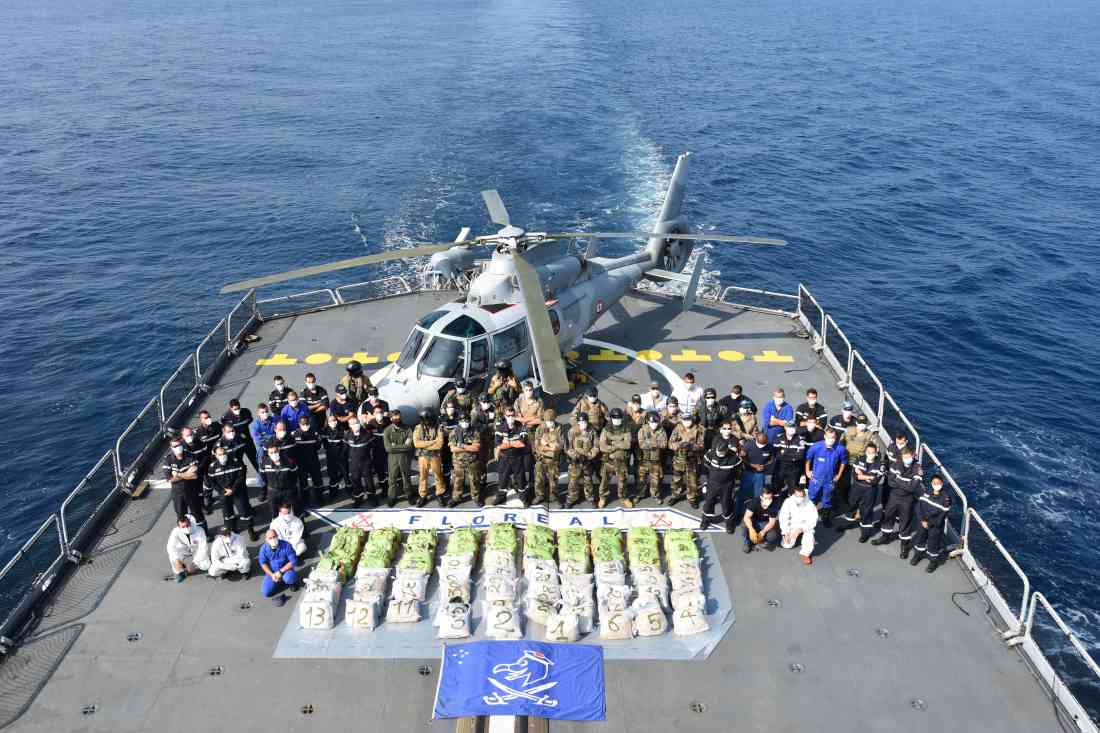
A French ship working in support of a Combined Maritime Forces (CMF) task force has seized over one tonne of hashish worth $8 million, 8 November 20.
Sailors on board French Ship Floréal, the lead Floréal-class frigate, captured the drugs from a suspicious vessel during a counter-narcotics operation in the Arabian Sea’s infamous ‘Hash Highway’.
The ship was operating in support of CMF’s Combined Task Force 150 (CTF 150) at the time of the seizure, which comes just weeks after a Royal Navy ship working as part of a CTF 150 operation intercepted over 450kg of methamphetamine.
“This seizure marks yet another successful drugs bust by CTF 150,” said the task force’s Commander, Rear Admiral Sulieman Alfakeeh of the Royal Saudi Naval Forces. “With two successful drugs seizures in a matter of weeks, we are proving that we are a formidable force against drug smugglers, keeping millions of dollars of illegal substances off the streets.”
A team of French sailors conducted the boarding of the suspicious vessel, which was sailing along a route known for transiting drugs.
The one tonne haul of hashish was well-hidden on board the vessel and required an extensive search by the highly trained boarding team, made even more challenging by the threat of COVID. The ship’s medical team was responsible for decontaminating all personnel and all equipment to ensure the safety of its personnel was maintained.
This drugs seizure marks another success in a long string of CMF activities; in addition to the historic Royal Navy methamphetamine seizure in October, last month the USS Winston S. Churchill assisted an Iranian-flagged motor vessel in distress while in support of CTF 150. In the last few days, the French Ship Jean Bart, alongside the Japanese Ship Ariake, operating under a CTF 151 tasking, provided the medical evacuation of an injured mariner.
“The Combined Maritime Forces is founded on a shared commitment to ensuring the safety of all legitimate mariners at sea,” said Commodore Dean Bassett Royal Navy, Deputy Commander of the Combined Maritime Forces. “Sometimes this involves assisting those in distress, and other times it targets those who seek to use the maritime environment to conduct illegal activities such as terrorism, smuggling and piracy.”
The Combined Maritime Forces (CMF) is a multinational maritime partnership which exists to counter illicit non-state actors on the high seas, promoting security, stability and prosperity in the Arabian Gulf, Red Sea, Gulf of Aden, Indian Ocean and Gulf of Oman. CTF 150 operates to disrupt and deny criminal and terrorist organizations operating outside of the Arabian Gulf, to ensure that legitimate commercial shipping can transit the region, free from non-state threats. CTF 150 is currently led by the Royal Saudi Naval Force, the second time that the country’s Navy has led the task force.

In a recent Zoom call, the commander of the Combined Task Force 151, Rear Admiral Nejat Inanir, spoke with the Head of the Djibouti Coastguard, Colonel Waiss Omar Bogoreh to discuss their continued partnership in conducting counter-piracy operations.
Rear Admiral Inanir thanked Colonel Bogoreh for his support in a recent counter piracy operation, Focused Operation Shamal. “It’s been a job really well done. Your assistance is very much appreciated,” said Rear Admiral Inanir. He also passed on a personal message of gratitude from the Combined Maritime Forces (CMF) commander, Vice Admiral Samuel Paparo.
While Djibouti is not a member of CMF, CTF 151 regularly works closely with the nation’s Navy and Coastguard to support maritime security operations in the region, sharing information and informing merchant vessels transiting through their waters when military assets are working to protect the region’s shipping lanes nearby.
Colonel Bogoreh said: “We are always willing collaborate further with CMF. We have eight or nine years of a history of working together in what is a very successful relationship.”
Source: combinedmaritimeforces.com
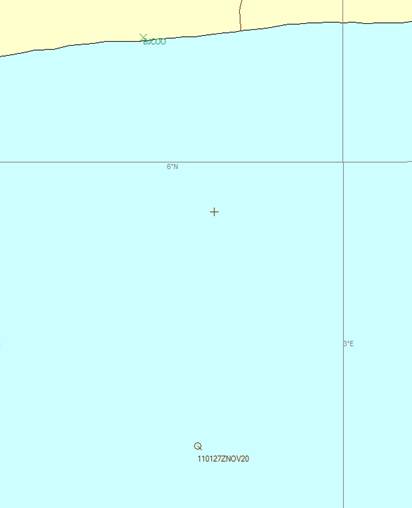
MDAT-GoG reported on November 11th that a tanker was under attack by armed pirates in one skiff, in position 0512N 00235E (70 Nm southeast of Cotonou) at 0119UTC.
The initial report came from the vessel itself, which followed up to state that the attack had been aborted. It is not known at this time whether the vessel was protected by armed guards or was able to evade the pirates.
This is the latest in a series of attacks, primarily against tankers, in the last week, several of which have occurred at least 70nm from shore, highlighting the risk to vessels transiting the GoG.

Written by Venezuela Investigative Unit, InSight Crime
Fishermen are denouncing increased piracy around Lake Valencia in northern Venezuela, which is weakening one of the last productive industries in the area.
For months, heavily armed pirates have attacked homes along the now-defunct Valencia-Güigüe highway in the state of Carabobo every 15 to 22 days. Residents report that they arrive on motorboats, armed with machine guns, and demand that fishermen hand over various belongings including fishing gear. Although no people have reportedly been harmed in recent attacks, there is reason to fear an escalation of violence if families are unable to meet the pirates’ increasing demands, according to press reports.
In 2017, four brothers were found dead in Lake Valencia, allegedly killed by pirates who tried to steal their boat engine motor while they were fishing.
Piracy on Venezuelan lakes is not a new phenomenon nor is it limited to Lake Valencia. Fishermen on Lake Maracaibo, in the northwestern state of Zulia, have reported extortion and violence from pirates for at least a decade. These attacks increased throughout 2019. Local residents told InSight Crime that pirates demand that fishermen surrender part of their daily catch. If fishermen refuse or do not surrender enough fish, the pirates take their boats or engines and demand payments of up to $2,000 to secure their return.
As the economic situation in Venezuela continues to deteriorate, the few remaining industries that continue to generate any profit are likely to remain prime targets for extortion and theft. Fishing keeps local populations afloat on the shores of Lake Maracaibo and Lake Valencia, although profits have decreased in recent years due to inflation and environmental problems. This relative success has ensured that piracy remains a profitable criminal economy.
Fishermen have begged for state protection, but the government’s inaction in the face of these attacks will give little hope to vulnerable populations. Although the governor of Zulia announced the creation of a maritime force to protect fishermen from pirates in mid-2019, the barebones unit was comprised of only 35 police officers and one boat. In its first operation, the brigade freed four captives and retrieved two boats stolen by pirates. Despite this early success, a local fisherman and community leader told InSight Crime last March that attacks have continued.
And while much of the fishing on Lake Valencia is artisanal and does not feed into major industries, fishermen on Lake Maracaibo often sell their catch to companies that ship internationally. Capitalizing on this connection, gangs often charge fishermen extortion fees for access to Lake Maracaibo and to the seafood companies on its shores. A community leader in Zulia confirmed to InSight Crime that gangs, including Tren del Norte and Los Leal, are among several groups that engage in piracy and jockey for control of this economy in Lake Maracaibo.
Source: insightcrime.org
 Maritime Security News