CMF and Djibouti develop partnership to combat piracy

In a recent Zoom call, the commander of the Combined Task Force 151, Rear Admiral Nejat Inanir, spoke with the Head of the Djibouti Coastguard, Colonel Waiss Omar Bogoreh to discuss their continued partnership in conducting counter-piracy operations.

Rear Admiral Inanir thanked Colonel Bogoreh for his support in a recent counter piracy operation, Focused Operation Shamal. “It’s been a job really well done. Your assistance is very much appreciated,” said Rear Admiral Inanir. He also passed on a personal message of gratitude from the Combined Maritime Forces (CMF) commander, Vice Admiral Samuel Paparo.

While Djibouti is not a member of CMF, CTF 151 regularly works closely with the nation’s Navy and Coastguard to support maritime security operations in the region, sharing information and informing merchant vessels transiting through their waters when military assets are working to protect the region’s shipping lanes nearby.

Colonel Bogoreh said: “We are always willing collaborate further with CMF. We have eight or nine years of a history of working together in what is a very successful relationship.”

Source: combinedmaritimeforces.com

Pirates of the Lake – Gangs Prey on Venezuelan Fishermen

Written by Venezuela Investigative Unit, InSight Crime

Fishermen are denouncing increased piracy around Lake Valencia in northern Venezuela, which is weakening one of the last productive industries in the area.

For months, heavily armed pirates have attacked homes along the now-defunct Valencia-Güigüe highway in the state of Carabobo every 15 to 22 days. Residents report that they arrive on motorboats, armed with machine guns, and demand that fishermen hand over various belongings including fishing gear. Although no people have reportedly been harmed in recent attacks, there is reason to fear an escalation of violence if families are unable to meet the pirates’ increasing demands, according to press reports.

In 2017, four brothers were found dead in Lake Valencia, allegedly killed by pirates who tried to steal their boat engine motor while they were fishing.

Piracy on Venezuelan lakes is not a new phenomenon nor is it limited to Lake Valencia. Fishermen on Lake Maracaibo, in the northwestern state of Zulia, have reported extortion and violence from pirates for at least a decade. These attacks increased throughout 2019. Local residents told InSight Crime that pirates demand that fishermen surrender part of their daily catch. If fishermen refuse or do not surrender enough fish, the pirates take their boats or engines and demand payments of up to $2,000 to secure their return.

InSight Crime Analysis

As the economic situation in Venezuela continues to deteriorate, the few remaining industries that continue to generate any profit are likely to remain prime targets for extortion and theft. Fishing keeps local populations afloat on the shores of Lake Maracaibo and Lake Valencia, although profits have decreased in recent years due to inflation and environmental problems. This relative success has ensured that piracy remains a profitable criminal economy.

Fishermen have begged for state protection, but the government’s inaction in the face of these attacks will give little hope to vulnerable populations. Although the governor of Zulia announced the creation of a maritime force to protect fishermen from pirates in mid-2019, the barebones unit was comprised of only 35 police officers and one boat. In its first operation, the brigade freed four captives and retrieved two boats stolen by pirates. Despite this early success, a local fisherman and community leader told InSight Crime last March that attacks have continued.

And while much of the fishing on Lake Valencia is artisanal and does not feed into major industries, fishermen on Lake Maracaibo often sell their catch to companies that ship internationally. Capitalizing on this connection, gangs often charge fishermen extortion fees for access to Lake Maracaibo and to the seafood companies on its shores. A community leader in Zulia confirmed to InSight Crime that gangs, including Tren del Norte and Los Leal, are among several groups that engage in piracy and jockey for control of this economy in Lake Maracaibo.

Source: insightcrime.org

Japanese warship concludes counter-piracy operations in the Gulf of Aden

Media Release

After six months conducting counter piracy operations with the Combined Maritime Forces (CMF) in the Gulf of Aden, the Japanese ship Ohnami prepares to return to her home port. 

The Takanami class destroyer has been working in support of the CMF’s Combined Task Force (CTF) 151, a counter-piracy task force which is currently led by the Turkish Navy. 

During their six month deployment JS Ohnami has accompanied hundreds of merchant ships in convoys to safeguard them from pirate attacks as they transit through the Gulf of Aden. The ship has also participated in a number of focused operations to deter piracy activity as the weather becomes more favourable for the pirates to operate small quick skiffs.

“The JS Ohnami’s dedication and professionalism has been essential for successful counter piracy operations. Thank you very much for supporting CTF 151 in so many diverse ways,” said Rear Admiral Nejat Inanir, commander of CTF 151.

With such a vast area of operations to patrol, partnership is at the centre of counter piracy operations in the region. The ability to work with other nations, across multiple languages, during operations and exercises is key to is key to the success of CTF 151 in combating piracy activity in the High Risk Area. 

Led by Commander Ishidera, the Ohnami crew have also engaged in many Passing Exercises, proving their ability to operate with warships from many nations. These exercises involve sharing information between partner navies securely and effectively, a crucial part of combating piracy. 

As the JS Ohnami prepares to sail home from her successful deployment, the Japanese Maritime Self Defence Force has handed over the baton to another destroyer, the JS Ariake, to continue the vital work to secure freedom of navigation of the millions of tons of merchant shipping that transits through the region annually.

Established in 2001, CMF comprises 33 member nations united by their desire to maintain maritime security by countering non-state actors who use the maritime environment to conduct illegal acts such as narcotics smuggling and piracy.

Military finds body of one of 7 slain ASG bandits in Sulu

by Martin Sadongdong

The military has finally recovered the body of one of the seven alleged Abu Sayyaf Group (ASG) bandits who were killed in a maritime encounter in Patikul, Sulu last week.

Major General William Gonzales, commander of Joint Task Force (JTF) Sulu, identified the body as Dave Sawadjaan, a nephew of slain ASG leader Hajan Sawadjaan, cousin of ASG bomb expert Mundi Sawadjaan, and brother of one alias “Urot” who was also a deceased member of ASG under Hajan’s command.

To continue reading, please click here.

Source: mb.com.ph

INTERNATIONAL COUNTER PIRACY OPERATION BLOWS THROUGH THE GULF OF ADEN

Media Release

With the monsoon season – which makes sea conditions favourable for smaller shipping vessels – over, a large multinational counter piracy operation has been conducted by the Combined Maritime Forces in the Gulf of Aden.

The operation, named Operation Shamal after the strong winds that blow from the north bringing sandstorms to the region, was designed to increase military patrolling in the area around the Gulf of Aden and the Horn of Africa.

The area is of immense importance as the main shipping lane from the Indian Ocean to the Mediterranean passes through it. With the Monsoon diminishing and sea becoming favourable for sailors, there has been a large increase in the number of smaller fishing vessels, skiffs and dhows operating again, mainly closer to the coastlines of coastal states.

“Focused Operation Shamal was conducted to demonstrate to potential pirates and sponsors of piracy that there is a significant military force in the region that would deal with any attempted piracy attack,” said Combined Task Force 151’s (CTF 151) Operations officer, Lieutenant Commander Yoo Sanghun of the Republic of Korea Navy.

“We are also here to reassure our partners on merchant ships that despite the increase in small boat activity, the military is there to respond,” he added.

The Operation was an international affair, with support from CMF members Pakistan, the Republic of Korea, the United States and the Japanese Maritime Self Defence Force.

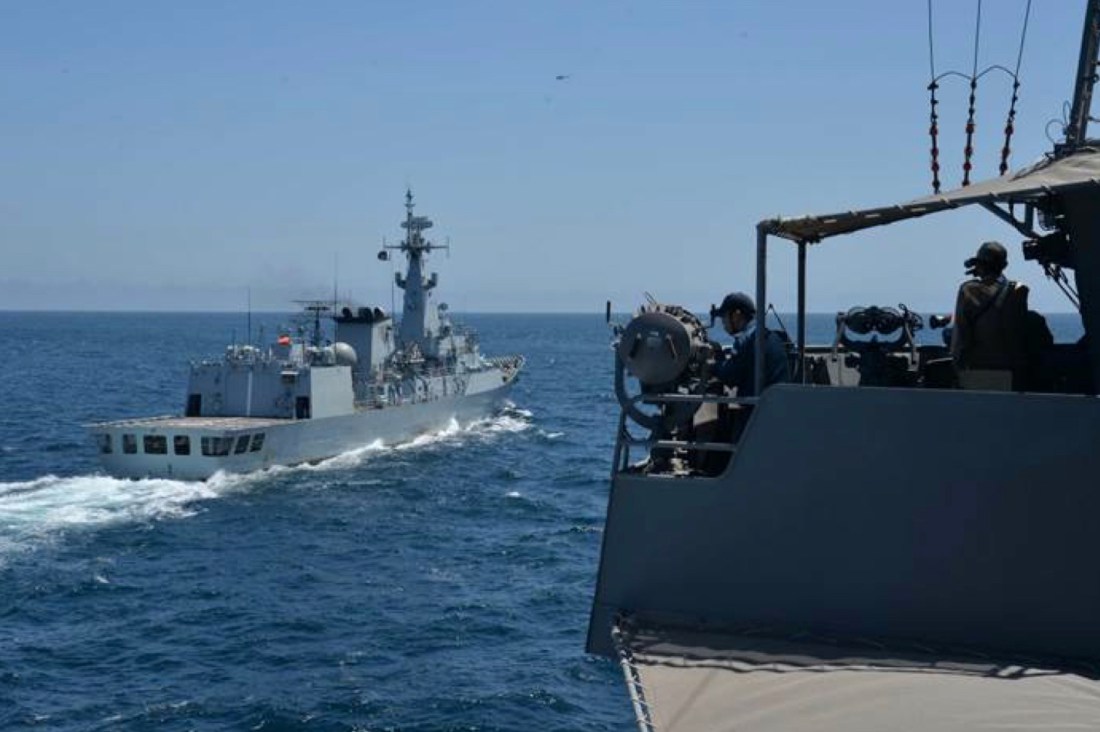
The Pakistan Navy ship Zulfiquar and the ROK ship Dae Jo Yeong drilled together during a Passing Exercise. The exercise is a testimony of the skills and professionalism of the respective navies and demonstrated their abilities to enhance interoperability at sea.

There was also a significant contribution from Djibouti and Oman, with Djibouti’s coastguard and the Royal Navy of Oman playing a vital part in contacting merchant vessels sailing through the area, alerting them to the presence of warships and gathering essential information about any suspicious activity they’d seen during their transit.

The UKMTO office in Dubai contributed to the operation, alerting merchant shipping to expect an increase in military activity, both visually and on VHF.

Military activity during the operation was not just limited to the sea; maritime patrol aircraft from both CMF and EU NAVFOR-participating countries contributed significantly to the operation, providing an overwatch right across the entire piracy High Risk Area. They identified potential piracy activity at an early stage, whether in the Somalian based known piracy camps or at sea.

“It is always pleasing when we are able to grow our capability by having so many countries operating closely together, whether it’s patrol aircraft and warships tactically maneuvering together or nation states coordinating their navies and coastguards to deliver freedom of navigation in a long term strategy,” said Rear Admiral Nejat Inanir of the Turkish Navy, Commander of CTF 151.

The region is in a state of transition between monsoon seasons; October is one of the busiest times for small fishing craft and dhows to operate and there will be an increase in small dhow traffic between the various ports on both sides of the Gulf of Aden. Merchant ships are encouraged to use the Internationally Recommended Transit Corridor (IRTC), where they are less likely to have any interaction with the smaller fishing skiffs, which are occasionally mistaken for pirates.

Warships and maritime patrol aircraft continuously patrol the Gulf of Aden throughout the year, but will be particularly vigilant in these weather transition zones. It’s vital to protect world trade through vulnerable chokepoints. With the seafarer hostages being released by pirates earlier this month, it’s a key reminder that organisations including CMF’s CTF 151 play a fundamental role to deter piracy from interrupting the free passage of these crucial sea lanes.

“It’s been a very successful operation,” said Rear Admiral Nejat Inanir. “Operation Shamal has provided a timely reminder to the maritime community that there is an international effort to maintain the free flow of commerce, today and always.”

Top Abu Sayyaf leader killed in Sulu Sea assault

By: , ,

ZAMBOANGA CITY, Zamboanga del Sur, Philippines — The top leader of a kidnap-for-ransom gang affiliated with the Abu Sayyaf group in Sulu was killed along with six others in a predawn operation by the military on Tuesday.

Lt. Gen. Corleto Vinluan Jr., commander of the Western Mindanao Command, said Mannul or Mannor Sawadjaan and his six heavily armed companions were leaving Sulare Island on a speedboat at past 1 a.m. on Tuesday when they were intercepted by government forces.

To continue reading, please click here.

Source: newsinfo.inquirer.net

Navy looks to shore up defence against Moz terror threats

SA mulls making a temporary Richards Bay naval base permanent as IS ups the ante – but experts have a problem with this

Orrin Singh

The South African Navy is looking to establish a permanent base in Richards Bay, on the KwaZulu-Natal north coast, as the rapid escalation of terror-related activities in northern Mozambique have security analysts and government officials concerned.

Sources in the navy told Sunday Times Daily this week that there were “legitimate concerns” of security threats stemming from terror attacks in Cabo Delgado, which had displaced more than 300,000 people, according to the UN Food Programme, and resulted in more than 2,000 deaths in the province.

To continue reading, please click here.

Source: timeslive.co.za

Three piracy attacks in S’pore Strait over 2 ½ hours

Nothing stolen; latest incidents bring Oct tally to six, highest monthly figure this year

Fabian Koh

Armed pirates stormed three ships in the Singapore Strait in the span of 2 ½ hours between Sunday night and yesterday morning.

But nothing was stolen from the bulk carriers in the three separate incidents, which took place in close proximity to one another in the eastbound lane of the Traffic Separation Scheme (TSS) in the waterway.

To continue reading, please click here.

Source: straitstimes.com

How Covid-19 has escalated the maritime drug trade – and what AI can do about it

HMS Defender and drugs haul

Adele Berti

Israeli maritime intelligence and predictive analytics company Windward is using artificial intelligence to identify and pinpoint Europe-bound vessels that might be illicitly carrying drugs for distribution in the continent.

Spearheaded by CEO Ami Daniel, a local entrepreneur with a background serving in the navy, the company bids to speed up the digitalisation of the maritime sector by offering a predictive intelligence solution that relies on AI and big data for a range of applications including safety, security and finance.

To continue reading, please click here.

Source: ship-technology.com

CTF151 and Pakistan Navy hold talks ahead of CTF Command takeover

Media release

The Turkish-led Combined Task Force 151 (CTF 151) held a recent engagement with the Assistant Chief of Naval Staff (Ops) of the Pakistan Navy, two months ahead of the Pakistan takeover of CTF 151 command.

Rear Admiral Nejat Inanir of the Turkish Navy, the Commander of the Combined Maritime Forces’ CTF 151, followed the current Covid-19 trend of using Zoom conference calling to discuss matters of mutual cooperation and security in the region. Pakistan will be assuming command of CTF 151 in December for a record ninth time, marking this time as a key preparation period.

RAdm Inanir thanked the longstanding support and contribution of the Pakistan Navy to the Combined Maritime Forces for its provision of personnel and maritime assets which contribute to counter piracy operations in the region.

“I am so pleased to see Pakistan contribute to CMF so effectively. Their support aids how we maintain maritime security and ensure the free flow of commercial maritime trade,” said RAdm Inanir said. “We are seeing a large increase in small vessel activity now that the monsoon season is transitioning and it’s vital that CTF 151 continues to suppress any piracy activity early.”

Cdre Faisal commended the strong leadership of Turkish-led CTF 151:  “All support will be provided to CTF 151 for Counter Piracy Operations as and when required,” he said.

Both Commanders agreed to provide further assistance and collaboration to achieve their common goal of providing maritime security in the region and making the seas safe for legitimate mariners and seafarers.

The Combined Maritime Forces (CMF) is a multinational maritime partnership which exists to counter illicit non-state actors on the high seas, promoting security, stability and prosperity in the Arabian Gulf, Red Sea, Gulf of Aden, Indian Ocean and Gulf of Oman. CTF 151 is one of three CMF task forces with the mission to deter piracy across the Arabian Gulf, Red Sea, Gulf of Aden and the Gulf of Oman, protecting the free flow of maritime commerce. Pakistan last led CTF 151 in 2016.

ENDS