Busy Weekend for CTF 150. Impressive Drug Seizure for HMS Montrose

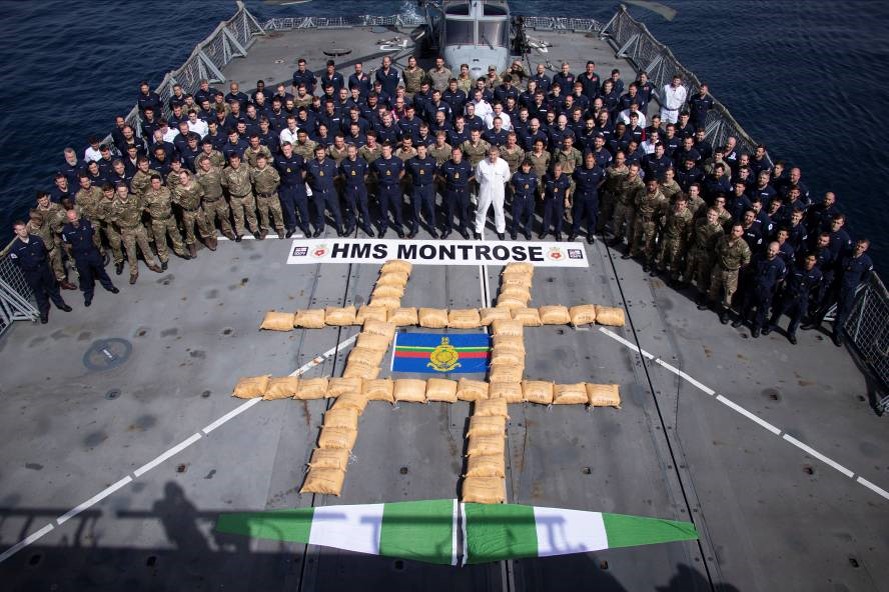
Starting on Valentine’s Day, ships working in direct support of Combined Task Force 150 (CTF 150) had a busy weekend, the result of which was a major drug bust by Her Majesty’s Ship (HMS) MONTROSE, a United Kingdom Royal Navy (RN) frigate.

In the late afternoon of 15 February, MONTROSE’s ‘WILDCAT’ shipborne helicopter spotted a suspicious dhow in an area of the Gulf of Oman known to be popular with drug smugglers.

As the sun rose over the Arabian Sea on the morning of 16 February, several packages could be seen floating in the water near the dhow. The packages were recovered and determined to be hashish. Royal Marine Commandos then boarded the dhow, securing it for search by a Royal Navy boarding team.

The master of the dhow admitted that the packages in the water came from his vessel, and after a thorough search of the dhow, the team found another cache of hashish. Add that to the drugs recovered from the water, and MONTROSE’s total seizure of hashish was 1045kg worth an estimated regional wholesale value of $538,860 U.S. dollars.

This is the first seizure for HMS MONTROSE while working in direct support of the Australian lead CTF 150. The Royal Australian Navy, with support staff from the Royal Canadian, and Royal New Zealand navies assumed command of CTF 150 in early December 2019.

“Fantastic work by the crew of HMS MONTROSE in tracking this smuggler, stopping them from ditching their cargo, and keeping these drugs from reaching their destination,” said Commodore Ray Leggatt, Royal Australian Navy, Commander of CTF 150. “With the support of ships like COURBET and MONTROSE, CTF 150 continues to apply pressure and disrupt the operations of terrorist and criminal organisations in the region that seek to use the maritime domain for their illegitimate trade.”

Denying the use of the maritime domain to illegitimate traffic in the region is CTF 150’s mission. The cooperation and support of CMF participating nations like France and the United Kingdom are the key mission enablers that CTF 150 relies on to carry out the mission. The 33 nations of CMF, working together, improves maritime security, helps strengthen regional nations’ maritime capabilities, and upholds international norms and today’s bust is just the latest example of that cooperation in action.

Source: combinedmaritimeforces.com

Nigeria: FG moves to enforce Anti-Piracy Law as stiff penalty awaits offenders

The Federal Government has embarked on measures to ensure a smooth enforcement of the newly enacted anti piracy law as part of efforts to stem criminality on Nigerian waters. This was revealed in Lagos at the annual Strategic Admiralty Law Seminar for Judges put together by the Nigerian Institute of Advanced Legal Studies (NIALS) and the Nigerian Maritime Administration and Safety Agency (NIMASA). The theme of the conference was, “Suppression of Piracy and Other Maritime Offences (SPOMO) Act, 2019: Key to Accelerating and Achieving Safe and Secure Shipping in Nigeria.” it was meant to sensitise judicial sector actors on the import of the antipiracy law.

Speaking at the opening ceremony, the Directors-General of NIMASA and NIALS, Dr. Dakuku Peterside and Professor Mohammed Tawfiq Ladan, respectively, emphasised the need for unencumbered implementation of the law. They called for cooperation among the enforcement agencies, stressing that stringent penalties await maritime criminals in the country.

To continue reading, please click here.

Source: worldstagegroup.com

Pirates attack tanker off Benin, kidnap crew

On Feb. 20th, MDAT-GoG, the agency monitoring maritime crime in West Africa and the Gulf of Guinea, reported an attack on a vessel in position 05°08’31’’N – 002°06’14.4’’E.

Although the agency has not updated their report since then, media outlets and independent sources now say that at least nine crew (possibly 10, there is some confusion about the actual number) were taken hostage after at least two armed pirates boarded the ship, named as the MT Alpine Penelope.

The incident reportedly occurred some 76nm off Cotonou and the location suggests that pirate groups in the region are moving away from areas where naval patrols have been stepped up in recent weeks, such as off the Niger Delta.

Yesterday’s attack is another example of the changing economies of piracy. Until 2018, pirate groups in the region took advantage of the oil market by hijacking tankers and stealing crude for re-sale either domestically or elsewhere in the Gulf of Guinea. However, as oil prices fell, criminal gangs in West Africa reaslised that stolen crude and related products no longer offered a good return on investment and turned to kidnap instead. Media reports suggest a number of the kidnapped crew are Georgian nationals.

Ransomware-hit US gas pipeline shut for two days

A ransomware attack on a US natural gas facility meant a pipeline had to be shut down for two days, the US Department of Homeland Security (DHS) has said.

However, it did not name the facility or say when the attack happened.

A malicious link sent to staff at the facility eventually caused the shutdown “of the entire pipeline asset”.

It was so severe in part because the organisation was not prepared for such an attack, the DHS statement said.

The incident was detailed in a security alert., which revealed it to be a “spear-phishing” attack, in which individuals are sent fraudulent but believable scam messages.

That let the attacker into the company’s IT network.

How did that shut down a pipeline?

Often, the “operational network” which runs computers in the factory is separated from the office IT – but not in this case, meaning the ransomware infection was allowed to spread.

Ransomware typically encrypts files on a victim’s computer and demands payment before offering to unlock them again – although there is no guarantee that the cyber-criminals who develop such software will be true to their word.

A spate of ransomware attacks has troubled various US organisations recently – from local authorities to hospitals to a maritime base.

In the case of the natural gas facility, only one office was targeted, but others in different geographic locations were forced to close down, too.

The DHS said the affected organisation had not properly prepared for a cyber-attack of this kind – with its emergency plans being focused on all sorts of physical attacks instead.

“Consequently, emergency response exercises also failed to provide employees with decision-making experience in dealing with cyber-attacks,” the department added.

All organisations, regardless of what sector they are in, should prepare for the possibility of a ransomware attack, said Carl Wearn, head of e-crime at cloud email firm Mimecast.

Businesses could do this “by implementing offline back-ups with a fall-back email and archiving facility, as a minimum” he said.

Source: bbc.co.uk

NIMASA, NIALS decry crimes on Nigerian waterways

By Sulaimon Salau

The Nigerian Maritime Administration and Safety Agency (NIMASA), and the Nigerian Institute of Advanced Legal Studies (NIALS), have decried the high rate of piracy, armed robbery, and other maritime crimes on the nation’s waterways.

The Director-General of NIMASA, Dr Dakuku Peterside, said with the world’s waters accounting over 80 per cent of transportation requirements in the global trading supply chain network across established international routes and trade lanes, the threats of piracy, armed robbery at sea and other maritime crimes remain a global concern.

To continue reading, please click here.

Source: guardian.ng

Kenya to combat drug trafficking through review of private jetties

HMS Defender and drugs haul

(Xinhua) — Kenya plans to combat international drug trafficking and smuggling of contraband goods through the review, vetting and registration afresh of the nearly 700 private jetties and landing sites across the country, a government official said on Wednesday.

Fred Matiang’i, Cabinet Secretary of Ministry of Interior and Coordination of National Security, told a forum in Mombasa that he was in consultation with his Transport counterpart James Macharia in a bid to review and register afresh all the jetties and landing sites, especially at the Indian Ocean coast.

To continue reading, please click here.

Source: xinhuanet.com

Indian Coast Guard arrests ‘pirates’

The Times of India reports today (Feb. 20th) that up to nine thieves boarded the MV Al-Marjo around eight nautical miles off the Pipavav coast on Wednesday 19th. Reportedly, the vessel was heading for a breakers yard when the group boarded her via a tug.

The ship’s crew sent a distress call and the Indian Coast Guard responded, with a patrol arresting the group and seizing their vessel. The matter has now been handed over to the local marine police.

Source: timesofindia.indiatimes.com

Shipping is so insecure we could have driven off in an oil rig, says Pen Test Partners

By Gareth Corfield

Penetration testers looking at commercial shipping and oil rigs discovered a litany of security blunders and vulnerabilities – including one set that would have let them take full control of a rig at sea.

Pen Test Partners (PTP), an infosec consulting outfit that specialises in doing what its name says, reckoned that on the whole, not many maritime companies understand the importance of good infosec practices at sea. The most eye-catching finding from PTP’s year of maritime pentesting was that its researchers could have gained a “full compromise” of a deep sea drilling rig, as used for oil exploration.

To continue reading, please click here.

Source: theregister.co.uk

Navy intercepts ‘stolen oil’ vessel in Rivers

From Rosemary Nwisi, Port Harcourt

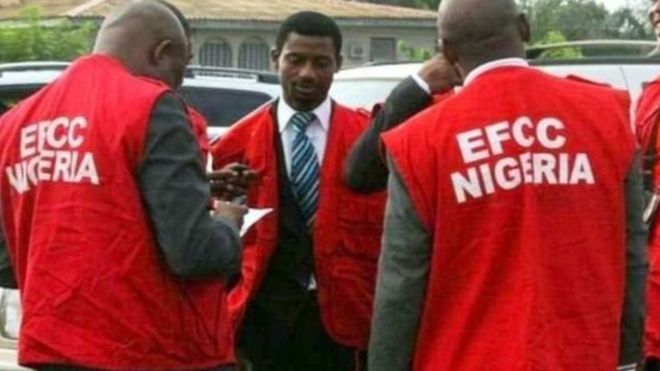
The Economic and Financial Crimes Commission (EFCC) in Port Harcourt, the Rivers State capital, has said it received a vessel carrying a huge quantity of crude oil from men of the Nigerian Navy Forward Operation Base (FOB).

The vessel, MT Preye I, was reportedly intercepted by the Navy on Bonny waterways at about 6.15 pm on January 10, 2020. A statement from the public Affairs department of the anti-graft agency said 11 crew members of the vessel were arrested.

To continue reading, please click here.

Source: thenationonlineng.net

Nigeria: Oil Theft, Piracy, Cost Nigeria U.S.$750m in 2019 – NNPC

The Nigerian National Petroleum Corporation, NNPC, Tuesday, decried the growing activities of oil thieves and pirates, stating that Nigeria lost about $750 million to oil theft in 2019.

In a presentation to members of the Executive Intelligence Management Course 13 of the National Institute for Security Studies (NISS) who were on a study tour to the NNPC in, Abuja, Group Managing Director of NNPC, Mallam Mele Kyari, described the activities of the thieves and pirates as a threat to the operations of the corporation.

To continue reading, please click here.

Source: allafrica.com