The Marshall Islands-flagged tanker Duke was attacked on Sunday as she sailed from Luanda, Angola, to Lomé, Togo. Six pirates boarded the vessel about 115 nautical miles south-east of Lomé and kidnapped all but one on board – believed to be a Nigerian national. The remaining crew of 20 Indian seafarers were kidnapped.
According to analysts from Dryad Maritime, the specific methodology used are unclear, but given that the incident occurred a significant distance offshore, the pirates are likely to have used a mothership to aid operations.
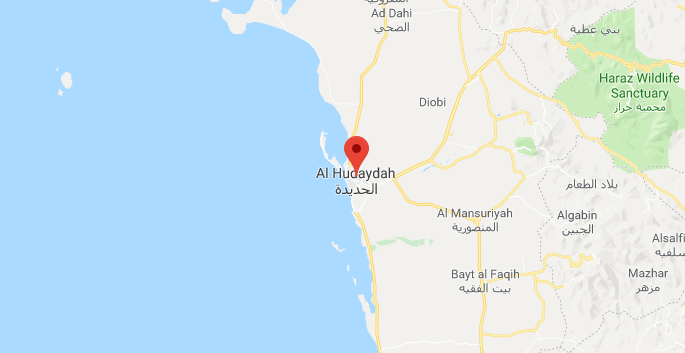
TEHRAN (Tasnim) – Saudi Arabia has prevented 13 ships carrying energy derivatives and food for Yemenis from entering Yemen’s port of Hudaydah for over 40 days amid a humanitarian catastrophe in the Arab country, a report said.
According to Yemen’s Arabic-language al-Masirah television network, 13 ships destined for the impoverished Arab country have been impounded by the kingdom and diverted to the port of Jizan in southwestern Saudi Arabia.
The report added that the vessels had undergone inspection by the United Nations and obtained the relevant papers. So far, only one of the vessels has been allowed to leave the port of Jizan.
Back on November 23, the Yemeni minister of public health and population said it is estimated that every 10 minutes a child under the age of five dies from extreme hunger in the country, warning that the ongoing Saudi-led blockade is also taking a heavy toll on newborn babies.
Saudi Arabia and a number of its allies launched a devastating campaign against Yemen, with the goal of bringing the government of former president Abd Rabbuh Mansur Hadi back to power and eliminating the Houthi Ansarullah movement, whose fighters have been helping the Yemeni army significantly in defending the country against invaders since the onset of war.
The US-based Armed Conflict Location and Event Data Project (ACLED), a nonprofit conflict-research organization, estimates that the war has so far claimed more than 100,000 lives.
The Saudi-led war has also taken a heavy toll on Yemen’s infrastructure, destroying hospitals, schools, and factories. According to the United Nations, more than 24 million people are in dire need of humanitarian aid, including 10 million suffering from extreme levels of hunger.
MarsecNews: For the sake of clarity, this information comes from an Iranian media outlet. Iran backs the Houthi rebels in the country. I know maritime security companies who assist the World Food Programme and they have not reported any difficulties (other than those normally expected in Yemen) in disembarking aid goods at ports such as Hodeidah.
Worried over the increasing rate of oil theft in the country, the Governor of Edo State, Godwin Obaseki, yesterday called for the establishment of ‘Special Courts’ and training of judges to prosecute and convict perpetrators of crude oil theft in the country.
Obaseki, who chaired a committee set up by the National Economic Council Committee to find a lasting solution to the issues of oil theft and pipeline vandalisation, made the call during the inaugural Nigeria Extractive Industries Transparency Initiative (NEITI) policy dialogue with the theme: “Stemming Oil Theft in Nigeria.”
ENISA, the European Union Agency for Cybersecurity, has published Good practices for Cybersecurity in the Maritime Sector – Port Security, a report providing guidance for ports to strengthen their cybersecurity.
The agency says ports must address cybersecurity as a top priority in order to ensure their safety, security, compliance and commercial competitiveness, while unlocking the full capabilities of their digital transformation.
THE Ports Facility Security Officer Forum of Nigeria, PFSOFN, has said that collaboration among agencies of government was key to security in the maritime industry, a development that will attract more investment in the sector.
Speaking at the opening ceremony of the just concluded annual conference of the PFSOFN, Chairman of the Forum, Barrister Emmanuel Onyeabadi, said that a better synergy and collaboration among agencies will go a long way in eliminating conflicts between government security agencies.
To continue reading, please click here.
Source:
MarsecNews: In my opinion, one of the main issues in Nigeria is the number of agencies all competing in the same maritime space. If anything, the answer is to combine those agencies and create a proper hierarchy which can then offer real leadership and task personnel accordingly, without worrying about treading on other agencies’ toes.
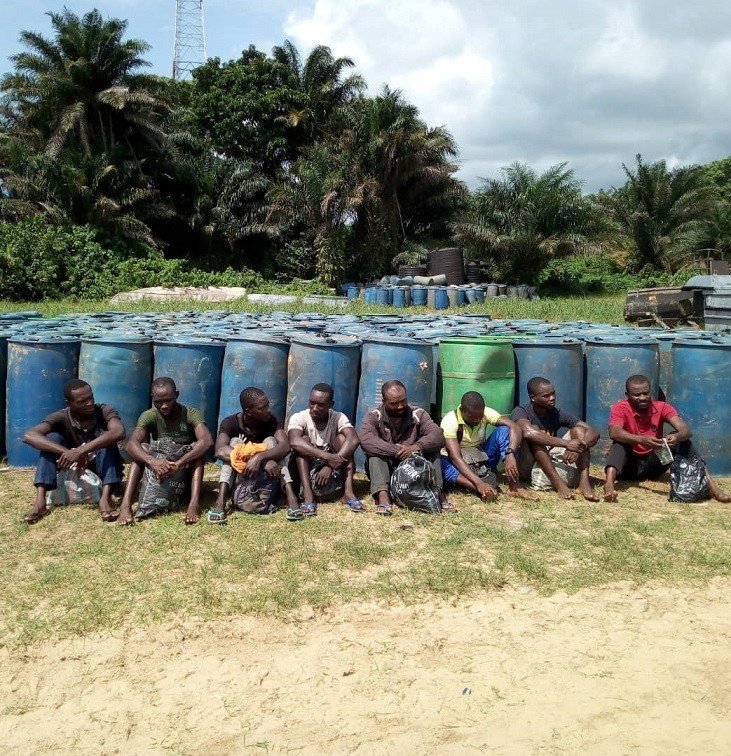
The Nigerian Navy Ship Victory patrol team has intercepted a wooden boat conveying 432 drums of illegally refined automotive gasoline oil from Nigeria to Cameroon.
The Commander of NNS Victory, Rear Admiral Vincent Okeke, said seven suspects were arrested in connection with the seized products at Agbana West Point by Tom Shot Island.
Despite ongoing incidents of piracy in Asia, international co-operation efforts are having genuine success at containing the issue. Various policy initiatives are showing promise for the security of the region’s sea lanes, now and into the future, Sam Bateman writes.
Since I wrote on the subject of piracy in Asia for Policy Forum in 2016, the situation has shown marked improvement. According to the Regional Cooperation Agreement on Combating Piracy and Armed Robbery against Ships in Asia (ReCAAP), there were 76 incidents in Asia in 2018 as compared with 203 in 2015. In the first nine months of 2019, 54 incidents occurred in the region as compared with 64 in the same period of 2018, a significant drop by any measure.
We are delighted to confirm that late on Friday evening, December 6, 2019, the nine crew members from MV Bonita held as hostages, were released in Nigeria and brought to a safe place in southern Nigeria, after 35 days in captivity.
All crew members have gone through medical examinations Friday and Saturday. The doctor declared all nine fit to fly/travel on Saturday. Needless to say, the captivity has been a very difficult experience for them. The crew members will receive further care and follow up after arrival in the Philippines. Ugland will continue to work with our crew members throughout their recovery process.
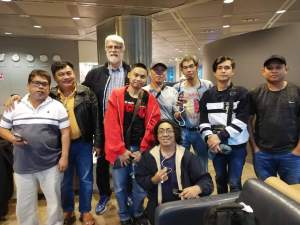
After being safely transported out of Nigeria, the crew members have now safely arrived in Manila, Philippines, to reunite with their families and colleagues.
Representatives from Ugland headquarters’ in Grimstad, Norway and other parties have been actively engaged in the process of bringing the hostages home and have been present both in Nigeria and the Philippines.
We are very thankful and relieved that the crew are now free and back home. President Øystein Beisland says: “We are truly happy that the nine crew members are now reunited with their families and have their wellbeing at heart. I would on behalf of the company like to sincerely thank all parties that have contributed to resolving this difficult situation”.
FREE AND SAFE: Eight of the nine hostages from MV Bonita en route to Manila, the ninth crew member is behind the camera. Executive Vice President in Ugland, Arnt Olaf Knutsen, behind
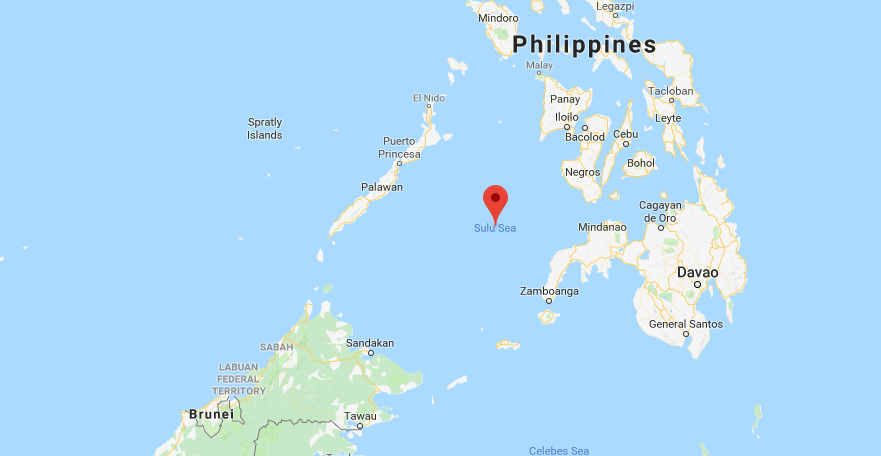
Maritime security concerns in the Sulu-Celebes Sea, like kidnap for ransom and terrorism, are expected to be addressed as the Philippines and Indonesia renew their commitment to enforce security in the said sea.
The Philippines, through the Philippine Coast Guard (PCG), and Indonesia, through the Indonesian Maritime Security Force also known as Humas Bakamla RI (BAKAMLA), aim to intensify maritime security cooperation through the re-signing of the memorandum of understanding (MOU) with implementing arrangement (IA) that will be held in Bali, Indonesia next year.
ReCAAP Information Sharing Centre Conducts Anti-Piracy Capacity Building Programme for Senior Officers of Maritime Authorities and Law Enforcement Agencies in Cooperation with Vietnam Coast Guard ReCAAP Information Sharing Centre (ISC) in cooperation with ReCAAP Vietnam Focal Point (Vietnam Coast Guard) today convened the Capacity Building Senior Officer’s Meeting in Hanoi, Vietnam.
The three-day programme will gather senior officers from 16 ReCAAP Member Countries as well as Malaysia and Indonesia to review the situation of piracy and armed robbery against ships in Asia including the incidents of abduction of crew in the Sulu-Celebes Seas, share specific case studies, and discuss ways to improve the maritime safety situation in Asia.
Complementing the programme is a lecture on international maritime laws and their applications, as well as a scenario-based exercise facilitated by Professor Max Mejia of the World Maritime University.
Participants of the programme will also have an opportunity to have a dialogue with the shipping industry based in Vietnam to better understand their concerns.
“The ReCAAP model is unique because it gives emphasis on information sharing among a network of 20 ReCAAP Focal Points across Asia, Australia, Europe and the United States as an approach to fighting maritime crimes,” said Mr. Masafumi Kuroki, Executive Director of ReCAAP ISC. “Thanks to the regional and international cooperation, incidents of piracy and sea robbery in Asia are decreasing. We will continue to strengthen the capability and cooperation of ReCAAP Focal Points and regional authorities to keep Asian waters—one of the most economically vital in the world—safe for seafarers, ships and cargoes.”
The ReCAAP Member Countries represented at the Capacity Building Senior Officers’ Meeting 2019 in Hanoi are Australia, Bangladesh, Brunei, Cambodia, China, India, Japan, Korea, Laos, Myanmar, the Philippines, Singapore, Sri Lanka, Thailand, the United Kingdom, and Vietnam.
Mr. Masafumi Kuroki, Executive Director of ReCAAP Information Sharing Centre noted that the ReCAAP model of information sharing among a network of 20 ReCAAP Focal Points across Asia, Australia, Europe and the United States is an effective approach to fighting maritime crimes