Twenty-eight Incidents Reported to ReCAAP Information Sharing Centre from January to June 2019, Marking 32% Year-on-Year Decrease, and the Lowest in Number among 13-Year Period of January to June
The ReCAAP Information Sharing Centre (ISC) today released its Half-Yearly (January to June 2019) Report. Highlights of the report, whose information is verified by the respective government agencies, also known as Focal Points, and regional authorities, include:
Overall Summary
Total of 28 incidents reported from January to June 2019, of which 25 were actual incidents while 3 were attempted cases
Of the 28 incidents reported, 26 (93%) were armed robbery against ships and two (7%) were piracy
This marks a 32% decrease compared to the same period in 2018 in the number of incidents reported
This is also the lowest number among the 13-year period (2007-2019) of January to June
In terms of severity, there was one Category 1 incident, two Category 2 incidents, two Category 3 incidents and 20 Category 4
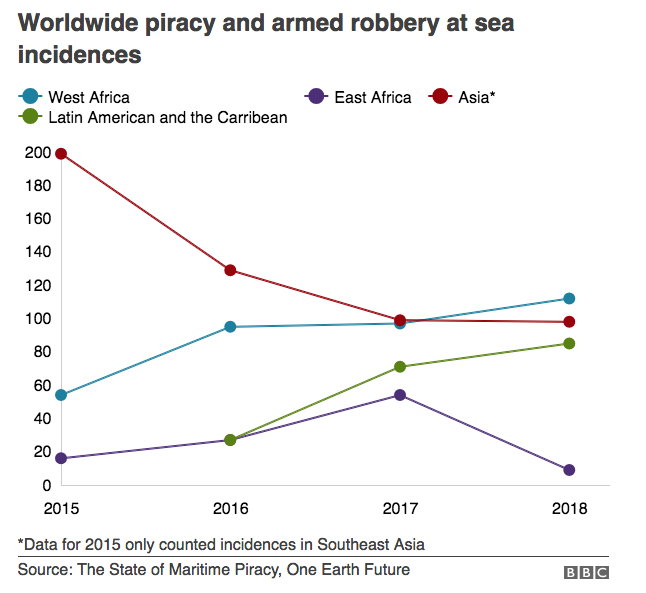
The seas off West Africa’s oil-rich coastline are now the most dangerous in the world for shipping, according to a new report.
One Earth Future, which produces an annual State of Maritime Piracy, says that while attacks have been falling substantially in some regions of the world, in West Africa they’ve been on the rise and are now more frequent than anywhere else.
So why the increase in West Africa, and what shipping is being targeted?
What is piracy?
A strict definition of maritime piracy only includes attacks on shipping on the high seas – that is, more than 12 nautical miles off the coastline and not under the jurisdiction of any state.
Inside a country’s territorial waters and within port facilities, these attacks are defined as armed robberies at sea.
However, the data we’ve used from this latest report combines these two sets of data to give an overall picture of incidents at sea both inshore and offshore.
In 2018, there were 112 such incidents in West African waters.
It’s not just the huge tankers exporting oil and gas from Nigeria and Ghana that are targeted.
Commercial ships from smaller countries are also in the sights of the pirates.
At a recent event in London, President Faure Gnassingbé of Togo – a country sandwiched between these two regional giants – highlighted his own concerns at the rise in attacks on regional shipping.
“Our region is distinguished by the resurgence of transnational criminality on the high seas in the Gulf of Guinea,” said Mr Gnassingbé.
Why are attacks rising?
Most of the attacks have been against ships involved in oil and gas transportation, such as tankers, bulk carriers and tugs. Fishing vessels have also been targeted.
The coastline off Nigeria saw the most attacks in 2018. This is partly because of “petro-piracy”, targeting tankers from Nigeria’s rich oil and gas fields.
There were also incidents reported at the loading and anchorage facilities in the Nigerian port of Lagos.
Piracy in the form of hijacking and kidnapping for ransom payments was also common off the coasts of Benin, Ghana, Nigeria, Congo-Brazzaville and Cameroon.
Rich pickings at sea, political instability, the lack of law enforcement and poverty on land are all factors which have contributed to the increase in piracy.
Most of the seafarers affected are not from the region. Around half are from the Philippines, followed by India, Ukraine and Nigeria.
One of the reasons West Africa is now the number one spot for piracy is because of of the downward trends recorded elsewhere.
The East African shipping routes along the Somali coastline have been notorious for hijackings and robberies.
But since peaking in 2011, rates of piracy there have fallen off dramatically in recent years.
Local efforts on land in Somalia to change attitudes towards permitting piracy and building legal capacity to prosecute criminals have also helped improve the situation.
In Asia, the Malacca Strait, a busy, commercially important stretch of water between Malaysia and Indonesia, experienced a high number of attacks in 2015.
Concerted action by regional naval forces has reduced the problem there, but piracy still persists.
Attacks against shipping in the Caribbean and off the coast of Latin American have, however, risen.
Venezuela in particular has become a hotspot for piracy.
“Political and economic instability is a big factor there,” says Lydelle Joubert, an expert on piracy at One Earth Future.
From Southeast Asia and the Indian Ocean to Latin America and the Caribbean, the developing world is paying a price for maritime piracy and pilfering. Southeast Asia was home to two-fifths of the world’s pirate attacks between 1995 and 2013, while the waters off Africa remain a watery version of the Wild West.
A crew sailing off the coast of Singapore had a close encounter with pirates late last week, according to a new report from ReCAAP, the south east Asian anti-piracy center.
A tug-and-barge was heading westbound about five miles southwest-by-west off the coast of Singapore on Sunday. That’s in the narrow strait between Singapore and Malaysia on one side and Indonesia on the other. The tug master reported by radio that six pirates were boarding the barge “Smit Cyclone”.
During January-April 2019, four incidents of unauthorised boarding of ships in locations of close proximity to each other were reported in the western sector of Singapore Strait.
All four incidents occurred to tug boats towing barges and dredger while underway in the westbound lane of the Traffic Separation Scheme (TSS). Of the four incidents, two incidents reported loss of scrap metal, and nothing was reported stolen in the other two incidents. The crew was not injured in all four incidents.
A total of 10 incidents of armed robbery against ships (comprising nine actual incidents and one attempted incident) were reported in Asia during January-March 2019 compared to 21 incidents (comprising 15 actual incidents and six attempted incidents) during January-March 2018. This accounts for a 52% decrease in the total number of incidents reported during January-March 2019 compared to the same period in 2018.
The number of actual incidents has also decreased by 40% during January-March 2019 compared to January-March 2018. Both the total number of incidents and number of actual incidents reported during January-March 2019 are the lowest among the period of January-March of 13-year (2007-2019).
ReCAAP Information Sharing Centre (ISC) today held its annual Piracy and Sea Robbery Conference to an audience of international maritime stakeholders including shipping and marine insurance companies, regulators and law enforcement agencies, as well as the diplomatic community based in Singapore.
In his keynote address, Mr. Koji Sekimizu, former Secretary General of the International Maritime Organization (IMO) reviewed the history of activities of IMO in dealing with maritime security and anti-piracy actions covering the establishment of ReCAAP, Somali Piracy, the Contact Group in conjunction with UN Security Council decisions, Djibouti Code of Conduct, Best Management Practices, and discussed a number of issues from his wide experience dealing with these matters as UN officer working at IMO and in the wider context of Maritime Governance by UN and IMO.
The conference addressed topics that are currently high on the agenda of the international maritime community including:
Piracy and Sea Robbery Situation in Asia (ReCAAP ISC)
Abduction of Crew in the Sulu-Celebes Seas and Waters off Easter Sabah (Philippine Coast Guard)
Update on the Indian Ocean High Risk Area (INTERTANKO)
Maritime Cybersecurity (BIMCO)
Effects and Implications of Piracy (Panel discussion moderated by World Maritime University)
“In 2018, there were 76 incidents of piracy and armed robbery reported in Asia. This was a 25% decrease in the total number of incidents and a 31% decrease in actual incidents compared to 2017. Nonetheless, it is important that we continue to reinforce the ownership of the Coastal States in addressing maritime crime, the cooperation between law enforcement agencies and the industry, and the timely reporting by ships, all of which have led to the decrease of incidents in Asia. The topics and speakers of this year’s conference have been designed to reflect the vitality of that shared responsibility,” remarked Masafumi Kuroki, Executive Director of ReCAAP ISC.
“Over the past couple of years, piracy and terrorism in the Sulu and Celebes Seas has been a point of concern for the shipping industry. The valuable counter-piracy lessons learned here, and off Somalia, are worth exploring, and may well be applied in the current piracy hotspot number one: The Gulf of Guinea. The annual ReCAAP ISC conference will surely help us do just that,” said Jakob P. Larsen, Head of Maritime Security at BIMCO.
“The threat from piracy remains, in Asia and also in the Indian Ocean. The Indian Ocean High Risk Area (HRA) continues to serve an important reference in ensuring ships and seafarers are prepared for pirate attacks,” said Tim Wilkins, Environment Director and Regional Manager, Asia-Pacific of INTERTANKO. “A serious threat remains despite the reduction to the area’s geographic boundaries and so correct reporting, vigilance and adherence to the 5th edition of the Best Management Practices to Deter Piracy and Enhance Maritime Security in the Red Sea, Gulf of Aden, Indian Ocean and Arabian Sea (BMP5) remains crucial. Shipowners must remain alert and law enforcement agencies must continue to provide protection to shipping.”
Ambassador Ong Keng Yong, Executive Deputy Chairman of RSIS, highlighted the relevance of the conference, “This annual conference is an important knowledge-sharing platform on risks and threats facing the international maritime community. We discussed piracy and sea robbery as well as relevant emerging technologies, and shared ideas on solving problems affecting ship owners and seafarers. The most useful part of this exchange is on how to work together effectively.”
Members of three key regional maritime security agreements*, which IMO has helped to establish, are undergoing training tackling maritime crime in Jeddah, Saudi Arabia (10 – 28 March 2019).
Thirty participants from 24 countries** are learning theoretical and practical skills to deal with piracy/robbery against ships, drug trafficking, marine terrorism, weapons smuggling, human trafficking and more.
The course is organized by IMO and Saudi Arabia under the auspices of the Jeddah Amendment to Djibouti Code of Conduct and conducted by experts from the Saudi Arabia Border Guard, UNODC, INTERPOL and IMO.
The training is taking place at the Mohammed Bin Naif Academy for Maritime Science and Security Studies and is the first of three training workshops to be organized by IMO and the Saudi Border Guard in Jeddah during 2019 – with financial assistance from Saudi Arabia.
The series of workshops will enable participants from different regions to share ideas and best practices in order to promote maritime security.
* The Djibouti Code of Conduct; the West and Central Africa Code of conduct; and the Regional Cooperation Agreement on Combating Piracy and Armed Robbery against Ships in Asia (ReCAAP)
** Bahrain, Comoros, Djibouti, Egypt, Ethiopia, Ghana, India, Jordan, Kenya, Madagascar, Maldives, Mauritius, Mozambique, Myanmar, Oman, Saudi Arabia, Seychelles, Somalia, South Africa, the Sudan, Cape Verde, Sri Lanka, United Republic of Tanzania and Yemen.
The 13th Governing Council Meeting of the ReCAAP ISC was held on 19 to 22 March 2019 in Singapore, hosted by the Singapore Government. The Council reviewed the activities of ReCAAP ISC in FY2018 and deliberated on its activities for FY2019 and beyond. On 22 March 2019, the Open Session was held with External Participants comprising representatives from three countries and 13 organisations.
The Council commended ReCAAP ISC on producing positive results in respect to its activities in FY2018 under the three pillars of its mission, i.e., information sharing, capacity building and cooperative arrangement. The Council reviewed the progress of the implementation of the Roadmap for the Future of ReCAAP ISC and appreciated the continued progress as well as new initiatives ReCAAP ISC has made under the Roadmap as a Centre of Excellence for information sharing.
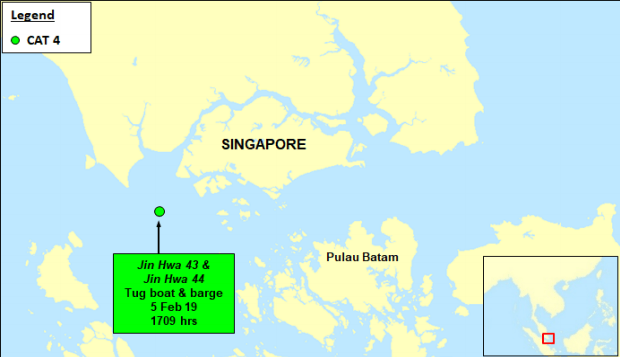
Piracy and Armed Robbery Against Ships in Asia OVERVIEW During 5-11 Mar 19, an incident of armed robbery against ship was reported to ReCAAP ISC. The incident occurred on 5 Feb 19 and was reported to ReCAAP ISC by Focal Point Singapore after verification with the relevant agencies. The location of the incident is shown in the map below; and detailed description of the incident is tabulated in attachment.


 Maritime Security News