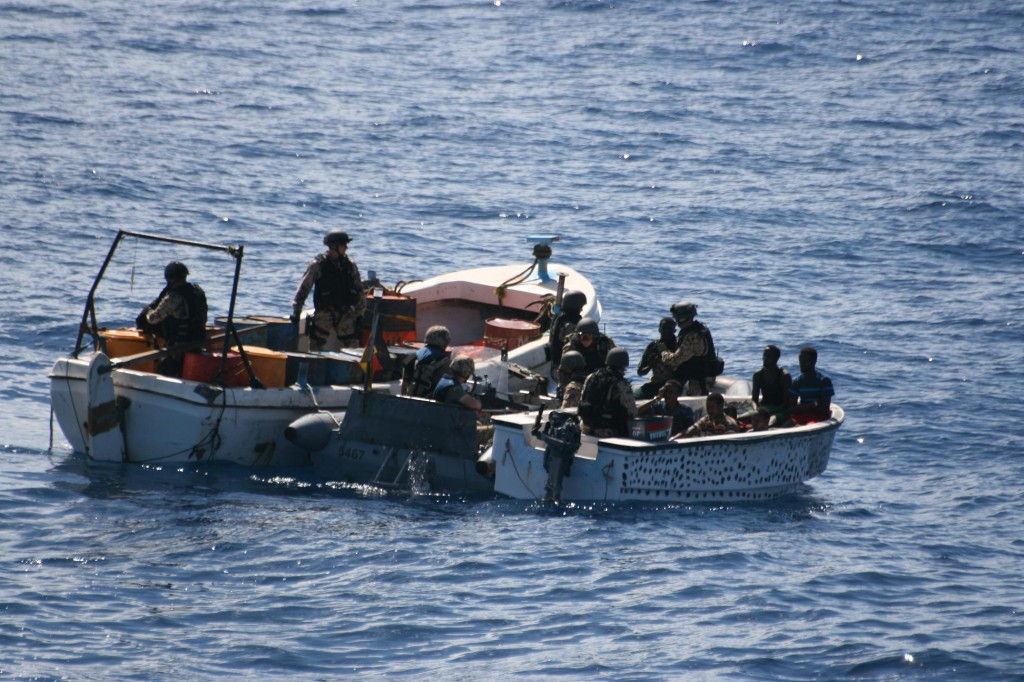
Iranian hostages held by Somali pirates since 2015 freed: Adviser

The men are the last of the crew of Iranian fishing vessel FV Siraj, captured by the pirates on March 22, 2015.

Three Iranian hostages held by Somali pirates since 2015 have been freed, a senior maritime crime adviser told the Reuters news agency on Thursday.

The men are the last of the crew of the Iranian fishing vessel FV Siraj, which was captured by pirates on March 22, 2015.

The fourth member of the crew was freed last year as he needed urgent medical care.

To continue reading, please click here.

Source: aljazeera.com

Pirates hijack Panama-flagged ship off Somalia coast

MarsecNews: This report has now been classified as not being a maritime security incident and EU NAVFOR has released a statement, which can be found by clicking here.

Pirates have hijacked a Panama-flagged ship that was travelling from the United Arab Emirates to Mogadishu port.

Piracy off the coast of Somalia had reduced significantly in recent years, in part because of extensive international military patrols.

This is the first attack for several years.

The ship was attacked at night when the crew was sleeping, Anadolu news agency quotes a security official in Somalia’s autonomous Puntland region as saying.

Six pirates were involved in the attack, according to the governor of Gardafu region in Puntland Musse Salah, who is quoted by Reuters news agency.

The authorities of the Bari region where the incident happened say the ship had developed mechanical problems.

Source: bbc.co.uk

France Hands Over Command of CTF 150 to the Kingdom of Saudi Arabia

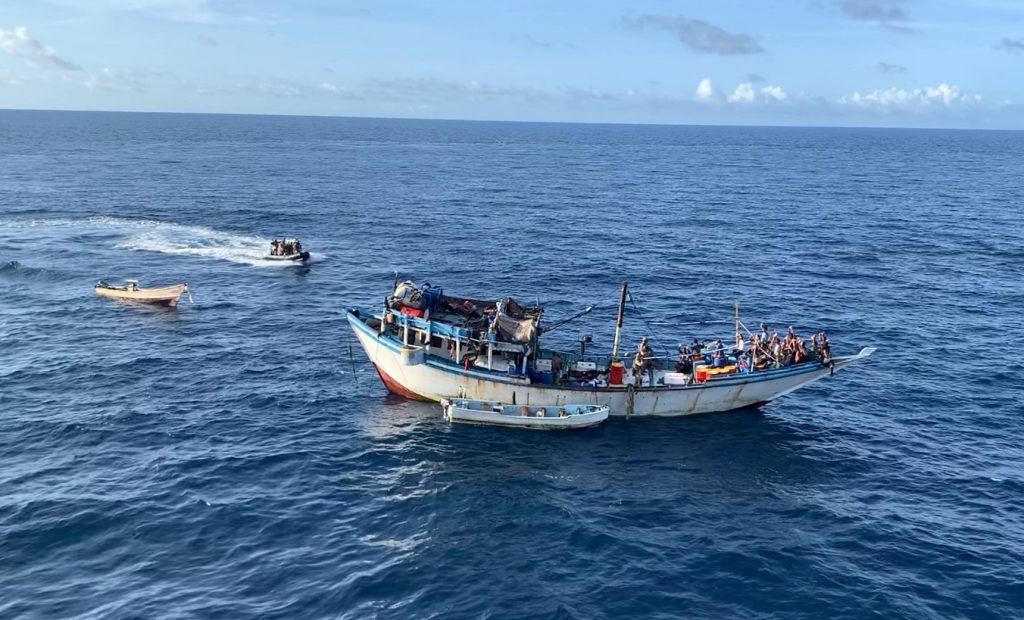
File image of an approach on a dhow

Captain Riviere of the French Marine Nationale handed over Command of CTF 150 to Rear Admiral Alfaqeeh of the Saudi Royal Naval Force in a virtual ceremony.

The CTF 150 (Combined Task Force 150) mission is to disrupt criminal and terrorist organisations and their mandated related illicit activities by restricting their freedom of manoeuvre in the maritime domain. The task force’s activities deny criminal and terrorist organisations a method of conducting operations or moving personnel, weapons or income-generating narcotics and charcoal.

Speaking via video link at the conference, Captain Riviere said, “I was very fortunate to be able to draw the CTF 150 team from not only France, but also the United Kingdom and the United Arab Emirates, building a combined, diverse and effective staff made up of professionals from three very capable nations.”

“To my team, I thank you for your committed support, your hard work, and determination in making these four months a success.”

This was the eleventh occasion that the French Marine Nationale has Commanded the task force to support CMF’s maritime security mission in the region, continuing to support 17 ships and operations at sea throughout the global COVID-19 pandemic.

After four months of leading CTF 150, Captain Riviere passed the baton onto Rear Admiral Alfaqeeh of the Saudi Royal Naval Force, who has an accomplished military record  spanning almost thirty years. He has commanded ships and squadrons, and has served tours in the West Fleet, as well as experience commanding in a coalition.

Rear Admiral Alfaqeeh said: “It is such a great opportunity to work and represent my country with such a professional and enthusiastic team. Our team members come from Bahrain, Jordan, Saudi Arabia and the United States.

“We will all do our best to execute and accomplish the Task Force’s mission in collaboration with a coalition of ships from multiple countries.”

During the virtual ceremony, Vice Admiral Malloy, Commander of Combined Maritime Forces, congratulated Captain Riviere and his team: “Captain Riviere, you and everyone under your leadership should be proud of your lasting contribution to global security.

“As the eleventh French Officer to lead this CTF, you represented your country with operational excellence, dedication and integrity, and we are grateful for your leadership and your wisdom.”

He went on to welcome the Saudi-led task force: “Admiral, under your leadership, I have no doubt that CTF 150 will maintain a high level of vigilance and excellence required to set the watch, assuring the merchant community of our unblinking commitment while deterring illicit activity in our area of operations.”

France is handing over its eleventh Command of CTF 150. This will be the Saudi Royal Naval Force’s second Command of the Task Force.

Source: combinedmaritimeforces.com

Coast Guard, not concession, solution to insecurity of nation’s waters — Borha

By Godfrey Bivbere MARITIME Consultant and former general manager of the Nigerian Ports Authority, NPA, Christopher Borha, has said only the establishment of a Coast Guard is the permanent solution to the problem of piracy on the nation’s waters. Borha said that several attempts made in the past to curb the problem of piracy and armed robbery on the nations had failed because the Federal Government is taking the wrong approach.

In an exclusive chat with Vanguard Maritime Report, Borha who is also Head Analyst of C.A. Borha Management and Economic Services, stressed that the personnel for the Maritime Coast Guard should be drawn from the Nigerian Navy, the Marine Command of the Nigerian Police and other government agencies with security responsibilities.

To continue reading, please click here.

Source: vanguardngr.com

NIMASA indicates turnaround in maritime security

By Cynthia Alo The Director-General of the Nigerian Maritime Administration and Safety Agency (NIMASA), Dr. Bashir Jamoh, has described the conviction of three persons in connection with vessel hijack on the Gulf of Guinea, as a signal that Nigeria is on the right path in the war against piracy and other crimes on the nation’s waterways.

The Federal High Court in Port Harcourt had, two days ago, convicted the persons who were accused of involvement in the hijack of an Equatorial Guinean flagged vessel named, MV ELOBEY VI, off Equatorial Guinea’s coast on March 21, 2020.

To continue reading, please click here.

Source: vanguardngr.com

IMSC Statement on the Incident with Motor Tanker Wila

BAHRAIN

08.13.2020

Story by NAVCENT Public Affairs 

U.S. Naval Forces Central Command / U.S. 5th Fleet

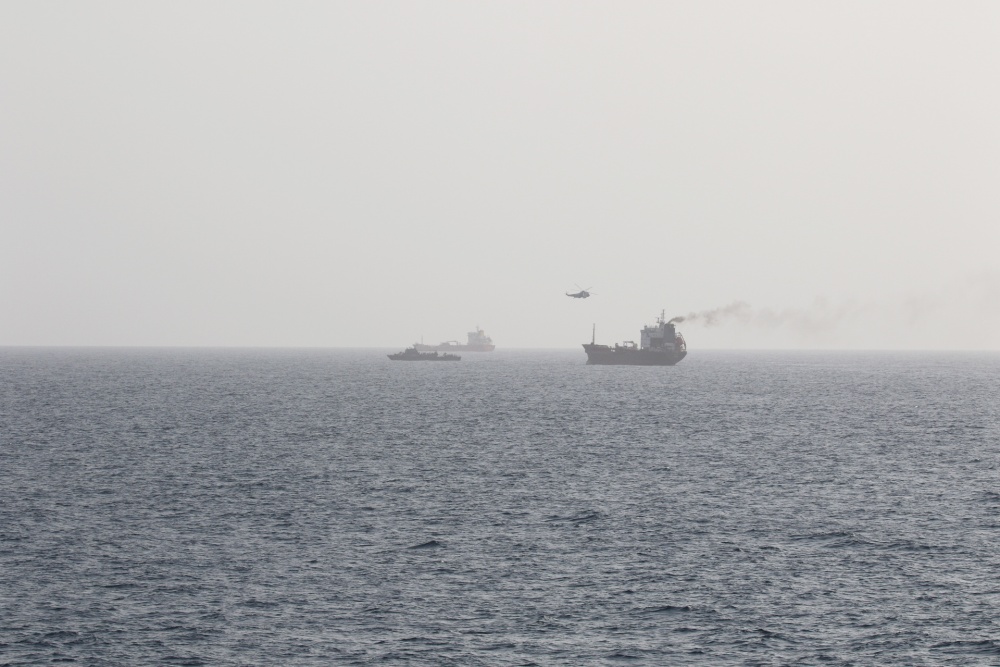
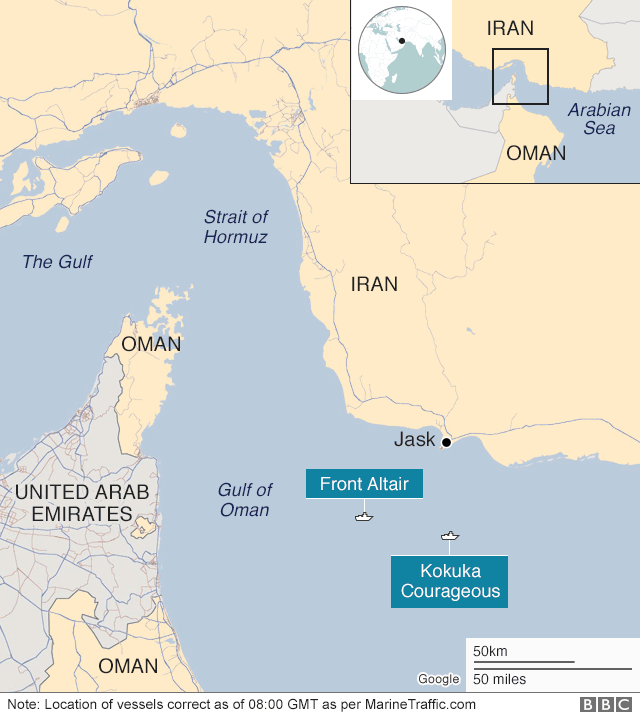
Coalition Task Force (CTF) Sentinel, the operational arm of the International Maritime Security Construct (IMSC) monitored an incident involving Iranian forces who boarded a tanker in the international waters of the Gulf of Oman near the Strait of Hormuz, Aug 12.

A video captured the moment an Iranian Sea King helicopter hovered above M/T Wila and armed Iranian personnel fast roped aboard the ship. Initial reports indicate two Iranian ships in the vicinity of the incident.

Iran’s use of its military forces to conduct an armed boarding of a commercial vessel in international waters constitutes a blatant violation of international law that undermines freedom of navigation and the free flow of commerce. We call on Iran to articulate to the international community the legal basis for its actions. This type of reckless, aggressive behavior by Iran destabilizes the region and threatens the rules based international order.

A CTF Sentinel coalition ship was providing overwatch in the immediate area and monitored the incident. There were no calls for help issued by Wila. CTF Sentinel’s mission is to deter and expose malign activity and reassure the maritime community in the region.

CTF Sentinel is working to secure the regional maritime commons and recommends Best Management Practices 5 (BMP5) as a guide for enhanced maritime security.

Source: dvidshub.net

To download BMP 5, please click here.

Security Contractors Convicted Under New Nigerian Anti-Piracy Law

A Nigerian court has completed its first ever convictions using the nation’s new anti-piracy law, and the defendents have been sentenced to a five-figure fine. There is a twist, however: according to Nigerian media, the accused are not pirates as traditionally conceived, but rather the local employees and managers of a global private security company.

Last month, nine individuals affiliated with the Lagos branch of a UK-based global security company were charged in connection with the boarding and maritime kidnapping incident aboard the ro/ro ferry Elobey VI. The men were accused of involvement in a criminal conspiracy that resulted in the abduction of three crewmembers from the vessel off Equatorial Guinea on March 21. The captives were released in mid-May after the payment of a $200,000 ransom.

To continue reading, please click here.

Source: maritime-executive.com

Mozambique on the offensive to retake key port

Mozambique’s defence forces have said fighting for the key port of Mocimboa da Praia is continuing, after reports it had fallen to Islamist militants on Wednesday.

The military said there was ongoing action to – as it put it – neutralise the terrorists, who were using the local population as shields.

There have been days of fighting for the port in the gas-rich north of Mozambique.

The militants – linked to the Islamic State group – have briefly taken a number of northern towns in recent months, displacing tens of thousands of people.

Tanzania has said it will launch an offensive against the jihadists in forests bordering Mozambique.

Source: bbc.co.uk

Iranian Forces Board Liberian-Flagged Tanker in the Persian Gulf

In the latest salvo of the ongoing disputes regarding the shipment of Iranian oil, there are reports that Iranian Naval forces approached several vessels and boarded a Liberian-flagged tanker Wila as it was approaching the Khor Fakkan anchorage in the UAE.

The marine security firm Dryad Global reported the incident while also saying according to its analysis that, “Iran’s actions today do not raise the overall risk posed by vessels within either the Gulf of Oman or Strait of Hormuz.” In an update to its initial report, using data from TankerTracker, Dryad however later added details suggesting that Iranian forces also approached the Marshal Island flagged MT Freud and the Panama flagged MT Chemway Arrow prior to boarding the Wila.

To continue reading, please click here.

Source:

Op-Ed: A Simple Deal on Embarked Guards Could End West African Piracy

By Jakob Voight

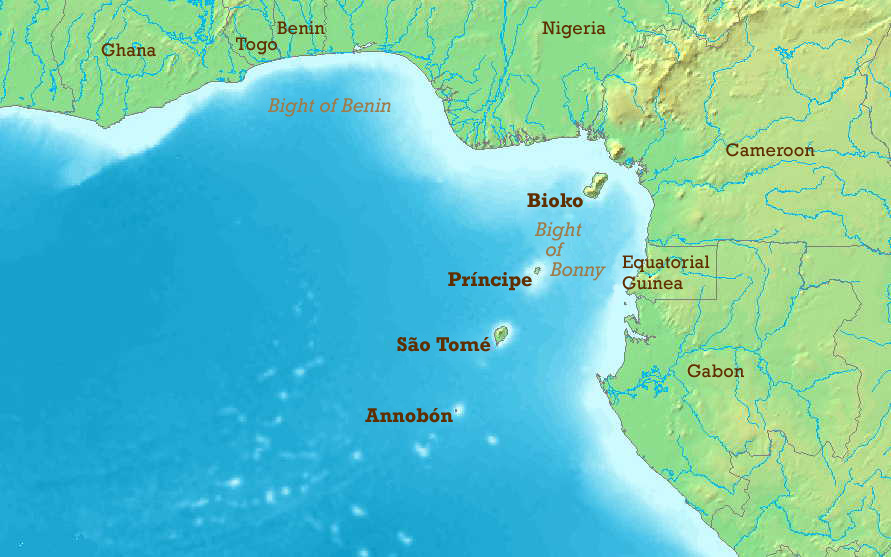
On July 17, 2020, the tanker Curacao Trader was boarded by pirates at a position about 210 nautical miles from Nigerian shores. 13 Russian and Ukrainian seafarers were abducted. Two weeks before, the freighter Kota Budi was boarded about 200 nm from Nigerian shore. What is particularly noticeable about these attacks is the location: when looking at the statistics for 2019, it appears that the average distance of confirmed pirate attacks was 62 nm from shore, with only seven attacks at positions more than 100 nm from shore. In 2020, the average distance of confirmed pirate attacks was 75 nm, and there have already been several pirate attacks at positions more than 100 nm from shore.

Despite the improvement of the regional cooperation demonstrated in the response to the Hai Lu Feng 11 attack in May, despite the arrival of new maritime platforms, despite the use of surveillance systems like the Deep Blue project in Nigeria, it is obvious that pirates are a permanent threat off West Africa. The increase of pirates’ operational range is not a surprise for informed observers. This trend was seen in the Indian Ocean between 2004 and 2010, when Somali pirates reached almost to the west coast of India. This evolution is not due to chance – it’s simply the search for “soft locations,” areas where no means of coercion prevent the act of piracy or react quickly enough to intervene in a boarding or kidnapping. West African pirates thus demonstrate their capacity for adaptation.

To continue reading, please click here.

Source: maritime-executive.com