Criminals to forfeit ships, illegal proceeds to govt

By BAYO AKOMOLAFE

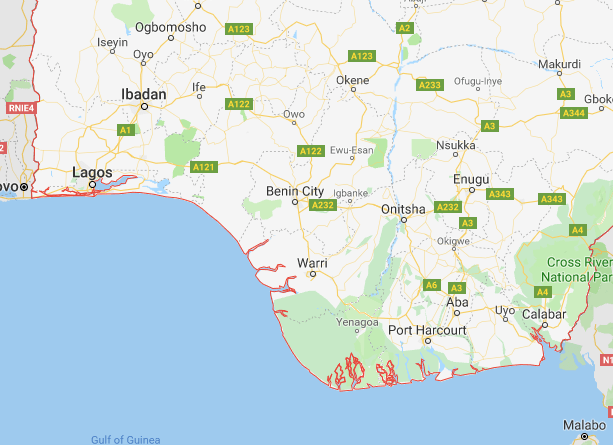
Efforts by government to tackle  illegal bunkering, kidnapping,  illegal fishing and smuggling on Nigerian waters have assumed a new dimension as past attempts failed to yield any meaningful result due to lack of effective law.

In the past, Nigeria had participated actively in a multi-national maritime exercise sponsored by the United States Military Africa Command (AFRICOM). Recently, it also participated in the 2019 Exercise Obangame Express attended by 33 countries from West Africa, Europe and North America.

The country had also acquired patrol boats and trained personnel with huge funds but these feats have not deterred criminals on Nigerian waters.

To continue reading, please click here.

Source: newtelegraphng.com

BP avoids sending tankers and crews into Gulf waters

Oil giant’s CEO takes decision amid fears its tankers could be targeted by Iranian forces as tensions mount

British oil giant BP is avoiding sending ships to the region after it had to shelter one of its tankers in the Gulf this month in fear it could be targeted by Iranian forces.

BP is “certainly not sending British ships and crews” through the Strait of Hormuz, the only way for tankers to reach the world’s biggest oil-exporting region, CEO Robert Dudley said in an interview on Bloomberg TV.

To continue reading, please click here.

Source: logisticsmiddleeast.com

Iran tanker seizure: UK warship HMS Duncan arrives in Gulf

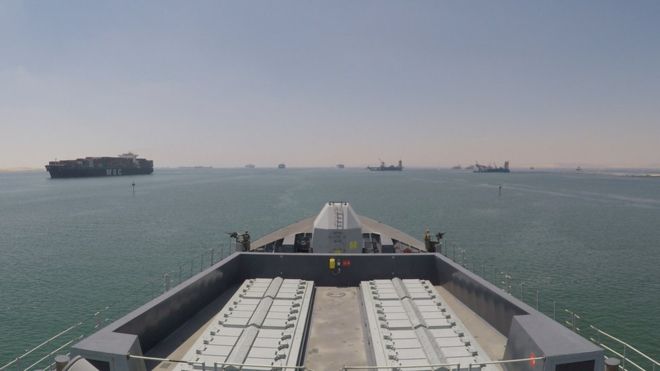
A second Royal Navy warship has arrived in the Gulf to protect British ships amid heightened tensions in the region.

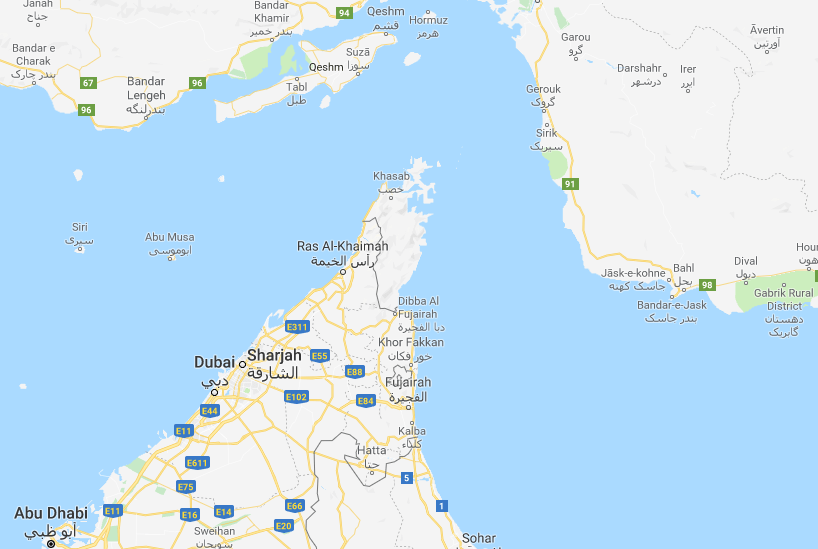
HMS Duncan has joined frigate HMS Montrose to escort vessels sailing under the British flag through the Strait of Hormuz.

HMS Montrose has so far accompanied 35 vessels through the strait, according to the Ministry of Defence (MoD).

Defence Secretary Ben Wallace said the UK continued to push for a diplomatic resolution to the situation.

He said: “Freedom of navigation in the Strait of Hormuz is vital not just to the UK, but also our international partners and allies.

“Merchant ships must be free to travel lawfully and trade safely, anywhere in the world.”

Mr Wallace added the Royal Navy will continue to provide a safeguard for UK vessels “until this is the reality”.

HMS Duncan is a Type 45 Destroyer which the Royal Navy describes as “among the most advanced warships ever built”.

Why have tensions escalated?

Earlier this month, British Royal Marines helped seize Iranian tanker Grace 1near Gibraltar which was suspected of breaking EU sanctions, infuriating Iran.

In response, Tehran threatened to capture a British oil tanker.

On 19 July, British-flagged oil tanker Stena Impero was seized by Iran’s Revolutionary Guard in the key shipping route.

A second British-linked tanker, the MV Mesdar, was also boarded by armed guards but was released.

Tehran said the Stena Impero was “violating international maritime rules”.

HMS Montrose was alerted but it was too far away to stop the seizure.

Iran’s state-run IRNA news agency said the tanker was captured after it collided with a fishing boat and failed to respond to calls from the smaller craft.

But the then foreign secretary Jeremy Hunt said it was seized in Omani waters in “clear contravention of international law” and then forced to sail into Iran.

The tanker’s Swedish owners, Stena Bulk, said it had been complying with regulations and had been in international waters.

Stena Bulk said the 23 crew members, who are Indian, Russian, Latvian and Filipino, are in good health and have met with officials from their respective countries.

How has the UK reacted?

The then foreign secretary Jeremy Hunt called the seizure of the Stena Impero “state piracy”.

But he insisted: “Our priority continues to be to find a way to de-escalate the situation.”

Speaking to the BBC, former Cabinet minister Iain Duncan Smith described the UK-flagged ship’s capture as a “major failure” by the UK.

The then defence minister Tobias Ellwood told Sky News “it is impossible simply to escort each individual vessel”.

What has Iran said?

Iran’s foreign minister Javad Zarif said in a tweet the UK “must cease being an accessory to #EconomicTerrorism of the US”.

He said Iran guarantees the security of the Gulf and the Strait of Hormuz, and insisted its action were to “uphold international maritime rules”.

Iranian President Hassan Rouhani has indicated the Stena Imepero could be released if the UK returns the Grace 1.

In a statement on his website he said: “We are not going to continue tensions with some European countries and if they are committed to international frameworks and abandon some actions, including what they did in Gibraltar, they will receive a proper response from Iran”.

Source: bbc.co.uk

Pompeo’s Hollow Plan to Beef Up Security in the Gulf

BY LARA SELIGMAN

Experts are skeptical that U.S. allies will get on board.

In the wake of alleged aggression from Iran in the Persian Gulf, U.S. Secretary of State Mike Pompeo rolled out a new plan this week, dubbed “Sentinel,” to recruit U.S. partners to help enhance security for ships traversing the Strait of Hormuz and other choke points.

But experts are skeptical that the United States can get allies in the Gulf, Europe, or Asia to shore up the resources needed to make a significant difference to the commercial vessels facing threats from Tehran in the world’s busiest shipping lanes.

To continue reading, please click here.

Source: foreignpolicy.com

Gulf of Oman attacks prompt rise in armed guard requests

The Financial Times reports that the recent incidents in the Gulf of Oman have seen a rise in calls to maritime security companies by concerned shipping firms.

Since the attacks on the Front Altair and Kokuka Courageous, shipping companies who transit the region on a regular basis have been looking into additional protection for their vessels. During the height of Somali piracy in the region, it was the norm for the merchant marine to employ teams of armed guards in order to deter any potential attack, and it worked. No merchant vessel with armed guards has ever been hijacked in the Indian Ocean. That, combined with more aggressive and visible patrolling by the international naval forces present in the region, has seen the issue of piracy off Somalia reduce considerably since 2012.

The current threat, believed to be from Iran’s IRGC – an accusation denied by Iran – is leading to an increase in demand for armed protection services, a sector which has suffered considerably from rate cuts and an influx of cheaper personnel in recent years.

The main UK Private Maritime Security Companies (PMSC), such as Ambrey Risk and MAST report an increase in demand from previous and prospective clients keen to ensure the safety of their ships in the region.

While a team of armed guards is no match for the IRGC, even an unarmed security detail can offer additional security. Well trained guards on Watch duties can spot threats that crew might miss or dismiss as the local pattern of life and, while engaging hostile state actors is unlikely, they can offer the Master an early warning system that he may lack.

With the situation in the region fluid, it’s possible that a convoy escort programme, similar to that used in the Internationally Recognised Transit Corridor (IRTC) in the Gulf of Aden may be adopted, with support from the US Navy. Russia, China, South Korea and Japan’s MSDF have all run escorts through the Gulf of Aden, and a multi-national force may be more palatable to states bordering Iran.

However, nothing has been officially announced, leaving the shipping industry scrambling to come up with its own solutions, as is so often the case. The threat posed to vessels in the region continues to be real and the situation dangerous for crews.

‘Dark ship’ detection exposes sanction-busting ships

The use of synthetic aperture radar technology means ships can be detected even if they turn off Automatic Identification System transponders. Satellites can see through clouds to detect vessels using microwave pulses

Michelle Wiese Bockmann

VESSELS failing to comply with international sanctions will not be able to avoid being tracked in real time as technology used to detect illegal fishing is fully adapted for commercial shipping.

Iran’s fleet of 36 very large crude carriers and eight suezmax tankers have finessed and expanded the so-called practice of ‘going dark’ by establishing complicated logistics chains to avoid detection and thus disguise the origin and destination of oil cargoes.

To continue reading, please click here.

Source: lloydslist.maritimeintelligence.informa.com

Iranian naval mines likely used in UAE tankers attacks: Bolton

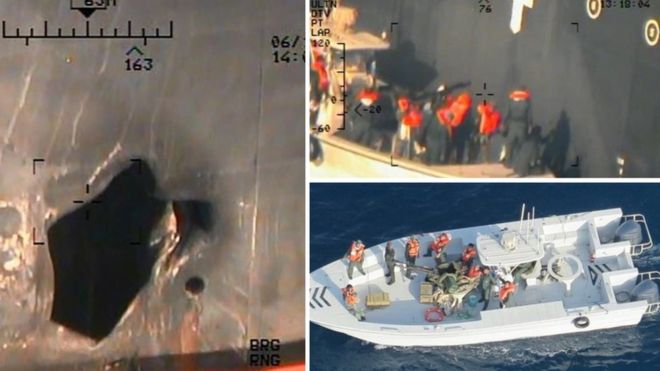
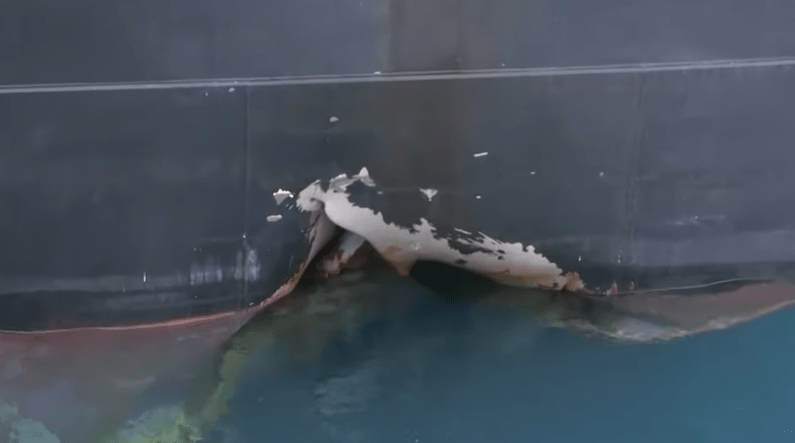
ABU DHABI (Reuters) – U.S. National Security Adviser John Bolton said on Wednesday that attacks on oil tankers off the coast of the United Arab Emirates this month were the work of “naval mines almost certainly from Iran”.

The UAE has not yet blamed anyone for the sabotage of four vessels, including two Saudi tankers, which was followed two days later by drone strikes on oil pumping stations in Saudi Arabia.

To continue reading, please click here.

Source: reuters.com

Saudi Arabia says its oil tankers among those hit off UAE coast

Persian Gulf/SoH

Rania El GamalBozorgmehr Sharafedin

DUBAI/LONDON (Reuters) – Saudi Arabia said on Monday that two of its oil tankers were among those attacked off the coast of the United Arab Emirates and said it was an attempt to undermine the security of crude supplies amid tensions between the United States and Iran.

The UAE said on Sunday that four commercial vessels were sabotaged near Fujairah emirate, one of the world’s largest bunkering hubs lying just outside the Strait of Hormuz, but did not describe the nature of the attack or say who was behind it.

To continue reading, please click here.

Source: reuters.com

The Forgotten Key to Maritime Security in the Sulu-Celebes Seas

Economic development in coastal communities will help stem the flow of illegal behavior.

By Jay Benson

Maritime insecurity in the Sulu and Celebes Seas is a persistent challenge. These waterways have recently been used  to conduct incursions into Lahad Datu, orchestrate kidnap for ransom activities by militant groups such as Abu Sayyaf, and facilitate illegal wildlife trafficking. Governments in the Philippines, Indonesia, and Malaysia have responded with increased maritime enforcement capacity and presence, as well as enhanced international coordination. Although these are important efforts that need to be maintained, an exclusive focus on enforcement capacity risks ignoring an equally important facet of maritime insecurity: economic exclusion and inequality in coastal communities.

To continue reading, please click here.

Source: thediplomat.com

Piracy on Nigerian waters: The truth

Globally, the International Maritime Bureau (IMB) Piracy Reporting Centre, based in Singapore, recorded 201 incidents of maritime piracy and armed robbery in 2018, up from 180 in 2017. The Gulf of Guinea remained increasingly dangerous for seafarers as reports of attacks in waters between the Ivory Coast and the Democratic Republic of Congo more than doubled in 2018.

The expansion of piracy in the Gulf of Guinea poses a dire threat to local economies, potentially undermining what little stability currently exists in the region. Oil revenue, which many countries in the region rely upon, is seriously threatened by pirate activity; 7 per cent of Nigeria’s oil wealth is believed lost due to such criminality.

To continue reading, please click here.

Source: vanguardngr.com