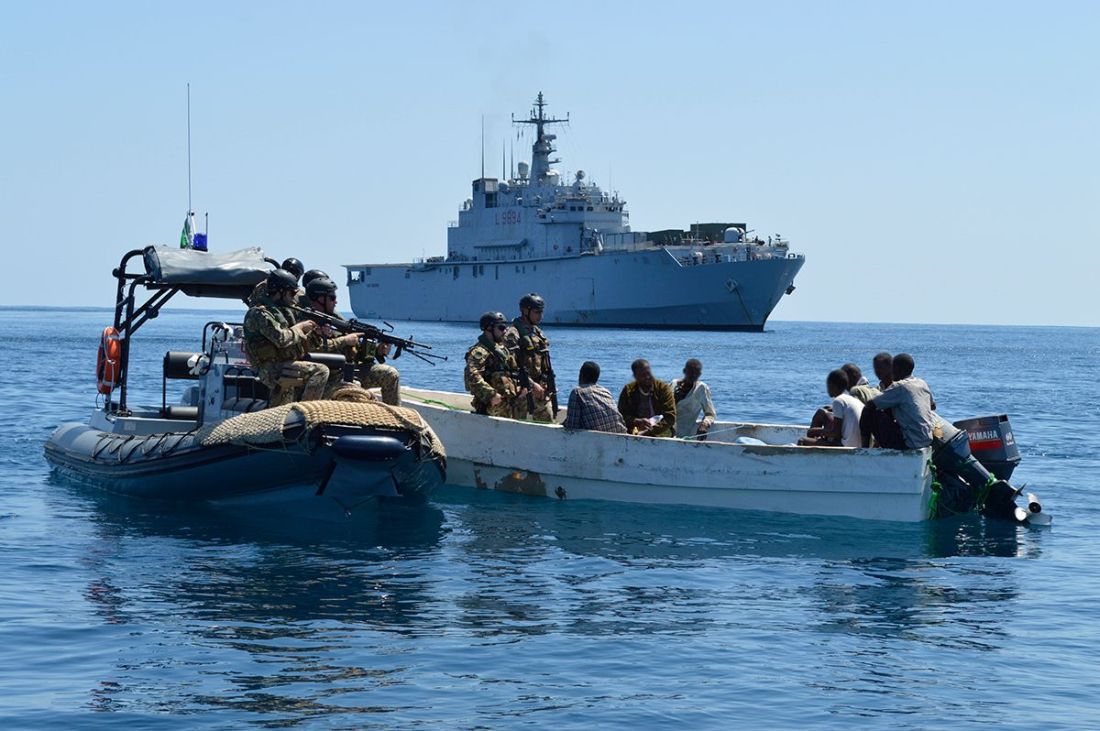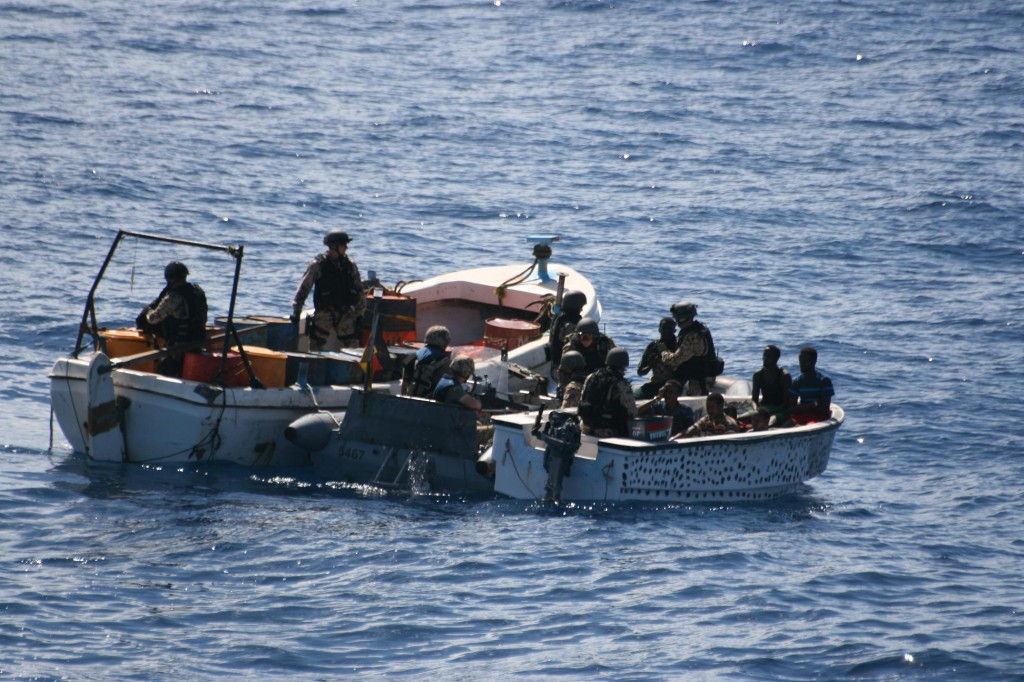
Kidnapping risk in Gulf of Guinea persists with 21 crew members kidnapped in Q1 2019

American, African & Chinese Navies Gathering at The International Maritime Defence Exhibition and Conference in Ghana This July 

– International Maritime Bureau: 22 Piracy Attacks in Q1, 2019 

Admiral James G. Foggo, III: A safe, stable, and secure Africa is in the interest of the global community, our shared goals of a secure, stable, and prosperous Africa benefits not only our African partners and the U.S., but also the international community 

 Rear Admiral Koi Alexis Maomou: IMDEC is a great opportunity to give, receive and discover new technological and scientific inventions in the field of defence and maritime safety 

20 captains, commodores, rear admirals, vice admirals, & admirals discussing illegal oil-bunkering, piracy, unregulated and unreported fishing, smuggling, human and drug trafficking, illegal bunkering and crude oil theft on the 24th & 25th of July in Accra 

Dubai and Accra, 27 June 2019 

In the first quarter of 2019, IMB reported 38 incidents of piracy and armed robbery at sea, representing 28 fewer incidents than the first quarter of 2018 (66). IMB’s Piracy Reporting Centre detailed that 27 vessels were boarded; seven vessels were fired upon and four attempted attacks occurred in the first quarter of 2019. No vessels were reported as hijacked for the first time since the first quarter of 1994. 

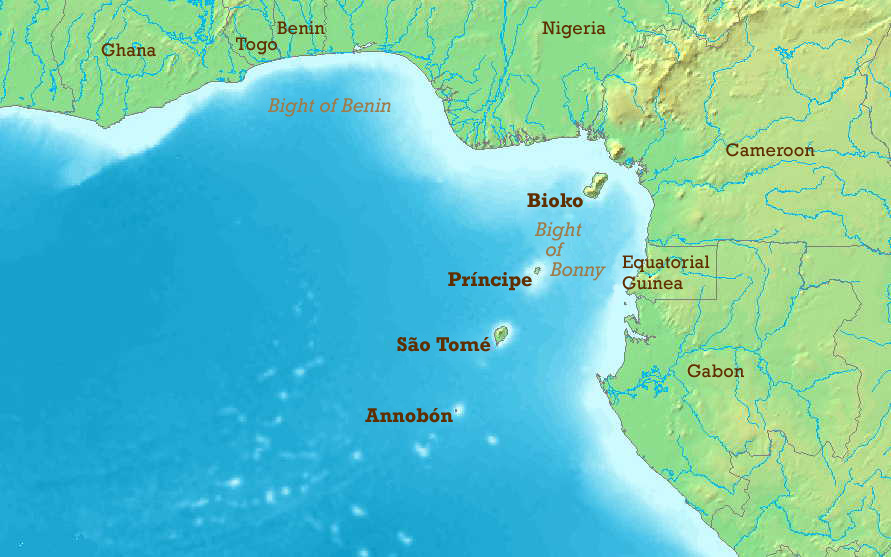
The Gulf of Guinea represented a high number of piracy and armed robbery attacks at sea, with 22 incidents reported in the first quarter of 2019. The region also accounted for all of the worldwide crew kidnappings as 21 crew members were kidnapped across five separate incidents. Incidents were reported in the coastal countries, of Benin, Cameroon, Ghana, Ivory Coast, Liberia, Nigeria and Togo in the first quarter of 2019. 

To continue reading, please click here.

Source: businessghana.com
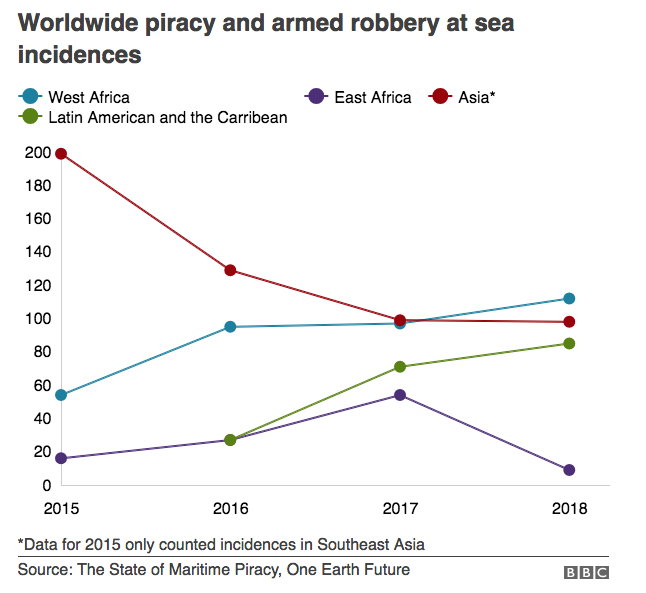
Piracy in West Africa: The world’s most dangerous seas?

The seas off West Africa’s oil-rich coastline are now the most dangerous in the world for shipping, according to a new report.

One Earth Future, which produces an annual State of Maritime Piracy, says that while attacks have been falling substantially in some regions of the world, in West Africa they’ve been on the rise and are now more frequent than anywhere else.

So why the increase in West Africa, and what shipping is being targeted?

What is piracy?

A strict definition of maritime piracy only includes attacks on shipping on the high seas – that is, more than 12 nautical miles off the coastline and not under the jurisdiction of any state.

Inside a country’s territorial waters and within port facilities, these attacks are defined as armed robberies at sea.

However, the data we’ve used from this latest report combines these two sets of data to give an overall picture of incidents at sea both inshore and offshore.

In 2018, there were 112 such incidents in West African waters.

It’s not just the huge tankers exporting oil and gas from Nigeria and Ghana that are targeted.

Commercial ships from smaller countries are also in the sights of the pirates.

At a recent event in London, President Faure Gnassingbé of Togo – a country sandwiched between these two regional giants – highlighted his own concerns at the rise in attacks on regional shipping.

“Our region is distinguished by the resurgence of transnational criminality on the high seas in the Gulf of Guinea,” said Mr Gnassingbé.

Why are attacks rising?

Most of the attacks have been against ships involved in oil and gas transportation, such as tankers, bulk carriers and tugs. Fishing vessels have also been targeted.

The coastline off Nigeria saw the most attacks in 2018. This is partly because of “petro-piracy”, targeting tankers from Nigeria’s rich oil and gas fields.

There were also incidents reported at the loading and anchorage facilities in the Nigerian port of Lagos.

Piracy in the form of hijacking and kidnapping for ransom payments was also common off the coasts of Benin, Ghana, Nigeria, Congo-Brazzaville and Cameroon.

Rich pickings at sea, political instability, the lack of law enforcement and poverty on land are all factors which have contributed to the increase in piracy.

Most of the seafarers affected are not from the region. Around half are from the Philippines, followed by India, Ukraine and Nigeria.

One of the reasons West Africa is now the number one spot for piracy is because of of the downward trends recorded elsewhere.

The East African shipping routes along the Somali coastline have been notorious for hijackings and robberies.

But since peaking in 2011, rates of piracy there have fallen off dramatically in recent years.

This is in large measure as a result of a successful multi-national effort to patrol these waters and take firm action action against acts of piracy.

Local efforts on land in Somalia to change attitudes towards permitting piracy and building legal capacity to prosecute criminals have also helped improve the situation.

In Asia, the Malacca Strait, a busy, commercially important stretch of water between Malaysia and Indonesia, experienced a high number of attacks in 2015.

Concerted action by regional naval forces has reduced the problem there, but piracy still persists.

Attacks against shipping in the Caribbean and off the coast of Latin American have, however, risen.

Venezuela in particular has become a hotspot for piracy.

“Political and economic instability is a big factor there,” says Lydelle Joubert, an expert on piracy at One Earth Future.

Source: bbc.co.uk

Piracy and pilfering at sea

By LLOYD GREEN

From Southeast Asia and the Indian Ocean to Latin America and the Caribbean, the developing world is paying a price for maritime piracy and pilfering. Southeast Asia was home to two-fifths of the world’s pirate attacks between 1995 and 2013, while the waters off Africa remain a watery version of the Wild West.

To put things into perspective, Somali pirates cost East Africa more than US$24 billion between 2010 and 2017, the Horn of Africa remains a pirate hotspot, and West Africa’s Gulf of Guinea has witnessed an explosion in hostage-takings and kidnappings.

To continue reading, please click here.

Source: asiatimes.com

Only international action will stop increase in piracy: BIMCO

A fresh annual report from the International Maritime Bureau shows that attacks in West Africa helped push piracy numbers up in 2018. In terms of military and law enforcement, an international operation is not complicated, so what is needed above all is the will to act.

According to the bureau’s report, there were 201 incidents in total* reported to the bureau last year. That is a rise from 180 incidents in 2017 and from 191 in 2016. Of this, 48 incidents took place in Nigeria, up from 33 in 2017 and 36 incidents in 2016.

The report also showed that the region saw a considerable spike in violence in the last quarter of the year, with 40 kidnappings in the waters off Nigeria alone. In West Africa, there appears to be challenges with underreporting, which is estimated at as much as 40%, the report says.

To continue reading, please click here.

Source: hellenicshippingnews.com

Maritime Security News: It’s worth noting that the IMB only collates reports submitted to them directly by CSOs and Masters. To gain a full picture of maritime crime, it is necessary to collate reports from all agencies.

Nigeria, others lost $2.3bn to maritime crime in three years – UN report

Tunde Ajaja

The United Nations Office on Drugs and Crime says the estimated economic cost of piracy to Nigeria and other West African countries between 2015 and 2017 stands at $2.3bn.

It stated that within the period under review, the sub-region lost about $777.1m to piracy on an annual basis, which it said was in addition to human costs as the Gulf of Guinea experienced an escalation of piracy, kidnapping and armed robbery at sea incidents in recent years.

To continue reading, please click here.

Source: punchng.com

There Is No Piracy In Nigeria, But Armed Robbery – Bello

The Executive Secretary, Nigerian Shippers Council, Barrister Hassan Bello, says there is no piracy in Nigeria, but what we have are incidences of armed robbery. Bello said the armed robbery incidences and not piracy has been confirmed by the International Maritime Bureau (IMB).

The Secretary in a statement made available to The Tide queried the rational behind foreign shipping lines slamming ‘war risk surcharges’ on Nigerian bound cargoes,
He said the slamming war risk are deliberate extortion of Nigerian importers and creating a wrong impression about Nigeria’s maritime sector.

To continue reading, please click here.

Source: thetidenewsonline.com

Pirate attacks continue in West Africa

The Gulf of Guinea has recorded its third ship hijacking this month, with a chemical tanker captured off Togo, as the region continues to see a spike in maritime insecurity.

According to the International Maritime Bureau’s piracy reporting centre, armed pirates boarded and hijacked an anchored chemical tanker at Lome Anchorage on 12 May, holding its crew hostage.

To continue reading, please click here.

Source: defenceweb.co.za

Tanker attacked, 6 crew kidnapped

Mikhail Voytenko

Product tanker APECUS attacked by 6 persons at Bonny Outer Anchorage, Nigeria at 1330 UTC Apr 19, 6 crew kidnapped, according to IMB report. Tanker was moved to Bonny inner anchorage. According to AIS records, tanker during recent months traded between Tema Ghana, Lome Togo, and Lagos, she arrived at Bonny anchorage from Lagos on Apr 20 or earlier. AIS records history is sketchy – tanker was trading in dangerous waters, probably having to switch off AIS for security reasons. 

To continue reading, please click here.

Source: maritimebulletin.net

Piracy Attacks on Nigeria’s Risky Waterways Fall 36%

By Elisha Bala-Gbogbo

Piracy attacks off Nigeria’s coast fell to 14 in the first quarter from 22 a year ago after the navy improved its response to incidents, the International Maritime Bureau said.

“These results confirm the Nigerian navy’s increased efforts to actively respond to reported incidents by dispatching patrol boats,” the London-based body that tracks attacks on sea vessels said. “Despite these efforts, Nigerian waters remain risky for vessels, especially the port of Lagos where four incidents have been reported.”

To continue reading, please click here.

Source: bloomberg.com

Maritime piracy incidents down in Q1 2019 but kidnapping risk in Gulf of Guinea persists

The International Chamber of Commerce International Maritime Bureau’s (IMB) report for the first quarter of 2019 reveals fewer incidents of piracy and armed robbery against ships than the first three months of 2018.

The IMB Piracy Reporting Centre, a 24-hour, free service offered by the IMB, enables shipmasters to report any incidents of piracy and armed robbery, globally against ships. Since 1991, the IMB Piracy Reporting Centre has provided the industry, government bodies and response agencies with timely data on the location of piracy and armed robbery incidents at sea.

Global trends

In the first quarter of 2019, IMB reported 38 incidents of piracy and armed robbery at sea, representing 28 fewer incidents than the first quarter of 2018 (66). IMB’s Piracy Reporting Centre detailed that 27 vessels were boarded, seven vessels were fired upon and four attempted attacks occurred in the first quarter of 2019. No vessels were reported as hijacked for the first time since the first quarter of 1994.

“These latest statistics from the IMB Piracy Reporting Centre are encouraging. However, first quarter statistics is too short a period on which to anticipate trends over the year.  It confirms the importance of information sharing and coordinated action between the industry and response agencies. Going forward, it is critical to continue to build more effective reporting structures to enable a strong, unified response when dealing with piracy incidents,” said IMB Director Pottengal Mukundan.

High risk in Gulf of Guinea

The Gulf of Guinea represented a high number of piracy and armed robbery attacks at sea, with 22 incidents reported in the first quarter of 2019. The region also accounted for all of the worldwide crew kidnappings as 21 crew members were kidnapped across five separate incidents. Incidents were reported in the coastal countries, of Benin, Cameroon, Ghana, Ivory Coast, Liberia, Nigeria and Togo in the first quarter of 2019.

Gains in Nigeria, but caution urged

Nigeria has been a hotspot for piracy incidents over the past decade. However, in the first quarter of 2019, Nigeria experienced a decrease in reported piracy incidents. Nigeria reported 14 incidents of piracy for Q1 2019, in comparison to 22 incidents in Q1 2018. These results confirm the Nigerian Navy’s increased efforts to “actively respond to reported incidents by dispatching patrol boats,” the report notes. Despite these efforts, Nigerian waters remain risky for vessels, especially the port of Lagos where four incidents have been reported.

Improvements in Asia

In Asia, Indonesia witnessed a decrease in piracy activities for the first quarter of 2019. There were only three incidents reported against anchored vessels in ports in Indonesia – the fewest reported incidents since 2010 – according to the report. As with Nigeria, increased cooperation and information sharing between the Indonesian Marine Police and IMB Piracy Reporting Centre has enabled regular patrols in high-risk areas.

Data sharing remains critical

The declining rate of piracy incidents worldwide in the first quarter of 2019 reinforces the importance of transparency, communication and coordination, between vessels and coastal authorities. By reporting all incidents to the IMB Piracy Reporting Centre and  coastal authorities the response can be better organised improving  incident response times and prompt advice to vessels aimed at a more optimal use of  resources.  National governments and coastal authorities can use this data to collaborate and strengthen their piracy prevention efforts.

Source: iccwbo.org