The recent admission by the former Minister of Transportation, Mr. Rotimi Amaechi, that the security situation in the maritime sector has become bad and last Monday’s Q2 report by the International Maritime Bureau naming Nigeria as a hotbed of piracy in the Gulf of Guinea, leaves much to be desired.
As stakeholders in the nation’s maritime industry await the deployment of the $195 million maritime security equipments approved by President Muhammadu Buhari, a not very cheery news broke last Monday about the increasing pirates attacks on Nigeria’s territorial waters. Put simply, Nigeria was again rated number one in pirates attack in the Gulf of Guinea by the International Maritime bureau (IMB).
A royal father in Bille Kingdom of Degema Local Government Area of Rivers state, Alabo Bennett Okpokiye-Dokubo, has raised the alarm over incessant attacks by sea Pirates on Bille waterways.
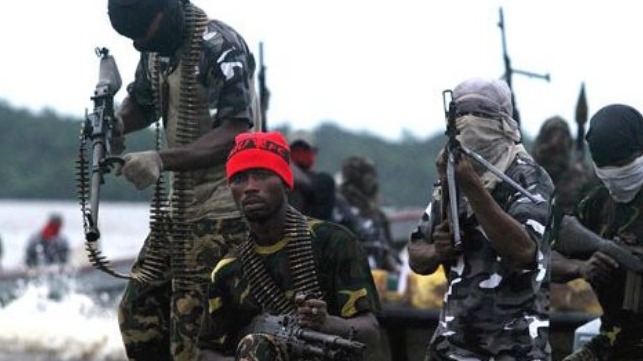
Dokubo, who cried out to newsmen in Port Harcourt, the State capital on Tuesday, said the activities of the criminals led to the death of one Abraham Anthony Alex, while some others sustained different degrees of injury. He disclosed that the armed criminals who dressed in Army camouflage have constantly attacked travelers on the middle of the high sea, dispossess them of their belongings and the passenger boat they were travelling in, leaving them stranded at the middle of nowhere.
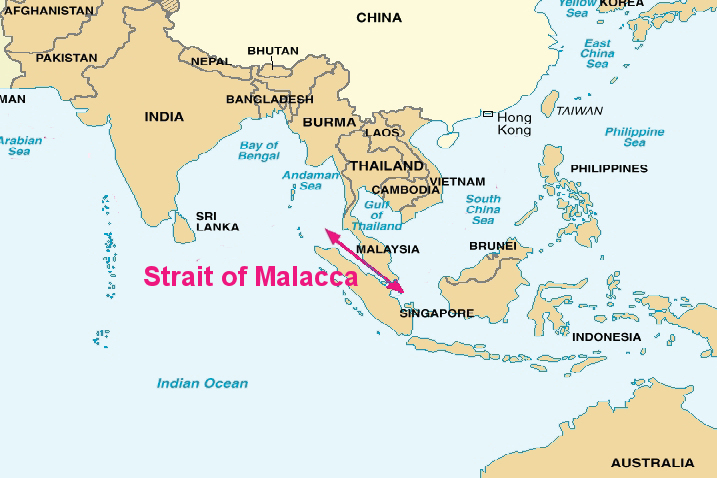
The Maritime and Port Authority of Singapore (MPA) has responded to China’s decision to raise the security level for its vessels heading through the Strait of Malacca, asserting that no information has been received about an immediate threat.
According to Bloomberg, a notice was served by China’s transport ministry on July 2, advising Chinese-flagged vessels to adopt heightened security measures and raise their security warning to level three.
Adhoc committee set up by the State House of Assembly to investigate the frequent attacks and robbery on the Bille-Port Harcourt sea route has submitted its report. The committee is chaired by member representing Gokana State Constituency, Hon. Dumle Maol, who submitted the report last Thursday after it carried out its investigations.
Among recommendations made by the committee was for the security agencies patrol along the waterways to curb the frequent waylay on passenger boats by sea pirates. It also called on the authorities to ensure that the miscreants and robbers are fished out and arrested, so as to stein the menace in the future.
President Muhammadu Buhari has signed into law an anti-piracy bill to improve security on Nigeria waterways and exclusive economic zone, the Nigerian Maritime Administration and Safety Agency said.
The so-called Suppression of Piracy and other Maritime Offences Bill will “ensure safe and secure shipping on Nigerian waters, prosecute infractions, and criminalize piracy,” the agency known as NIMASA said in emailed statement Wednesday.
Shipping companies are asked by authorities in Beijing to increase the security level on ships transiting the Strait of Malacca, one of the world’s busiest waterways. Cosco Shipping’s tanker unit has warned its staff about possible attacks from some Indonesian gangs
‘The raising of the threat level for Chinese-flagged vessels has been unexpected, particularly as the regional dynamics within and surrounding the Malacca Strait are stable’ — maritime security intelligence company Dryad Global
BEIJING has raised the security level on Chinese-flagged vessels
transiting the Straits of Malacca, according to documents seen by
Lloyd’s List.
Shipping companies have been advised to implement Security Level 3 — the highest state of alertness under the International Ship and Port Facility Security Code — effective from 2200hrs local time July 2, the Ministry of Transport said in a notification.
The seas off West Africa’s oil-rich coastline are now the most dangerous in the world for shipping, according to a new report.
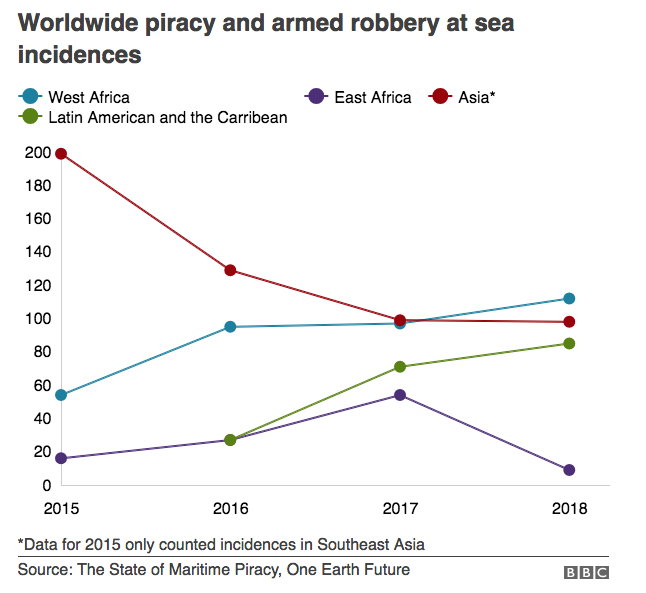
One Earth Future, which produces an annual State of Maritime Piracy, says that while attacks have been falling substantially in some regions of the world, in West Africa they’ve been on the rise and are now more frequent than anywhere else.
So why the increase in West Africa, and what shipping is being targeted?
What is piracy?
A strict definition of maritime piracy only includes attacks on shipping on the high seas – that is, more than 12 nautical miles off the coastline and not under the jurisdiction of any state.
Inside a country’s territorial waters and within port facilities, these attacks are defined as armed robberies at sea.
However, the data we’ve used from this latest report combines these two sets of data to give an overall picture of incidents at sea both inshore and offshore.
In 2018, there were 112 such incidents in West African waters.
It’s not just the huge tankers exporting oil and gas from Nigeria and Ghana that are targeted.
Commercial ships from smaller countries are also in the sights of the pirates.
At a recent event in London, President Faure Gnassingbé of Togo – a country sandwiched between these two regional giants – highlighted his own concerns at the rise in attacks on regional shipping.
“Our region is distinguished by the resurgence of transnational criminality on the high seas in the Gulf of Guinea,” said Mr Gnassingbé.
Why are attacks rising?
Most of the attacks have been against ships involved in oil and gas transportation, such as tankers, bulk carriers and tugs. Fishing vessels have also been targeted.
The coastline off Nigeria saw the most attacks in 2018. This is partly because of “petro-piracy”, targeting tankers from Nigeria’s rich oil and gas fields.
There were also incidents reported at the loading and anchorage facilities in the Nigerian port of Lagos.
Piracy in the form of hijacking and kidnapping for ransom payments was also common off the coasts of Benin, Ghana, Nigeria, Congo-Brazzaville and Cameroon.
Rich pickings at sea, political instability, the lack of law enforcement and poverty on land are all factors which have contributed to the increase in piracy.
Most of the seafarers affected are not from the region. Around half are from the Philippines, followed by India, Ukraine and Nigeria.
One of the reasons West Africa is now the number one spot for piracy is because of of the downward trends recorded elsewhere.
The East African shipping routes along the Somali coastline have been notorious for hijackings and robberies.
But since peaking in 2011, rates of piracy there have fallen off dramatically in recent years.
Local efforts on land in Somalia to change attitudes towards permitting piracy and building legal capacity to prosecute criminals have also helped improve the situation.
In Asia, the Malacca Strait, a busy, commercially important stretch of water between Malaysia and Indonesia, experienced a high number of attacks in 2015.
Concerted action by regional naval forces has reduced the problem there, but piracy still persists.
Attacks against shipping in the Caribbean and off the coast of Latin American have, however, risen.
Venezuela in particular has become a hotspot for piracy.
“Political and economic instability is a big factor there,” says Lydelle Joubert, an expert on piracy at One Earth Future.
KOTA TINGGI: The Malaysian Maritime Enforcement Agency (MMEA) thwarted an attempt by a group of foreign men to steal items on board a commercial vessel in Teluk Ramunia waters, off Pengerang, early yesterday.
Johor MMEA deputy operations director Sanifah Yusof said at 3am on Sunday, an MMEA patrol team from the Tanjung Sedili Maritime Zone came across two wooden boats, both named ‘Lima Sore’ secured to the ‘M.T. Ponier’ vessel that was anchored about 2.9 nautical miles south of Teluk Ramunia.
Port Harcourt – Suspected sea pirates on Monday attacked seafarers travelling on Port Harcourt-Bille waterways in Akuku-Toru Local Government Area of Rivers State, injuring scores of passengers and robbing them of money, goods worth millions of naira, including the hijacking of their Commercial boats.
A Bille Community leader, Adokiye Bibi, who confirmed the latest pirates’ attack also stated that between Saturday, June 1 to Tuesday June 4, over seven commercial boats have been attacked by sea pirates and hijacked from their owners.
Maritime Security News:The Nigerian authorities regularly complain that incidents of armed robbery on Delta waterways are wrongly described as incidents of piracy. Looks like the message hasn’t filtered through to the media…
The Jamaica Defence Force is to acquire a Thales Gecko electro-optical tracking sensor system as part of a wider national programme to counter sea pirates, the company announced on 30 May.
The system will be used in conjunction with the Coast Watcher 100 radar, which is also being supplied by Thales, to help protect against “contraband operations in difficult scenarios”, including monitoring in high seas and heavy rainfall conditions, and providing additional cover from low-altitude air threats.




 Maritime Security News