Navy combs Niger Delta creeks to rescue Turkish sailors

Olaleye Aluko

The Nigerian Navy said on Thursday that it had deployed all its  units in the creeks and backwaters of Niger Delta to rescue 10 abducted Turkish sailors on MV Paksoy 1 vessel attacked by pirates.

The navy said  the vessel was intercepted around 8.30am on Monday by the Ghana Navy Ship, EHWOR, and escorted to the Tema Port in Ghana. The Navy Director of Information, Commodore Suleman Dahun, stated these in a statement  on Thursday.

To continue reading, please click here.

Source: punchng.com

US destroyed Iranian drone in Strait of Hormuz, says Trump

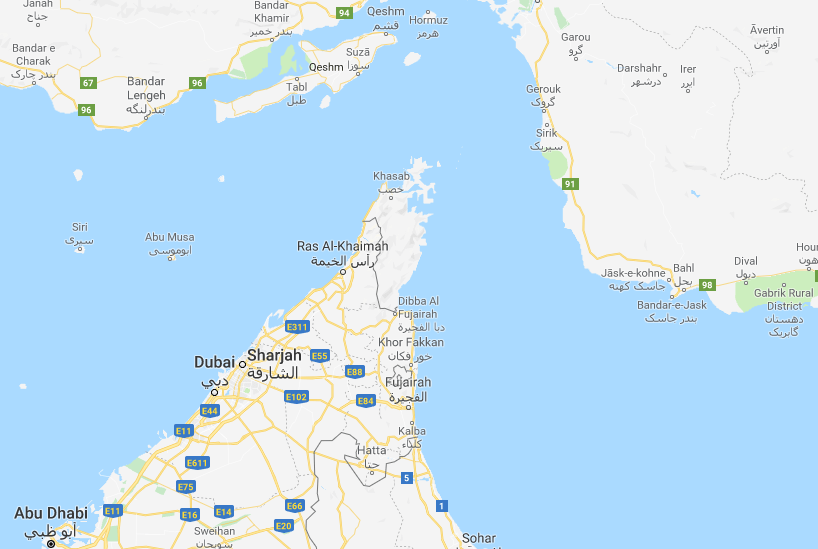
Persian Gulf/SoH

President Donald Trump has said the US Navy destroyed an Iranian drone in the Strait of Hormuz.

He said the USS Boxer amphibious assault ship “took defensive action” on Thursday after the drone came within about 1,000 yards (914m) of the vessel.

Iran said it had no information about losing a drone. In June, Iran downed a US military drone in the area.

Earlier, Tehran said it had seized a “foreign tanker” and its 12 crew on Sunday for smuggling fuel in the Gulf.

Iran has been blamed by the US for attacks on tankers which have happened in the world’s key shipping area since May. Tehran denies all the accusations.

The recent incidents have triggered fears of a military conflict in the region.

What have the US and Iran said about the incident?

Speaking at the White House, Mr Trump said: “I want to apprise everyone of an incident in the Strait of Hormuz today involving USS Boxer, a navy amphibious assault ship.

“The Boxer took defensive action against an Iranian drone which had closed into a very, very near distance, approximately 1,000 yards (914m), ignoring multiple calls to stand down and was threatening the safety of the ship and the ship’s crew. The drone was immediately destroyed.

“This is the latest of many provocative and hostile actions by Iran against vessels operating in international waters. The United States reserves the right to defend our personnel, facilities and interests.”

A defence department official quoted by the New York Times said the drone had been brought down using electronic jamming equipment.

Meanwhile, a senior Iranian official dismissed the US statement. In an English tweet posted on 19 July, Deputy Foreign Minister Abbas Araqchi even suggested the US may have downed its own drone by mistake.

Mr Araqchi’s comment came after Iranian Foreign Minister Mohammad Javad Zarif told reporters in New York on Thursday that “we have no information about losing a drone today”.

What about the seized oil tanker?

Iran’s Revolutionary Guards’ Sepah News site said on Thursday that an alleged fuel-smuggling ship was seized on Sunday during naval patrols aimed at “discovering and confronting organised smuggling”.

Iran’s state media quoted the Guards as saying the vessel had been smuggling one million litres (220,000 gallons) of fuel.

The state media later published footage of Iranian speedboats circling around the Panamanian-flagged Riah tanker.

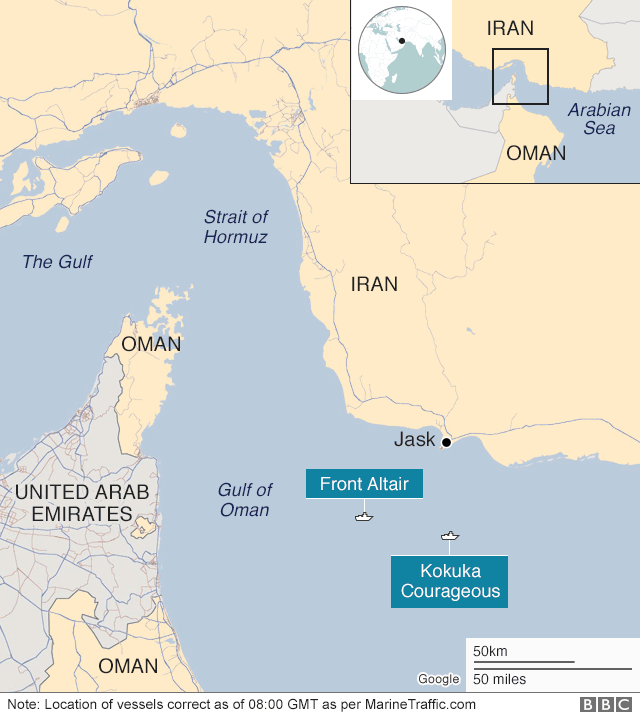
The vessel was seized south of Iran’s Larak Island, Iran said. Washington called on Iran to immediately release the ship.

What’s the background to this?

Tensions have been high in the Gulf since the US tightened the sanctions that it reimposed on Iran’s oil sector after unilaterally withdrawing from a landmark 2015 nuclear deal.

The US has blamed Iran for two separate attacks on oil tankers in the Gulf of Oman in May and June – an allegation Tehran has denied.

Iran also shot down a US surveillance drone over the Strait of Hormuz. Tehran said the aircraft had violated Iranian airspace, and that the incident sent a “clear message to America”.

The US military said the drone had been over international waters at the time, and condemned what it called an “unprovoked attack”.

UK warships have meanwhile been shadowing British oil tankers in the area since Iran threatened to seize one in response to the impounding of an Iranian tanker off Gibraltar.

The UK said the tanker was suspected of breaching EU sanctions against Syria. Iran denied it was en route there.

US Central Command Chief General Kenneth McKenzie, speaking on a visit to Saudi Arabia on Thursday, said he was working “aggressively” to find a solution to free passage for ships through the Gulf region, Reuters news agency reports.

Source: bbc.co.uk

Armed Robberies: 28 Incidents Reported to ReCAAP ISC in H1 2019

By Baibhav Mishra

Twenty-eight Incidents Reported to ReCAAP Information Sharing Centre from January to June 2019, Marking 32% Year-on-Year Decrease, and the Lowest in Number among 13-Year Period of January to June

The ReCAAP Information Sharing Centre (ISC) today released its Half-Yearly (January to June 2019) Report. Highlights of the report, whose information is verified by the respective government agencies, also known as Focal Points, and regional authorities, include:

Overall Summary

  1. Total of 28 incidents reported from January to June 2019, of which 25 were actual incidents while 3 were attempted cases
  2. Of the 28 incidents reported, 26 (93%) were armed robbery against ships and two (7%) were piracy
  3. This marks a 32% decrease compared to the same period in 2018 in the number of incidents reported
  4. This is also the lowest number among the 13-year period (2007-2019) of January to June
  5. In terms of severity, there was one Category 1 incident, two Category 2 incidents, two Category 3 incidents and 20 Category 4

To continue reading, please click here.

Source: seanews.co.uk

Navy traces abducted Turkish sailors to Ghana

Olaleye Aluko

The Nigerian Navy has traced the cargo ship on which 10 Turkish sailors were abducted to Ghana, saying rescue efforts were ongoing to bring back the sailors.

The navy said the vessel was at a Ghanaian port while it was working with sister navies to unravel the circumstances around the abduction of the Turkish sailors. The Turkish sailors were reported on Tuesday to have been kidnapped for ransom by armed men off the coast of Nigeria.

To continue reading, please click here.

Source: punchng.com

Navy: Fighting crime within the waterways

Philip Nwosu

In 2015the Chief of Naval Staff, Vice Admiral Ibok-Ete Ibas launched the force’s  strategic directive 2015-1, aimed at providing security in the maritime sector, ensure effective monitoring of the nation’s waterways and sustain its effort to maintain credible presence at sea.

After four years, the Nigerian Navy says it has been able to effectively police the nation’s waterways and ensure that the maritime sector is safe.

According to the Nigerian Navy, it has impounded and destroyed illegally refined crude oil valued at N8.4 billion between January and June 2019. The navy has destroyed and impounded 131,085.06 barrels of crude oil and about 29,612,202 litres of illegally refined products during its anti-crude oil theft campaign. It also destroyed 227 illegal refineries, 2,688 storage facilities, 364 wooden boats and impounded 11 barges and 32 vessels.

To continue reading, please click here.

Source: sunnewsonline.com

Oil discovery: Boost security at sea to ward off pirates – Oquaye to Navy

The Speaker of Parliament, Prof. Aaron Mike Oquaye has charged the Ghana Navy to step up security along Ghana’s coast.

He said Ghana’s oil sites are sea-based, hence exposes the country to various criminal threats. The Speaker cited issues that are associated with the increase in crime on the shores of oil-rich countries.

To continue reading, please click here.

Source: ghanaweb.com

Seeking to avoid escalation, ships deploy unarmed guards to navigate Gulf

Persian Gulf/SoH

Jonathan Saul

LONDON (Reuters) – Shipping companies are hiring unarmed security guards for voyages through the Middle East Gulf as an extra safeguard after a wave of attacks in the region, security companies involved said.

Relations between Iran and the West are increasingly strained after Britain seized an Iranian tanker in Gibraltar this month. Britain also said last week that one of its warships had to fend off Iranian vessels seeking to block a UK-owned tanker from passing through the Strait of Hormuz.

To continue reading, please click here.

Source: reuters.com

Departure of EU naval force risky for coast, report warns

File image of an approach on a dhow

By Samuel Baya

The possible withdrawal of the European Union Naval Force from the Indian Ocean waters has raised the need for other plans to ensure piracy does not rise again in the region, a new maritime report says.

A report by the Intergovernmental Standing Committee on Shipping (ISCOS) says that though piracy has been on the decline, the possibility of a withdrawal of the EU naval force that has been stationed in the Indian Ocean waters for years heralds uncertainty.

To continue reading, please click here.

Source: businessdailyafrica.com

U.S. unsure about circumstances of tanker towed to Iran

DUBAI (Reuters) – U.S. officials say they are unsure whether an oil tanker towed into Iranian waters was seized by Iran or rescued after facing mechanical faults as Tehran asserts, creating a mystery at sea at a time of high tension in the Gulf.

The MT Riah disappeared from ship tracking maps when its transponder was switched off in the Strait of Hormuz on July 14. Its last position was off the coast of the Iranian island of Qeshm in the strait.

To continue reading, please click here.

Source: reuters.com

Turkish sailors held hostage by armed pirates in Nigeria

A group of 10 Turkish sailors has been kidnapped by pirates off the coast of Nigeria, reportedly for ransom.

The Paksoy-1 was sailing from Cameroon to Ivory Coast when the pirates boarded the ship in the Gulf of Guinea.

It was not carrying freight and eight sailors managed to escape. Turkey says it is working to secure the release of those seized.

The International Maritime Bureau says the Gulf of Guinea is the most dangerous sea in the world for piracy.

Ömer Çelik, spokesman for Turkey’s ruling AK Party, said the ministry was following the case closely and “working on it”.

Numan Paksoy, operations manager at Kadıoğlu Maritime, said about “12 pirates with heavy guns” had attacked the boat.

Crew members hid in a safe room – the citadel – when the pirates boarded the ship, but emerged after “the assailants threatened to burn the ship and kill all of them”, he told the BBC in an emailed statement.

The attackers then picked 10 sailors and let the other eight go, he added.

73% of all sea kidnappings and 92% of hostage-takings occur in the Gulf of Guinea off Nigeria, Guinea, Togo, Benin and Cameroon, according to the International Maritime Bureau (IMB).

Recently, the organisation has noted “a welcome and marked decrease” in attacks in the region due to an increase in Nigerian Navy patrols.

Twenty-one incidents have been recorded around Nigeria so far this year, compared to 31 in the same period of 2018.

Source: bbc.co.uk