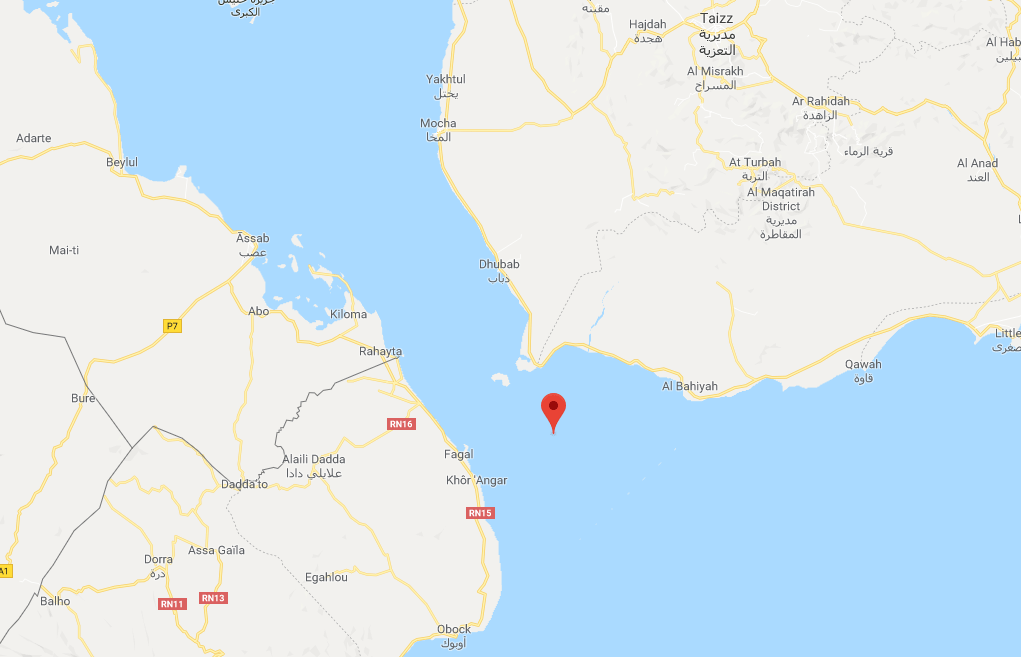
Head of the Houthis’ Supreme Political Council Mahdi al-Mashat has threatened to target the commercial navigation waterways and oil tankers in the Red Sea and the Arabian Sea, saying that they possess missiles that can reach Egypt and Sudan.
Mashat affirmed that the militias would continue to target cities and airports in Saudi Arabia.
(Reuters) – Federal authorities seized 16.5 tons of cocaine worth more than $1 billion from a ship in Philadelphia in one of the largest drug seizures in U.S. history, the U.S. Justice Department said on Tuesday.
Federal, state and local law enforcement agents on Monday boarded the MSC Gayane, a cargo ship docked in Philadelphia’s Packer Marine Terminal, and found cocaine in seven shipping containers, according to a criminal complaint filed in Philadelphia federal court.
The use of synthetic aperture radar technology means ships can be detected even if they turn off Automatic Identification System transponders. Satellites can see through clouds to detect vessels using microwave pulses
VESSELS failing to comply with international sanctions will not be able to avoid being tracked in real time as technology used to detect illegal fishing is fully adapted for commercial shipping.
Iran’s fleet of 36 very large crude carriers and eight suezmax tankers have finessed and expanded the so-called practice of ‘going dark’ by establishing complicated logistics chains to avoid detection and thus disguise the origin and destination of oil cargoes.
GENEVA/DUBAI (Reuters) – U.S. President Donald Trump said he was prepared to take military action to stop Tehran from getting a nuclear bomb but left open whether he would back the use of force to protect Gulf oil supplies that Washington fears may be under threat by Iran.
Worries about a confrontation between Iran and the United States have mounted since attacks last week on two oil tankers near the strategic Strait of Hormuz shipping lane at the entrance to the Gulf. Washington blamed long-time foe Iran for the incidents.
The seas off West Africa’s oil-rich coastline are now the most dangerous in the world for shipping, according to a new report.
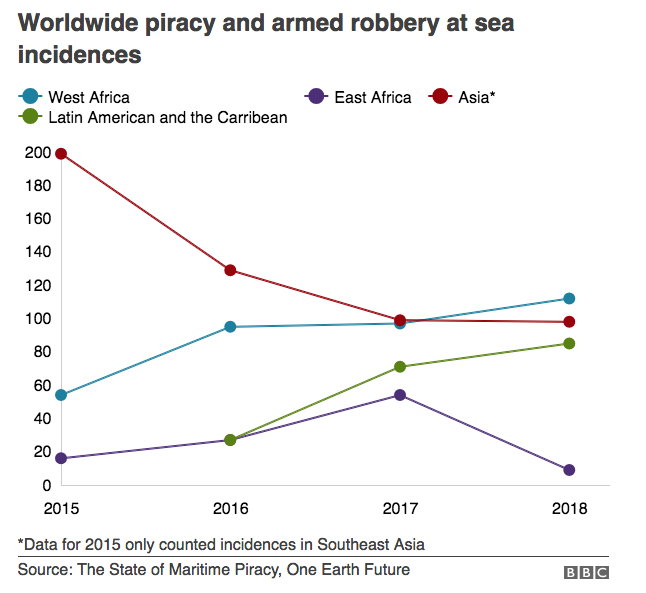
One Earth Future, which produces an annual State of Maritime Piracy, says that while attacks have been falling substantially in some regions of the world, in West Africa they’ve been on the rise and are now more frequent than anywhere else.
So why the increase in West Africa, and what shipping is being targeted?
What is piracy?
A strict definition of maritime piracy only includes attacks on shipping on the high seas – that is, more than 12 nautical miles off the coastline and not under the jurisdiction of any state.
Inside a country’s territorial waters and within port facilities, these attacks are defined as armed robberies at sea.
However, the data we’ve used from this latest report combines these two sets of data to give an overall picture of incidents at sea both inshore and offshore.
In 2018, there were 112 such incidents in West African waters.
It’s not just the huge tankers exporting oil and gas from Nigeria and Ghana that are targeted.
Commercial ships from smaller countries are also in the sights of the pirates.
At a recent event in London, President Faure Gnassingbé of Togo – a country sandwiched between these two regional giants – highlighted his own concerns at the rise in attacks on regional shipping.
“Our region is distinguished by the resurgence of transnational criminality on the high seas in the Gulf of Guinea,” said Mr Gnassingbé.
Why are attacks rising?
Most of the attacks have been against ships involved in oil and gas transportation, such as tankers, bulk carriers and tugs. Fishing vessels have also been targeted.
The coastline off Nigeria saw the most attacks in 2018. This is partly because of “petro-piracy”, targeting tankers from Nigeria’s rich oil and gas fields.
There were also incidents reported at the loading and anchorage facilities in the Nigerian port of Lagos.
Piracy in the form of hijacking and kidnapping for ransom payments was also common off the coasts of Benin, Ghana, Nigeria, Congo-Brazzaville and Cameroon.
Rich pickings at sea, political instability, the lack of law enforcement and poverty on land are all factors which have contributed to the increase in piracy.
Most of the seafarers affected are not from the region. Around half are from the Philippines, followed by India, Ukraine and Nigeria.
One of the reasons West Africa is now the number one spot for piracy is because of of the downward trends recorded elsewhere.
The East African shipping routes along the Somali coastline have been notorious for hijackings and robberies.
But since peaking in 2011, rates of piracy there have fallen off dramatically in recent years.
Local efforts on land in Somalia to change attitudes towards permitting piracy and building legal capacity to prosecute criminals have also helped improve the situation.
In Asia, the Malacca Strait, a busy, commercially important stretch of water between Malaysia and Indonesia, experienced a high number of attacks in 2015.
Concerted action by regional naval forces has reduced the problem there, but piracy still persists.
Attacks against shipping in the Caribbean and off the coast of Latin American have, however, risen.
Venezuela in particular has become a hotspot for piracy.
“Political and economic instability is a big factor there,” says Lydelle Joubert, an expert on piracy at One Earth Future.
KOTA TINGGI: The Malaysian Maritime Enforcement Agency (MMEA) thwarted an attempt by a group of foreign men to steal items on board a commercial vessel in Teluk Ramunia waters, off Pengerang, early yesterday.
Johor MMEA deputy operations director Sanifah Yusof said at 3am on Sunday, an MMEA patrol team from the Tanjung Sedili Maritime Zone came across two wooden boats, both named ‘Lima Sore’ secured to the ‘M.T. Ponier’ vessel that was anchored about 2.9 nautical miles south of Teluk Ramunia.
It recently stepped up production in response to the US tightening sanctions. The 2015 deal, from which the US has withdrawn, curbed Iran’s nuclear programme in exchange for the lifting of sanctions.
Iran’s President Hassan Rouhani said his country did not seek to wage war with any nation and had remained “loyal” to its international obligations.
Meanwhile, on Monday night three rockets hit a military base housing US troops north of Baghdad, the Iraqi military said. The US said it was “indirect fire” and did not cause injuries.
No group has admitted responsibility for the attack, though it follows warnings by US officials of an increased threat to US interests in Iraq by Iran-backed militias.
What do we know about the extra troops?
The US troop deployment to the Middle East was announced by Mr Shanahan late on Monday.
In his statement, he said the “United States does not seek conflict with Iran” but the action was taken to “ensure the safety and welfare of our military personnel working throughout the region to protect our national interests”.
He said the military would continue to monitor the situation and make adjustments to troop levels accordingly.
Monday’s troop increase announcement comes on top of 1,500 extra announced by President Donald Trump last month.
Secretary of State Mike Pompeo said on Sunday that the US did not want war with Iran, but was nevertheless “considering a full range of options”.
What do the latest images show?
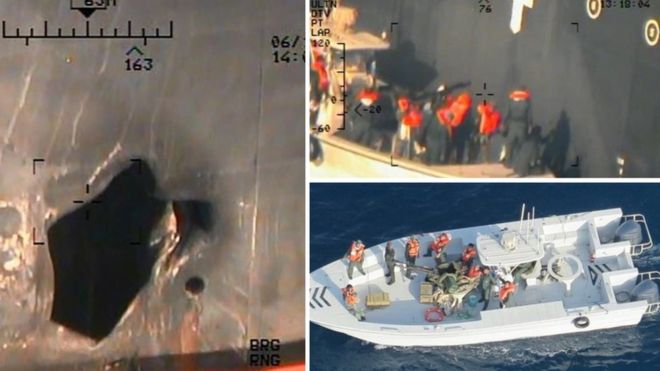
Shortly before the announcement, the Pentagon released new images including some purporting to show the remnants of an unexploded mine on a Japanese-owned oil tanker.
The photos appear to show it being removed by members of the Iranian Revolutionary Guard Corps. The Pentagon has already released grainy video said to show the same episode.
Also seen in the latest images is apparent damage – a hole – above the waterline on the hull of the Kokuka Courageous vessel.
Another image claims to show the Iranian Revolutionary Guard Corps vessel shortly after it was involved in removing the limpet mine.
A Norwegian-owned tanker, the Front Altair, also reported being hit by the blasts on Thursday.
The US has implicated Iran in the latest attacks and four others outside the Strait of Hormuz in May, allegations denied by Iran.
How do other sides see the situation?
China urged the US to lower the pressure and for Iran to stick to the nuclear deal, warning of a “Pandora’s box” in the region.
Russia – another party to the nuclear accord – also called for restraint, calling US actions “truly provocative”.
Saudi Arabia also blames Iran for the attacks on the two oil tankers, while the UK said it was “almost certain” Iran was responsible.
But EU foreign ministers meeting on Monday warned against jumping to conclusions and backed UN calls for an independent investigation.
Why are there new tensions?
In 2015, Iran agreed to a landmark deal with world powers to curb its nuclear development.
It agreed to limit the enrichment of uranium, which is used to make reactor fuel but also nuclear weapons, and other measures in return for relief from sanctions.
Mr Trump abandoned the nuclear accord last year and started to re-impose sanctions.
The move has crippled Iran’s economy, which relies on oil, and Iran has responded by scaling back its nuclear commitments.
On Monday, a spokesman for Iran’s Atomic Energy Organisation said it was on course to exceed agreed limits on its low-enriched uranium stockpiles by 27 June.
But, Iran said there was “still time” for European countries to act by protecting Iran from reinstated US sanctions.
Reports coming from Sabah suggest that Abu Sayyaf Group terrorists have kidnapped 10 crew from two fishing boats early on Tuesday 18th.
Media reports state that the incidents near Borneo Island, when two speedboats approached two fishing vessels. “Pirates” boarded the boats at around 2am LT, confiscated documents likely to relate to the nationality of the crew members, and then took 10 hostages before fleeing towards Sitangkai Island in the Philippines. The fishing boats were believed to be operating during curfew hours without a permit, according to a report in The Straits Times. The remaining crew were picked up by the MMEA.
The incident comes after a prolonged lull in kidnapping activities by the group. However, the loss of hostages in recent rescues and killings would suggest that the group is now looking to increase its funds by further Kidnap For Ransom efforts.
The incident prompted Sabah Chief Minister Datuk Seri Mohd Shafie Apdal to call for further security measures in Sabah, an area which has seen cross border criminality and kidnapping at sea in recent years.
The recent spike in attacks on tankers near the Persian Gulf is inflating insurance premiums for ships transiting through the wider Middle East, increasing the cost of transporting oil from the region.
Insurance rates for crude oil tankers loading in the Middle East are now up to 20 times higher following the latest attacks.
A suspected notorious cultist and illegal oil bunkering kingpin, Korobe Menele Loveday, who has been on the wanted list of the security agencies for terrorizing communities in Rivers State has been killed.
He was killed in a shootout with security operatives.



 Maritime Security News