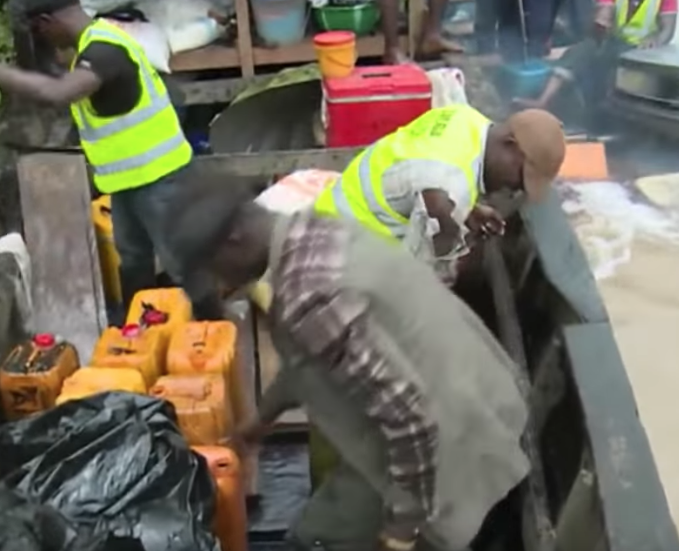
The Nigerian Navy said it operatives have impounded six ships and 80 wooden boats used by criminal elements for alleged illegal oil bunkering, used in siphoning of product from the Nigerian National Petroleum Corporation (NNPC) pipelines and crude oil well heads in six months. The Command also said it has destroyed over 50 illegal refineries at Yeye, Burutu and Ibafa creeks in Delta State.
The operatives of the Nigerian Navy Ship NNS, Delta gave the names of the six arrested ships as MT Aysu, MT Interim, MV Mama Elizabeth, MT Miracle, MV Nipal and SD Waterman and 80 wooden boats used by criminals for alleged illegal bunkering of petroleum products from NNPC.
The Management of C&I Leasing Plc has said contrary to report by some online media that its vessel, MV Charis, was arrested in Malabo, Equatorial Guinea, on the suspicion of involvement in piracy activities, the vessel was on its way to execute a recovery contract in Equatorial Guinea when it was hijacked by sea pirates.
The Managing Director, C&I Leasing, Mr Andrew Otike-Odibi, explained this in a statement while commending the Nigerian Maritime Administration and Safety Agency, the Nigerian Ambassador to Equatorial Guinea, Ambassador Toko Ali Gongulong; the Defence Attaché, Navy Captain Seyi Oladipo; and the Spanish Navy, for their intervention and timely release of the vessel.
The use of synthetic aperture radar technology means ships can be detected even if they turn off Automatic Identification System transponders. Satellites can see through clouds to detect vessels using microwave pulses
VESSELS failing to comply with international sanctions will not be able to avoid being tracked in real time as technology used to detect illegal fishing is fully adapted for commercial shipping.
Iran’s fleet of 36 very large crude carriers and eight suezmax tankers have finessed and expanded the so-called practice of ‘going dark’ by establishing complicated logistics chains to avoid detection and thus disguise the origin and destination of oil cargoes.
The seas off West Africa’s oil-rich coastline are now the most dangerous in the world for shipping, according to a new report.
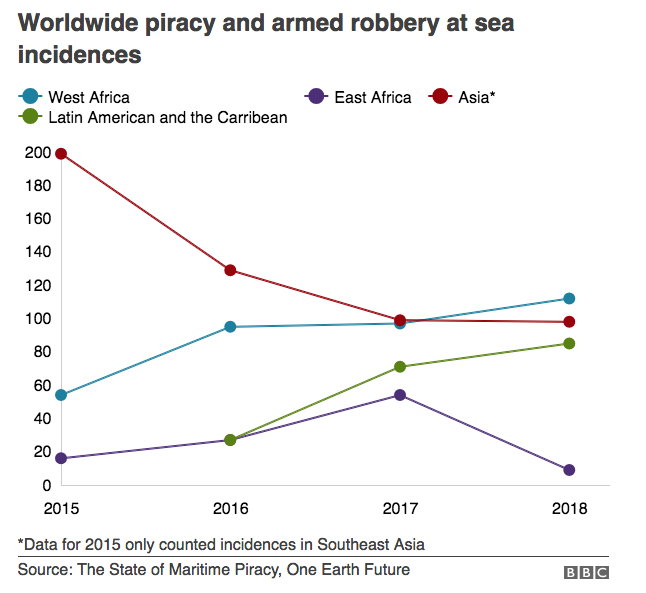
One Earth Future, which produces an annual State of Maritime Piracy, says that while attacks have been falling substantially in some regions of the world, in West Africa they’ve been on the rise and are now more frequent than anywhere else.
So why the increase in West Africa, and what shipping is being targeted?
What is piracy?
A strict definition of maritime piracy only includes attacks on shipping on the high seas – that is, more than 12 nautical miles off the coastline and not under the jurisdiction of any state.
Inside a country’s territorial waters and within port facilities, these attacks are defined as armed robberies at sea.
However, the data we’ve used from this latest report combines these two sets of data to give an overall picture of incidents at sea both inshore and offshore.
In 2018, there were 112 such incidents in West African waters.
It’s not just the huge tankers exporting oil and gas from Nigeria and Ghana that are targeted.
Commercial ships from smaller countries are also in the sights of the pirates.
At a recent event in London, President Faure Gnassingbé of Togo – a country sandwiched between these two regional giants – highlighted his own concerns at the rise in attacks on regional shipping.
“Our region is distinguished by the resurgence of transnational criminality on the high seas in the Gulf of Guinea,” said Mr Gnassingbé.
Why are attacks rising?
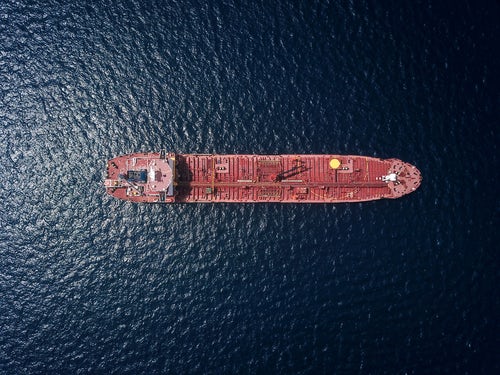
Most of the attacks have been against ships involved in oil and gas transportation, such as tankers, bulk carriers and tugs. Fishing vessels have also been targeted.
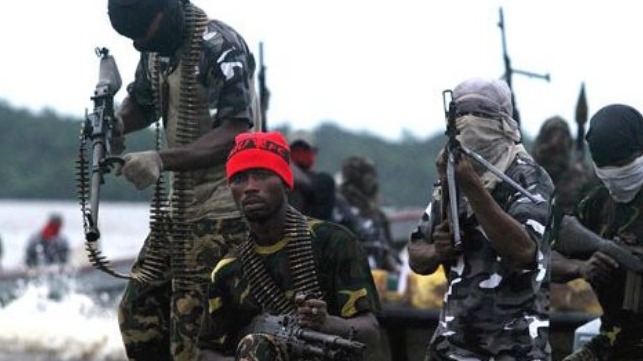
The coastline off Nigeria saw the most attacks in 2018. This is partly because of “petro-piracy”, targeting tankers from Nigeria’s rich oil and gas fields.
There were also incidents reported at the loading and anchorage facilities in the Nigerian port of Lagos.
Piracy in the form of hijacking and kidnapping for ransom payments was also common off the coasts of Benin, Ghana, Nigeria, Congo-Brazzaville and Cameroon.
Rich pickings at sea, political instability, the lack of law enforcement and poverty on land are all factors which have contributed to the increase in piracy.
Most of the seafarers affected are not from the region. Around half are from the Philippines, followed by India, Ukraine and Nigeria.
One of the reasons West Africa is now the number one spot for piracy is because of of the downward trends recorded elsewhere.
The East African shipping routes along the Somali coastline have been notorious for hijackings and robberies.
But since peaking in 2011, rates of piracy there have fallen off dramatically in recent years.
Local efforts on land in Somalia to change attitudes towards permitting piracy and building legal capacity to prosecute criminals have also helped improve the situation.
In Asia, the Malacca Strait, a busy, commercially important stretch of water between Malaysia and Indonesia, experienced a high number of attacks in 2015.
Concerted action by regional naval forces has reduced the problem there, but piracy still persists.
Attacks against shipping in the Caribbean and off the coast of Latin American have, however, risen.
Venezuela in particular has become a hotspot for piracy.
“Political and economic instability is a big factor there,” says Lydelle Joubert, an expert on piracy at One Earth Future.
A suspected notorious cultist and illegal oil bunkering kingpin, Korobe Menele Loveday, who has been on the wanted list of the security agencies for terrorizing communities in Rivers State has been killed.
He was killed in a shootout with security operatives.
By Tope Templer Olaiya, Sulaimon Salau, Gloria Ehiaghe (Lagos) and Rotimi Agboluaje (Ibadan)
Director General of the Nigerian Maritime Administration and Safety Agency (NIMASA), Dakuku Peterside, has said the agency was taking strategic steps to deal with maritime piracy.
He disclosed that the anti-piracy bill, sponsored by NIMASA, has been passed by the National Assembly and as soon as it is signed into law, it would help tame piracy in and open up more opportunities in the sector.
Naval forces from 33 countries came together for exercise Obangame Express to work on countering piracy, drug trafficking, and illegal fishing, which are common in the Gulf of Guinea.
Andréa Barretto
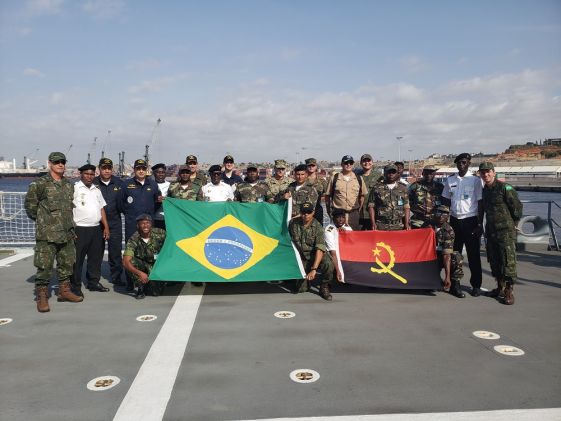
The Brazilian Navy (MB, in Portuguese) participated in the multinational exercise Obangame Express, on the African Coast, for the sixth time. Since 2010, the training gathers naval forces from Africa, Europe, and the Americas. The objective is to boost regional cooperation and promote maritime domain awareness.
The African Coast faces issues such as drug, arms, and human trafficking; illegal fishing, and piracy. During the two-week exercise, Obangame also develops information sharing standards and vessel interdiction expertise, to counter illegal activities at sea.
Brazilian Navy and Angolan Navy service members raise their country flags, on board the Brazilian ship Araguari, deployed for exercise Obangame Express 2019. (Photo: Brazilian Navy)
Oil major, Chevron Nigeria Limited has said crude oil theft, illegal oil refining and pipeline vandalism are major threats to Nigeria’s economy.
Chevron in a position paper presented at a one-day seminar on advocacy against crude oil theft in Warri, Delta State, said these challenges have continued to make it difficult for the country to meet its revenue projection, and at the same time have polluted the environment in the Niger Delta region.
The Ghana Navy and the Marine and Railways Unit of the Ghana Police Service have assured the public of continues service to safeguarding the port space and Ghana’s territorial waters.
This was said when, the Flag officer in charge of the Eastern Naval Command, Commodore James Kontoh and the Commander of the Marine, Port and Railways Unit of the Ghana Police Service, Chief Superintendent Joseph Ababio participated in Eye on Port’s live broadcast on national television, that seeks to bring port and maritime activities more closer to the public.
A consultant to the Nigeria Natural Resource Charter (NNRC), Mr. Niyi Awodeyi, has disclosed that about N995.2 billion is lost annually due to crude oil theft. Awodeyi, which said the amount was discovered in a recent findings, also estimated that N3.8trillion was lost in 2016.
Awodeyi, who also quoted a World Bank report stated that 80 per cent of crude oil revenue in Nigeria was in possession of just one percent of the country’s population, stated that the award of security contracts, “gave the actors access to the pipelines”, with surprise increase in crude oil theft.


 Maritime Security News