An SA Navy decision not to comment on an Operation Copper anti-piracy deployment has not improved the public image or perception of the maritime service of the national defence force, with experts cautioning this is a step backwards in terms of transparency.
When defenceWeb earlier this month requested some detail on an apparent upcoming deployment to the Mozambique Channel the official SA Navy response was: “This is an operational matter and we cannot comment on it”.
The Financial Times reports that the recent incidents in the Gulf of Oman have seen a rise in calls to maritime security companies by concerned shipping firms.
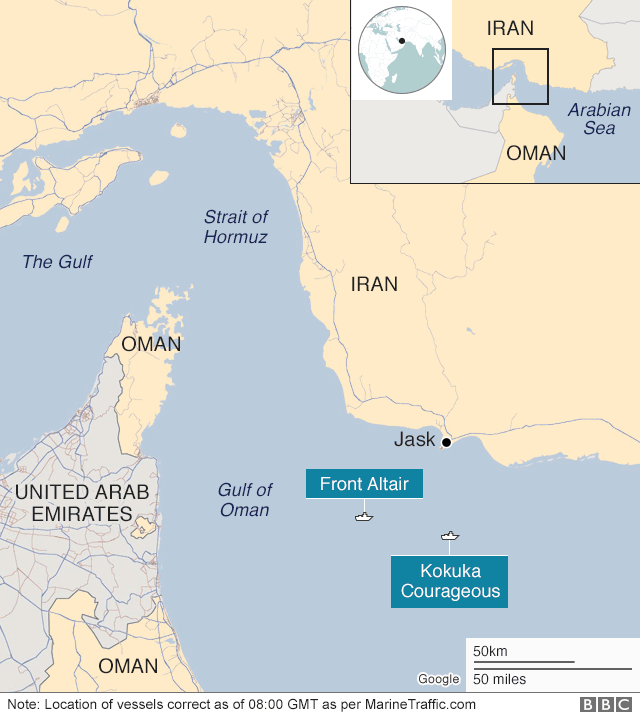
Since the attacks on the Front Altair and Kokuka Courageous, shipping companies who transit the region on a regular basis have been looking into additional protection for their vessels. During the height of Somali piracy in the region, it was the norm for the merchant marine to employ teams of armed guards in order to deter any potential attack, and it worked. No merchant vessel with armed guards has ever been hijacked in the Indian Ocean. That, combined with more aggressive and visible patrolling by the international naval forces present in the region, has seen the issue of piracy off Somalia reduce considerably since 2012.
The current threat, believed to be from Iran’s IRGC – an accusation denied by Iran – is leading to an increase in demand for armed protection services, a sector which has suffered considerably from rate cuts and an influx of cheaper personnel in recent years.
The main UK Private Maritime Security Companies (PMSC), such as Ambrey Risk and MAST report an increase in demand from previous and prospective clients keen to ensure the safety of their ships in the region.
While a team of armed guards is no match for the IRGC, even an unarmed security detail can offer additional security. Well trained guards on Watch duties can spot threats that crew might miss or dismiss as the local pattern of life and, while engaging hostile state actors is unlikely, they can offer the Master an early warning system that he may lack.
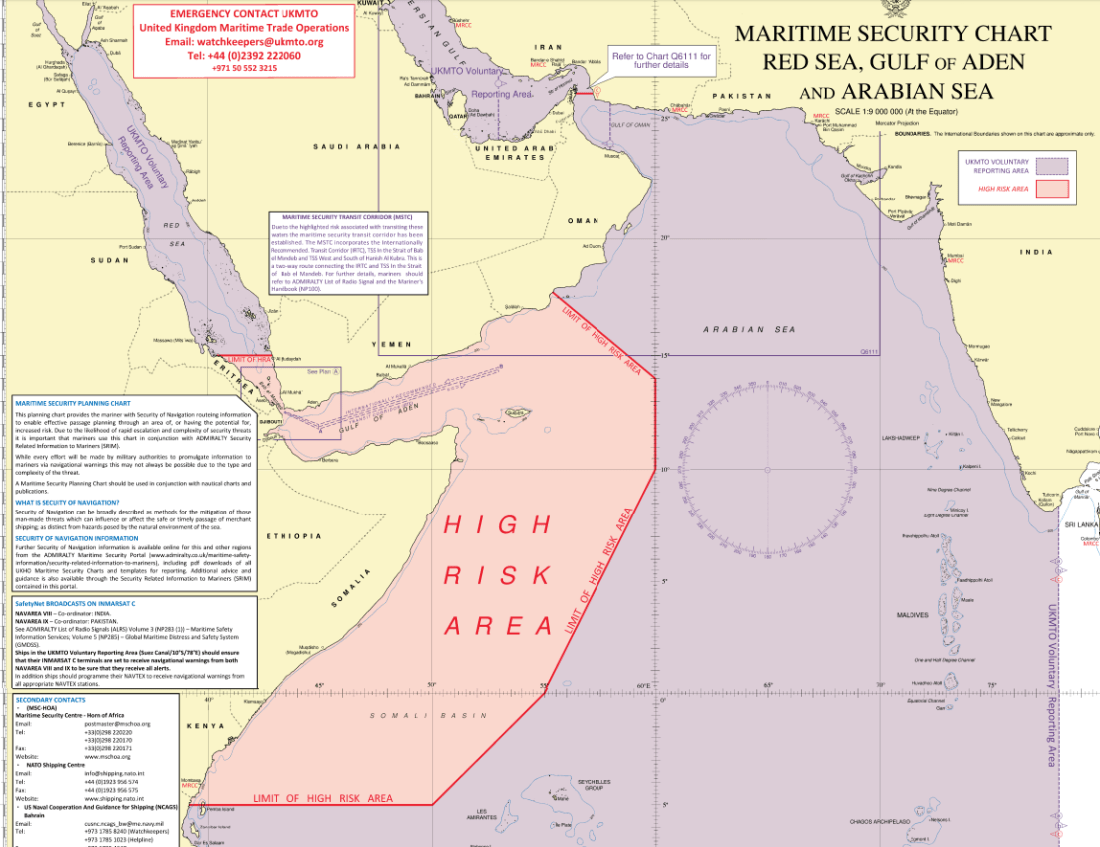
With the situation in the region fluid, it’s possible that a convoy escort programme, similar to that used in the Internationally Recognised Transit Corridor (IRTC) in the Gulf of Aden may be adopted, with support from the US Navy. Russia, China, South Korea and Japan’s MSDF have all run escorts through the Gulf of Aden, and a multi-national force may be more palatable to states bordering Iran.
However, nothing has been officially announced, leaving the shipping industry scrambling to come up with its own solutions, as is so often the case. The threat posed to vessels in the region continues to be real and the situation dangerous for crews.
A US military surveillance drone has been shot down by Iranian forces while flying over the Strait of Hormuz.
Iran’s Islamic Revolution Guards Corps (IRGC) said the drone had violated Iranian airspace. But US military said it had been over international waters.
IRGC commander-in-chief Maj-Gen Hossein Salami said the downing of the drone sent a “clear message to America” that Iran’s borders were its “red line”.
It comes at a time of escalating tension between the US and Iran.
On Monday, the US defence department said it was deploying 1,000 extra troops to the region in response to “hostile behaviour” by Iranian forces.
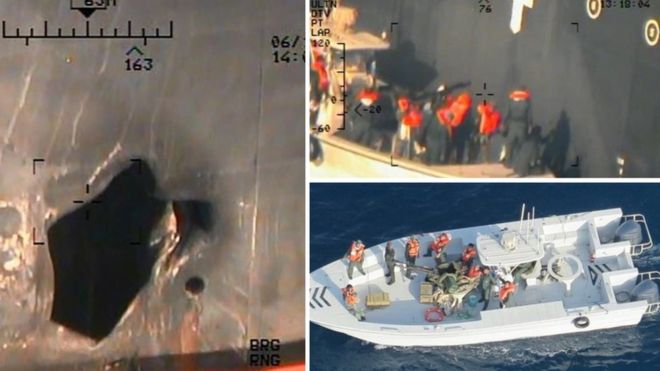
The US has also accused Iran of attacking two oil tankers with mines last Thursday just outside the Strait of Hormuz, in the Gulf of Oman. Iran rejects the allegation.
It was the second time in a month tankers have been attacked close in the region, through which a fifth of the world’s oil passes each day.
Tensions were further fuelled on Monday when Iran announced its stockpile of low-enriched uranium would next week exceed limits it agreed with world powers under a landmark nuclear deal in 2015.
Iran stepped up its production in response to tightening economic sanctions from the US, which unilaterally withdrew from the deal last year.
The drone was identified by the IRGC as a RQ-4 Global Hawk, but the US military official told Reuters news agency the drone was a US Navy MQ-4C Triton, a maritime patrol and reconnaissance aircraft based on the RQ-4B Global Hawk.
Later, in a speech carried live on Iranian state TV, Gen Salami warned the US that it needed to respect Iran’s territorial integrity and national security.
“The downing of the American drone was a clear message to America… our borders are our red line and we will react strongly against any aggression.”
He added: “Iran is not seeking war with any country, but we are fully prepared to defend Iran.”
Is this the first time Iran has targeted a US drone?
The drone had earlier observed a fire on board the other tanker, the Front Altair.
The previous week, another US MQ-9 Reaper was shot down over Yemen by a surface-to-air missile fired by the Iran-backed rebel Houthi movement.
The US military said the altitude of the engagement “indicated an improvement over previous Houthi capability, which we assess was enabled by Iranian assistance”. Iran denies providing weapons to the Houthis.
In 2011, Iran said it had captured a US RQ-170 Sentinel reconnaissance drone that had been reported lost by US forces in neighbouring Afghanistan. It developed its own version of the drone, one of which was shot down by Israel last year.
Head of the Houthis’ Supreme Political Council Mahdi al-Mashat has threatened to target the commercial navigation waterways and oil tankers in the Red Sea and the Arabian Sea, saying that they possess missiles that can reach Egypt and Sudan.
Mashat affirmed that the militias would continue to target cities and airports in Saudi Arabia.
The use of synthetic aperture radar technology means ships can be detected even if they turn off Automatic Identification System transponders. Satellites can see through clouds to detect vessels using microwave pulses
VESSELS failing to comply with international sanctions will not be able to avoid being tracked in real time as technology used to detect illegal fishing is fully adapted for commercial shipping.
Iran’s fleet of 36 very large crude carriers and eight suezmax tankers have finessed and expanded the so-called practice of ‘going dark’ by establishing complicated logistics chains to avoid detection and thus disguise the origin and destination of oil cargoes.
The seas off West Africa’s oil-rich coastline are now the most dangerous in the world for shipping, according to a new report.
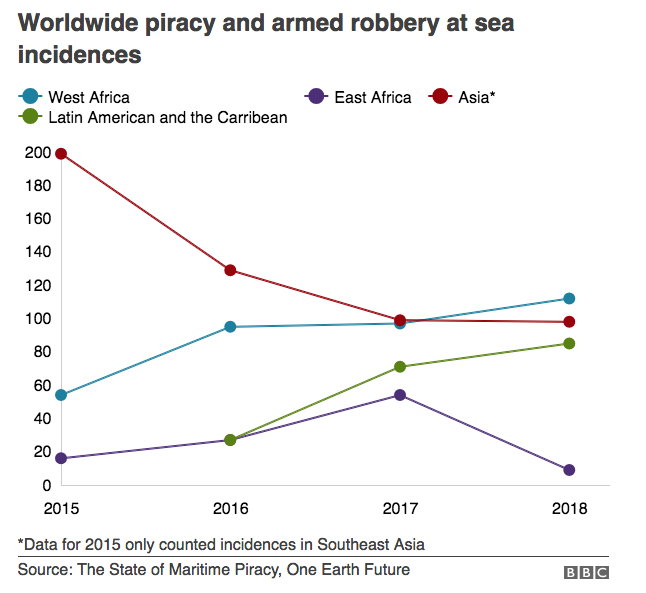
One Earth Future, which produces an annual State of Maritime Piracy, says that while attacks have been falling substantially in some regions of the world, in West Africa they’ve been on the rise and are now more frequent than anywhere else.
So why the increase in West Africa, and what shipping is being targeted?
What is piracy?
A strict definition of maritime piracy only includes attacks on shipping on the high seas – that is, more than 12 nautical miles off the coastline and not under the jurisdiction of any state.
Inside a country’s territorial waters and within port facilities, these attacks are defined as armed robberies at sea.
However, the data we’ve used from this latest report combines these two sets of data to give an overall picture of incidents at sea both inshore and offshore.
In 2018, there were 112 such incidents in West African waters.
It’s not just the huge tankers exporting oil and gas from Nigeria and Ghana that are targeted.
Commercial ships from smaller countries are also in the sights of the pirates.
At a recent event in London, President Faure Gnassingbé of Togo – a country sandwiched between these two regional giants – highlighted his own concerns at the rise in attacks on regional shipping.
“Our region is distinguished by the resurgence of transnational criminality on the high seas in the Gulf of Guinea,” said Mr Gnassingbé.
Why are attacks rising?
Most of the attacks have been against ships involved in oil and gas transportation, such as tankers, bulk carriers and tugs. Fishing vessels have also been targeted.
The coastline off Nigeria saw the most attacks in 2018. This is partly because of “petro-piracy”, targeting tankers from Nigeria’s rich oil and gas fields.
There were also incidents reported at the loading and anchorage facilities in the Nigerian port of Lagos.
Piracy in the form of hijacking and kidnapping for ransom payments was also common off the coasts of Benin, Ghana, Nigeria, Congo-Brazzaville and Cameroon.
Rich pickings at sea, political instability, the lack of law enforcement and poverty on land are all factors which have contributed to the increase in piracy.
Most of the seafarers affected are not from the region. Around half are from the Philippines, followed by India, Ukraine and Nigeria.
One of the reasons West Africa is now the number one spot for piracy is because of of the downward trends recorded elsewhere.
The East African shipping routes along the Somali coastline have been notorious for hijackings and robberies.
But since peaking in 2011, rates of piracy there have fallen off dramatically in recent years.
Local efforts on land in Somalia to change attitudes towards permitting piracy and building legal capacity to prosecute criminals have also helped improve the situation.
In Asia, the Malacca Strait, a busy, commercially important stretch of water between Malaysia and Indonesia, experienced a high number of attacks in 2015.
Concerted action by regional naval forces has reduced the problem there, but piracy still persists.
Attacks against shipping in the Caribbean and off the coast of Latin American have, however, risen.
Venezuela in particular has become a hotspot for piracy.
“Political and economic instability is a big factor there,” says Lydelle Joubert, an expert on piracy at One Earth Future.
Western commercial oil exploration in disputed areas of Somalia and discrepancies over which authorities can issue licenses to companies could spark further conflict in the African nation, U.N. monitors warned in a confidential report.
In the U.N. Monitoring Group’s latest annual report to the Security Council’s sanctions committee on Somalia and Eritrea, the experts said the Somali constitution gives considerable autonomy to regional governments to enter commercial oil deals.
Issues related to human and drug trafficking, maritime piracy and the legal aspects of combating these challenges are being discussed by experts at the Maritime Information Sharing Workshop, (MISW).
Stressing on the need for greater maritime collaboration, Deputy Chief of the Naval Staff Vice Admiral MS Pawar said there is a need to forge bonds based on trust, between partner countries in the region.
A presentation by the Ministerial Maritime Security in Eastern and Southern Africa and Indian Ocean (ESA-OI) took place at the Prime Minister’s Office (PMO) on Tuesday 11 June. The meeting was attended by Minister Mentor Sir Anerood Jugnauth and Minister of Foreign Affairs Nando Bodha.
“The Indian Ocean has become a hub of drug trafficking,” said the minister’s mentor. He explained that “we must take steps to counter this problem.”
The French Government has commended Kenya for establishing a Coast Guard Unit to police its vast Coastal maritime waters.
President Uhuru Kenyatta late last year unveiled the Kenya Coast Guard Service (KCGS) and launched into service its first offshore patrol boat christened Doria in Mombasa.



 Maritime Security News