A report by Bloomberg says that a British oil tanker is staying in the Persian Gulf in fear of being seized by Iran in retaliation for an Iranian tanker impounded by the British and Gibraltar authorities since July 4.
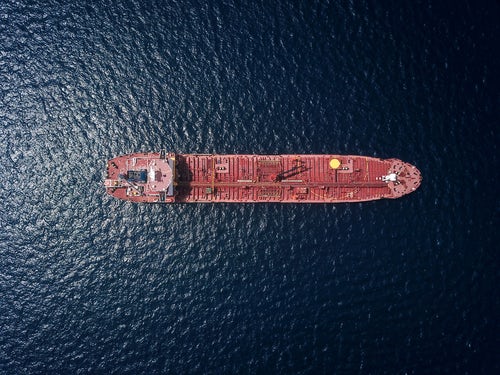
The mid-size oil tanker capable of carrying one million barrels of oil was reportedly moving toward one of Iraq’s oil terminals when it changed course and is currently anchored close to Saudi Arabia.
Experts are skeptical that U.S. allies will get on board.
In the wake of alleged aggression from Iran in the Persian Gulf, U.S. Secretary of State Mike Pompeo rolled out a new plan this week, dubbed “Sentinel,” to recruit U.S. partners to help enhance security for ships traversing the Strait of Hormuz and other choke points.
But experts are skeptical that the United States can get allies in the Gulf, Europe, or Asia to shore up the resources needed to make a significant difference to the commercial vessels facing threats from Tehran in the world’s busiest shipping lanes.
Questioning the longstanding American policy of defending maritime security in the Persian Gulf, President Donald Trump said Tuesday that the United States does not “need to be there” for merchant shipping in the region.
“China gets 91% of its Oil from the [Strait of Hormuz], Japan 62%, & many other countries likewise. So why are we protecting the shipping lanes for other countries (many years) for zero compensation. All of these countries should be protecting their own ships on what has always been a dangerous journey,” he wrote in a Twitter post on Tuesday morning. “We don’t even need to be there in that the U.S. has just become (by far) the largest producer of Energy anywhere in the world!”
The United States is launching a new maritime security initiative for the Persian Gulf region to counter the threat of Iranian attacks on shipping, a State Department official told reporters Monday. During previous regional conflicts, the U.S. Navy has periodically provided escorts for merchant shipping through the Strait of Hormuz, but this effort would be multilateral, according to the official.
The new program, called Sentinel, would be implemented with both material assets and monetary contributions from participating nations. The participants have not yet been named, but the official said that Secretary of State Mike Pompeo would seek the support of Saudi Arabia on Monday during a visit to Jeddah.
The Financial Times reports that the recent incidents in the Gulf of Oman have seen a rise in calls to maritime security companies by concerned shipping firms.
Since the attacks on the Front Altair and Kokuka Courageous, shipping companies who transit the region on a regular basis have been looking into additional protection for their vessels. During the height of Somali piracy in the region, it was the norm for the merchant marine to employ teams of armed guards in order to deter any potential attack, and it worked. No merchant vessel with armed guards has ever been hijacked in the Indian Ocean. That, combined with more aggressive and visible patrolling by the international naval forces present in the region, has seen the issue of piracy off Somalia reduce considerably since 2012.
The current threat, believed to be from Iran’s IRGC – an accusation denied by Iran – is leading to an increase in demand for armed protection services, a sector which has suffered considerably from rate cuts and an influx of cheaper personnel in recent years.
The main UK Private Maritime Security Companies (PMSC), such as Ambrey Risk and MAST report an increase in demand from previous and prospective clients keen to ensure the safety of their ships in the region.
While a team of armed guards is no match for the IRGC, even an unarmed security detail can offer additional security. Well trained guards on Watch duties can spot threats that crew might miss or dismiss as the local pattern of life and, while engaging hostile state actors is unlikely, they can offer the Master an early warning system that he may lack.
With the situation in the region fluid, it’s possible that a convoy escort programme, similar to that used in the Internationally Recognised Transit Corridor (IRTC) in the Gulf of Aden may be adopted, with support from the US Navy. Russia, China, South Korea and Japan’s MSDF have all run escorts through the Gulf of Aden, and a multi-national force may be more palatable to states bordering Iran.
However, nothing has been officially announced, leaving the shipping industry scrambling to come up with its own solutions, as is so often the case. The threat posed to vessels in the region continues to be real and the situation dangerous for crews.
A US military surveillance drone has been shot down by Iranian forces while flying over the Strait of Hormuz.
Iran’s Islamic Revolution Guards Corps (IRGC) said the drone had violated Iranian airspace. But US military said it had been over international waters.
IRGC commander-in-chief Maj-Gen Hossein Salami said the downing of the drone sent a “clear message to America” that Iran’s borders were its “red line”.
It comes at a time of escalating tension between the US and Iran.
On Monday, the US defence department said it was deploying 1,000 extra troops to the region in response to “hostile behaviour” by Iranian forces.
The US has also accused Iran of attacking two oil tankers with mines last Thursday just outside the Strait of Hormuz, in the Gulf of Oman. Iran rejects the allegation.
It was the second time in a month tankers have been attacked close in the region, through which a fifth of the world’s oil passes each day.
Tensions were further fuelled on Monday when Iran announced its stockpile of low-enriched uranium would next week exceed limits it agreed with world powers under a landmark nuclear deal in 2015.
Iran stepped up its production in response to tightening economic sanctions from the US, which unilaterally withdrew from the deal last year.
The drone was identified by the IRGC as a RQ-4 Global Hawk, but the US military official told Reuters news agency the drone was a US Navy MQ-4C Triton, a maritime patrol and reconnaissance aircraft based on the RQ-4B Global Hawk.
Later, in a speech carried live on Iranian state TV, Gen Salami warned the US that it needed to respect Iran’s territorial integrity and national security.
“The downing of the American drone was a clear message to America… our borders are our red line and we will react strongly against any aggression.”
He added: “Iran is not seeking war with any country, but we are fully prepared to defend Iran.”
Is this the first time Iran has targeted a US drone?
The drone had earlier observed a fire on board the other tanker, the Front Altair.
The previous week, another US MQ-9 Reaper was shot down over Yemen by a surface-to-air missile fired by the Iran-backed rebel Houthi movement.
The US military said the altitude of the engagement “indicated an improvement over previous Houthi capability, which we assess was enabled by Iranian assistance”. Iran denies providing weapons to the Houthis.
In 2011, Iran said it had captured a US RQ-170 Sentinel reconnaissance drone that had been reported lost by US forces in neighbouring Afghanistan. It developed its own version of the drone, one of which was shot down by Israel last year.
The recent spike in attacks on tankers near the Persian Gulf is inflating insurance premiums for ships transiting through the wider Middle East, increasing the cost of transporting oil from the region.
Insurance rates for crude oil tankers loading in the Middle East are now up to 20 times higher following the latest attacks.
DUBAI (Reuters) – The two oil tankers crippled in attacks in the Gulf of Oman last week that Washington and Riyadh have blamed on Iran are being assessed off the coast off the United Arab Emirates before their cargos are unloaded, the ships’ operators said on Sunday.
Damage assessment on Japan’s Kokuka Courageous and preparation for ship-to-ship transfer of its methanol cargo would start after authorities in Sharjah, one of the UAE’s seven emirates, complete security checks, Bernhard Schulte Shipmanagement said.
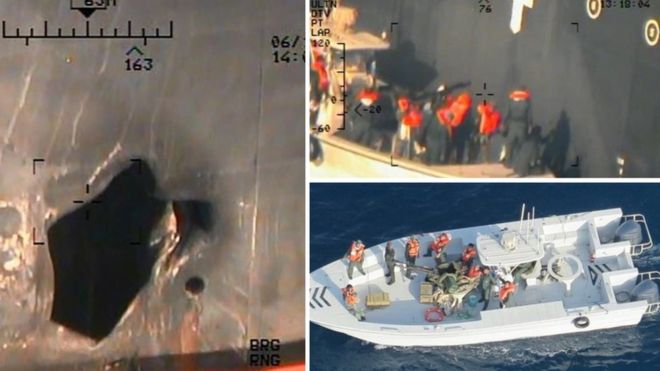
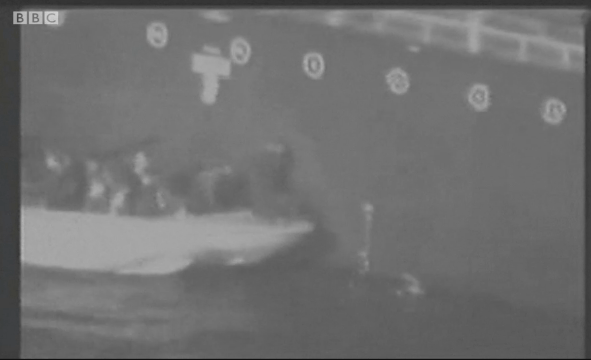
The US military has released a video which it says shows Iran’s Revolutionary Guard removing an unexploded mine from the side of an oil tanker damaged in an attack in the Gulf of Oman on Thursday.
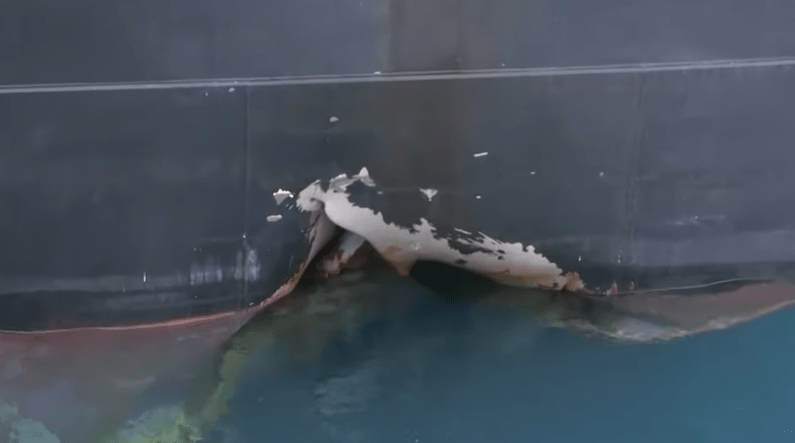
US officials also shared a photo of the Japanese tanker, apparently showing the unexploded mine before it was removed.
A Norwegian tanker was also damaged.
The US accused Iran of being behind the mine attacks. Iran said it “categorically rejects” the allegation.
The blasts came a month after four oil tankers were damaged in an attack off the coast of the United Arab Emirates. The US blamed Iran for that attack, but did not produce evidence. Iran also denied those accusations.
Tensions between the two countries have escalated significantly since US President Donald Trump took office in 2017. He abandoned a nuclear deal that was brokered by the Obama administration and imposed heavy sanctions on Iran.
Oil prices jumped as much as 4% after Thursday’s incident. The Gulf of Oman lies at one end of a vital shipping lane through which a third of the world’s transported oil – worth hundreds of millions of dollars – passes every year.
What we know about the explosions
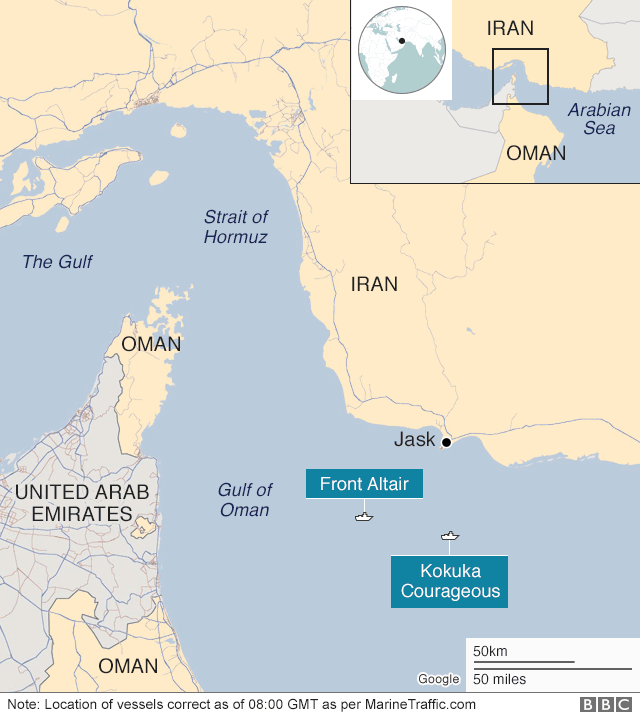
According to the US account of events, US naval forces in the region received distress calls from the Norwegian-owned Front Altair at 06:12 local time (02:13 GMT) and from the Kokuka Courageous at 07:00, following explosions, and moved towards the area.
It said the USS Bainbridge observed Iranian naval boats operating in the area in the hours after the explosions, and later removing the unexploded mine from the side of the Kokuka Courageous.
The crews of both vessels were evacuated to other ships nearby. Both Iran and the US later released pictures showing rescued crew members on board their vessels.
The operator of the Kokuka Courageous, BSM Ship Management, said its crew abandoned ship after observing a fire and an unexploded mine.
The Kokuka Courageous was about 20 miles off the Iranian coast when it sent its emergency call.
The Front Altair was carry naphtha, a petrol product, from the United Arab Emirates to Taiwan. The Kokuka Courageous was carrying methanol from Saudi Arabia to Singapore.
What did the US say?
US Secretary of State Mike Pompeo said at a news conference in Washington: “It is the assessment of the United States that the Islamic Republic of Iran is responsible for the attacks.
“This assessment is based on intelligence, the weapons used, the level of expertise needed to execute the operation, recent similar Iranian attacks on shipping, and the fact that no proxy group operating in the area has the resources and proficiency to act with such a high degree of sophistication.”
UK Foreign Secretary Jeremy Hunt said his country’s “starting point” was to “believe our US allies”.
“We are taking this extremely seriously and my message to Iran is that if they have been involved it is a deeply unwise escalation which poses a real danger to the prospects of peace and stability in the region,” Mr Hunt said.
How did Iran respond?
In a statement released on Friday, the Iranian mission to the United Nations said it rejected what it called an “unfounded” and “Iranophobic” allegation by the US.
“Iran categorically rejects the US’ unfounded claim with regard to 13 June oil tanker incidents and condemns it in the strongest possible terms,” the statement said.
Foreign Minister Javad Zarif on Twitter accused the US of making an allegation “without a shred of factual or circumstantial evidence” and attempting to “sabotage diplomacy”.
The alleged attacks took place as Iran’s Supreme Leader Ayatollah Ali Khamenei was meeting Japan’s Prime Minister Shinzo Abe during a two-day visit by Mr Abe to Iran.
The United Arab Emirates has told the UN Security Council a “state actor” was most likely behind attacks on four tankers off its coast.
The 12 May attacks bore the hallmarks of a “sophisticated and co-ordinated operation”, according to its report.
The UAE did not say who it thought was behind the attacks, which also targeted vessels from Saudi Arabia and Norway.
The US has accused Iran of being behind the attacks but Tehran denies this and has called for an investigation.
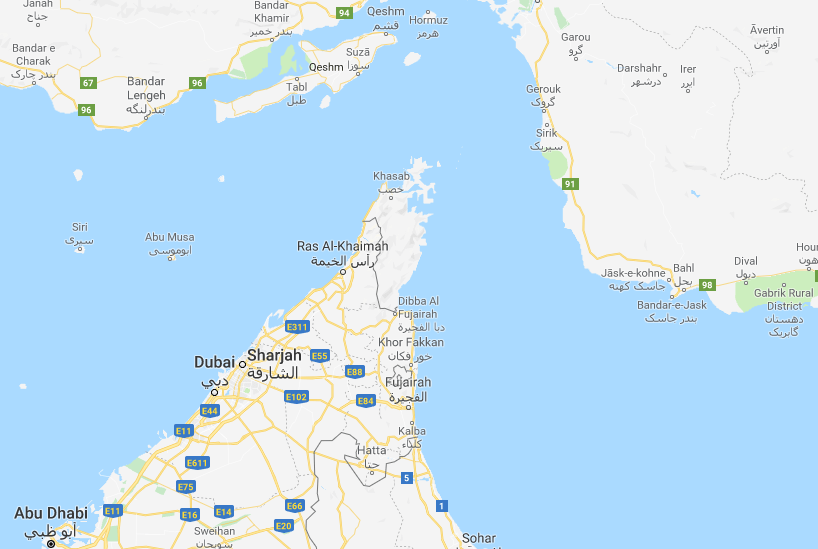
The attacks took place within UAE territorial waters east of the emirate of Fujairah, just outside the strategically vital Strait of Hormuz, in what the UAE called a “sabotage attack”.
They exacerbated long-standing tensions between Iran, and the US and its allies in the Gulf.
What does the report say happened?
According to the UAE-led investigation, which was presented to a closed session of the UN Security Council in New York, the attacks showed a “high degree of sophistication”.
“The attacks required the expert navigation of fast boats” which “were able to intrude into UAE territorial waters”, the report’s preliminary findings say.
Divers were used to attack the ships using limpet mines in order to cause damage but not cause a major explosion, the presentation says.
There were no casualties but Saudi Arabia has said two of its ships suffered “significant” damage. Another tanker was Norwegian-registered, while the fourth was UAE-flagged.
Why is Iran being accused?
The attacks happened at a time of escalating tension between the US and Iran, long-time foes.
They took place days after the US sent warships and bombers to the region in response to what it said was an unspecified plan by Iran to attack US forces in the area.
While it is unclear why Iran would carry out a relatively low-level attack on the multinational tankers, observers have speculated that it could have been to send a signal to forces ranged against it that it is capable of disrupting shipping there without triggering a war.
Responding to the UAE report, the Saudi Ambassador to the UN, Abdallah Y al-Mouallimi, said the kingdom believed “that the responsibility for this action lies on the shoulders of Iran. We have no hesitation in making this statement,” Reuters news agency reported.
However, Mr Bolton, long known for his hawkish stance on Iran, denied the Trump administration was seeking to overthrow the Iranian government.
“The policy we’re pursuing is not a policy of regime change,” he told reporters last week during a visit to London. “That’s the fact and everybody should understand it that way.”
Iran’s foreign ministry has rejected the US accusations as “ludicrous” and accused Mr Bolton of being a “warmonger”.
The decision was intended to bring Iran’s oil exports to zero, denying the government its main source of revenue.
US President Donald Trump reinstated the sanctions a year ago after abandoning the landmark 2015 nuclear deal that Iran agreed with six nations – the five permanent members of the UN Security Council and Germany.

 Maritime Security News