Naval forces from 33 countries came together for exercise Obangame Express to work on countering piracy, drug trafficking, and illegal fishing, which are common in the Gulf of Guinea.
Andréa Barretto
The Brazilian Navy (MB, in Portuguese) participated in the multinational exercise Obangame Express, on the African Coast, for the sixth time. Since 2010, the training gathers naval forces from Africa, Europe, and the Americas. The objective is to boost regional cooperation and promote maritime domain awareness.
The African Coast faces issues such as drug, arms, and human trafficking; illegal fishing, and piracy. During the two-week exercise, Obangame also develops information sharing standards and vessel interdiction expertise, to counter illegal activities at sea.
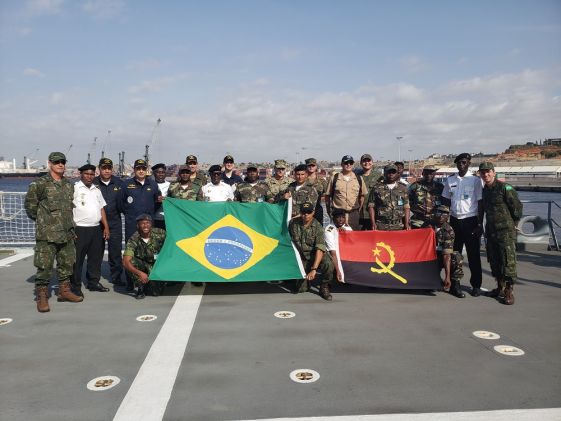
Brazilian Navy and Angolan Navy service members raise their country flags, on board the Brazilian ship Araguari, deployed for exercise Obangame Express 2019. (Photo: Brazilian Navy)
The Ghana Navy and the Marine and Railways Unit of the Ghana Police Service have assured the public of continues service to safeguarding the port space and Ghana’s territorial waters.
This was said when, the Flag officer in charge of the Eastern Naval Command, Commodore James Kontoh and the Commander of the Marine, Port and Railways Unit of the Ghana Police Service, Chief Superintendent Joseph Ababio participated in Eye on Port’s live broadcast on national television, that seeks to bring port and maritime activities more closer to the public.
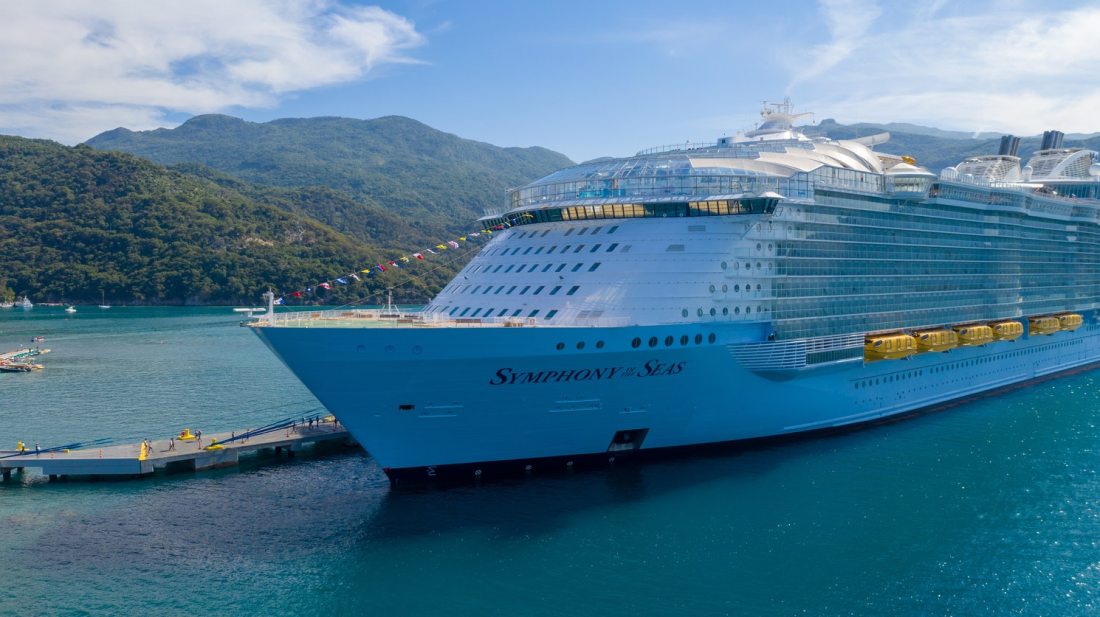
COLOMBO, June 11 (Xinhua) — Sri Lanka’s leading tour operators said on Tuesday that luxury cruise ships have begun calling at Sri Lanka’s ports following the improved security situation in the island country after the Easter terror attacks on April 21 which killed over 250 people.
Aitken Spence Maritime, agents for Hapag-Lloyd, was quoted by local media as saying that the shipping groups MS Europa 2 cruise ship called at Sri Lanka’s Colombo Port in the capital and Hambantota port in the south recently with 309 passengers and 356 crew onboard.
Following the increasing rate of piracy and hijacking of the crew for ransom in Nigerian waters, especially in the Gulf of Guinea, Indian Directorate General of Shipping in Mumbai, has issued a restriction on all seafarers who are Indian nationals, banning them from working in vessels in Nigeria and the Gulf of Guinea.
In a circular sent to all shipping owners, shipping companies and other practitioners which was signed by the Director-General of Shipping in India, Capt Anish Joseph, the state reportedly observed that there was an increasing trend in the number of incidents taking place inside the various coastal states jurisdiction in the GoG.
The geographic mandate of the Contact Group on Piracy off the Coast of Somalia (CGPCS) might be broadened to combat piracy in the Gulf of Guinea, Russia‘s Deputy Permanent Representative to the UN Dmitry Polyanskiy said during UN Security Council consultations on the situation in the Central African region.
“Our country has had a positive experience in international efforts to fight piracy in the northwestern part of the Indian Ocean as part of the Contact Group on this fight off the coast of Somalia. We hope that this experience might be useful for resolving similar issues in the Gulf of Guinea, including in the context of possibly broadening the geographic mandate of the Contact Group to include the Gulf of Guinea,” Polyanskiy said on Tuesday.
The Nigerian Navy has recruited 1,176 young men and women to aid the fight against sea pirates and oil bunkers in the nation’s maritime domain.
The Chief of Defence Staff, General Abayomi Olonisakin, stated this in a statement made available to The Tide shortly after the passing out parade of Batch 28, Basic Training School in Onne. He said the trainees underwent rigorous physical and mental training for seven months to prepare them for internal security operations across the country.
Bonny – The Nigerian Navy has called for more effective collaboration between security agencies and the people to tackle crime in Rivers.
The navy decried the upsurge in criminality across various communities and on waterways, express optimisms that it would be successful, if the residents were fully involved. Capt. Kolawole Oguntuga, the Commanding Officer, Forward Operating Base, Bonny, made the call on Thursday at the inauguration of a free medical outreach on Thursday in Bonny Local Government Area of Rivers.
THE Federal Government will begin the deployment of anti-piracy equipment in the nation’s Maritime sector by June 2019.
Disclosing this on Tuesday in Lagos during a stakeholders meeting tagged ‘Regulating The Maritime Industry For a Better Nigeria’, the Honourable Minister of Transportation, Rt. Hon. Rotimi Amaechi revealed that the situation as regards insecurity in the nation’s maritime sector is very bad as of now.
“The need for a strong maritime security presence in the High-Risk Area remains critical for the deterrence and prevention of future incidents and attacks.”
Rear Admiral Antonio Martorell Lacave
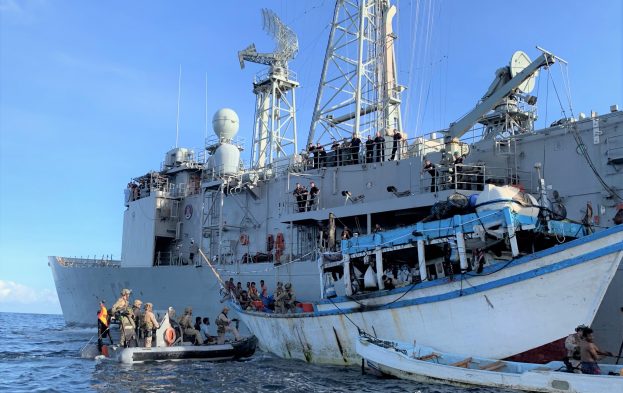
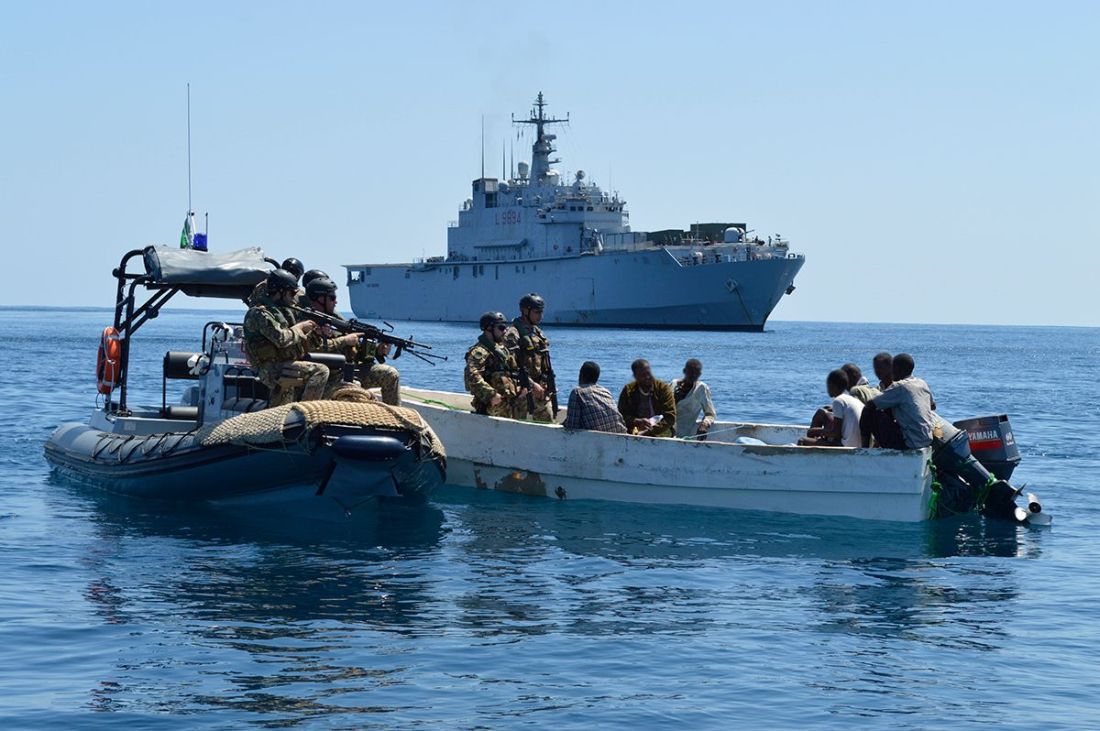
On 21 April, suspected pirates seized a fishing dhow off the coast of Somalia, holding 23 people hostage. In a matter of hours, the European Union’s counter-piracy force EU NAVFOR Somalia Operation Atalanta had responded to the attack. Two days later, the incident was over; Operation Atalanta had detained five suspects and released 23 hostages.
An Attack Dismantled
The incident began when five suspected pirates captured a fishing dhow off the coast of Somalia. The suspects proceeded to navigate the dhow along the coast, where they visited a pirate base camp and reinforced their crew with additional members. Next, using the captured dhow as a mother ship, the suspects attacked another fishing vessel, the FV Adria. This attack took place in the Indian Ocean, some 280 nautical miles off the coast of Somalia.
In self-preservation, FV Adria then conducted evasive manoeuvres and increased its speed. Another fishing vessel, the FV Txori Argi was also operating in the vicinity at the time and assisted the FV Adria as the suspects continued to chase her. After approximately one hour, the suspects approached both fishing vessels and attacked them with a rocket-propelled grenade. The Private Armed Security Teams (PAST) on board the FV Adria and the FV Txori Argi responded, and the suspects retreated.
That same day, EU NAVFOR dispatched its Maritime Patrol Aircrafts (MPRAs) and conducted a regional search, through which they were able to successfully identify and track the captured mother ship.
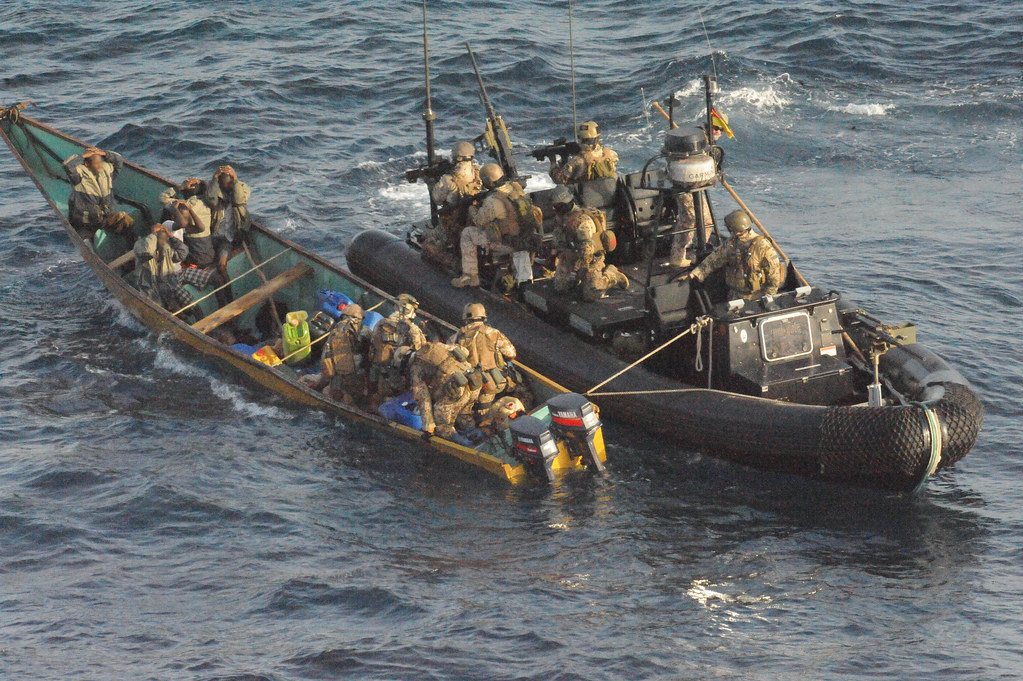
On 23 April, in collaboration with its MPRAs, EU NAVFOR’s flagship ESPS NAVARRA was able to approach, intercept and board the captured fishing vessel. With the support of the PAST and EU NAVFOR’s various active assets in the region—including the frigate ESPS NAVARRA and MPRAs German JESTER and Spanish CISNE—Operation Atalanta was able to control the situation and prevent any further imminent attacks.
“This incident clearly demonstrates that piracy and armed robbery at sea off the coast of Somalia have not been eradicated,” said Operation Commander Rear Admiral Antonio Martorell Lacave in an interview. “The need for a strong maritime security presence in the High-Risk Area remains critical for the deterrence and prevention of future incidents and attacks.”
Following the attack, Operation Atalanta urged the maritime industry to remain vigilant across the High-Risk Area and to comply with recommended Best Management Practises for Protection against Somalia Based Piracy, as supported by EU NAVFOR’s Maritime Security Centre Horn of Africa (MSCHOA). MSCHOA last updated the Best Management Practises for public reference in 2015, at the height of piracy attacks in the High-Risk Area.
Behind The Scenes
Lesser known to the public, however, was the fact that at the time of these attacks in April, Operation Atalanta was still in the midst of an important transition. Just three weeks before the attack—the first since October of last year—Operation Atalanta officially moved from its previous Operation Headquarters (OHQ) in Northwood, U.K., to its new OHQ in Rota, Spain. MSCHOA also moved from OHQ in Northwood to Brest, France, although it remains under command of OHQ in Rota. Additionally, the operation transferred command from Major General Charlie Stickland, UK Royal Marines, to Rear Admiral Antonio Martorell Lacave, Spanish Navy.
Lesser known to the public, however, was the fact that at the time of these attacks in April, Operation Atalanta was still in the midst of an important transition. Just three weeks before the attack—the first since October of last year—Operation Atalanta officially moved from its previous Operation Headquarters (OHQ) in Northwood, U.K., to its new OHQ in Rota, Spain. MSCHOA also moved from OHQ in Northwood to Brest, France, although it remains under command of OHQ in Rota. Additionally, the operation transferred command from Major General Charlie Stickland, UK Royal Marines, to Rear Admiral Antonio Martorell Lacave, Spanish Navy.
The handover and transfer of command was a careful process that lasted nearly a year in its entirety. After all arrangements for location, staffing and training were complete, the transitional phase also involved one month of parallel operational running between Northwood and Rota. However, one would never know it by the operational fluidity that the headquarters maintained throughout the process, and continues to demonstrate today. Highly skilled staff—some from the previous OHQ in Northwood, UK and some new to Operation Atalanta—maintained near perfect continuity throughout the transition.
Operation Atalanta Commander Rear Admiral Martorell Lacave says the manner in which Operation Atalanta handled this first piracy attack in its new OHQ is representative of the commitment and responsibility each branch of the operation feels to their duty.
“I am very confident in the capabilities of the staff in all branches of EU NAVFOR’s Operation and Force Headquarters,” he said. “As we have seen with this most recent incident, we continue to provide the same level and quality of operational outputs from Rota as were previously provided in Northwood.”
From Southeast Asia and the Indian Ocean to Latin America and the Caribbean, the developing world is paying a price for maritime piracy and pilfering. Southeast Asia was home to two-fifths of the world’s pirate attacks between 1995 and 2013, while the waters off Africa remain a watery version of the Wild West.



 Maritime Security News