ZAMBOANGA CITY, Philippines — The new leadership of the military’s Western Mindanao Command will rest the weight of its campaign in Sulu, considered among the remaining problem areas in Mindanao, its outgoing commander Lt. Gen. Arnel dela Vega said.
Dela Vega, who opted for early retirement from the service, will be replaced by Maj. Gen. Cirilito Sobejana in a change of command ceremony on Friday.
KUALA LUMPUR, Malaysia — Abu Sayyaf gunmen released nine hostages after finding that they were Bajau fishermen who had no money to pay for their ransom, Malaysian and Philippine officials said on Saturday.
The military said the nine men were found walking along a road in Talipao, Sulu, on Friday, three days after they were abducted in waters off Lahad Datu in Borneo on June 18.
KUALA LUMPUR (Bernama): Eight men have been arrested to help in investigations into the kidnapping of 10 Bajau Laut fishermen (sea gypsies) in Felda waters in Lahad Datu, Sabah on Tuesday (June 18), says CID director Datuk Huzir Mohamed.
He said six of those arrested are foreigners, aged between 17 and 60, who were spared by the armed kidnappers on Tuesday.
The seas off West Africa’s oil-rich coastline are now the most dangerous in the world for shipping, according to a new report.
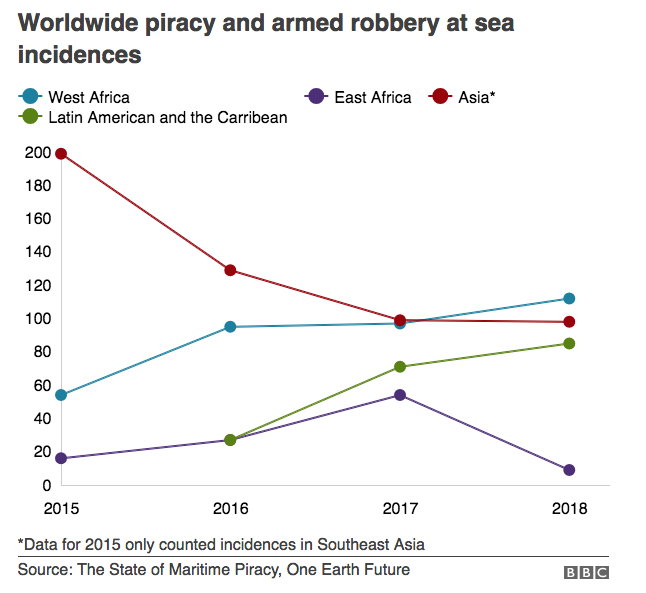
One Earth Future, which produces an annual State of Maritime Piracy, says that while attacks have been falling substantially in some regions of the world, in West Africa they’ve been on the rise and are now more frequent than anywhere else.
So why the increase in West Africa, and what shipping is being targeted?
What is piracy?
A strict definition of maritime piracy only includes attacks on shipping on the high seas – that is, more than 12 nautical miles off the coastline and not under the jurisdiction of any state.
Inside a country’s territorial waters and within port facilities, these attacks are defined as armed robberies at sea.
However, the data we’ve used from this latest report combines these two sets of data to give an overall picture of incidents at sea both inshore and offshore.
In 2018, there were 112 such incidents in West African waters.
It’s not just the huge tankers exporting oil and gas from Nigeria and Ghana that are targeted.
Commercial ships from smaller countries are also in the sights of the pirates.
At a recent event in London, President Faure Gnassingbé of Togo – a country sandwiched between these two regional giants – highlighted his own concerns at the rise in attacks on regional shipping.
“Our region is distinguished by the resurgence of transnational criminality on the high seas in the Gulf of Guinea,” said Mr Gnassingbé.
Why are attacks rising?
Most of the attacks have been against ships involved in oil and gas transportation, such as tankers, bulk carriers and tugs. Fishing vessels have also been targeted.
The coastline off Nigeria saw the most attacks in 2018. This is partly because of “petro-piracy”, targeting tankers from Nigeria’s rich oil and gas fields.
There were also incidents reported at the loading and anchorage facilities in the Nigerian port of Lagos.
Piracy in the form of hijacking and kidnapping for ransom payments was also common off the coasts of Benin, Ghana, Nigeria, Congo-Brazzaville and Cameroon.
Rich pickings at sea, political instability, the lack of law enforcement and poverty on land are all factors which have contributed to the increase in piracy.
Most of the seafarers affected are not from the region. Around half are from the Philippines, followed by India, Ukraine and Nigeria.
One of the reasons West Africa is now the number one spot for piracy is because of of the downward trends recorded elsewhere.
The East African shipping routes along the Somali coastline have been notorious for hijackings and robberies.
But since peaking in 2011, rates of piracy there have fallen off dramatically in recent years.
Local efforts on land in Somalia to change attitudes towards permitting piracy and building legal capacity to prosecute criminals have also helped improve the situation.
In Asia, the Malacca Strait, a busy, commercially important stretch of water between Malaysia and Indonesia, experienced a high number of attacks in 2015.
Concerted action by regional naval forces has reduced the problem there, but piracy still persists.
Attacks against shipping in the Caribbean and off the coast of Latin American have, however, risen.
Venezuela in particular has become a hotspot for piracy.
“Political and economic instability is a big factor there,” says Lydelle Joubert, an expert on piracy at One Earth Future.
Reports coming from Sabah suggest that Abu Sayyaf Group terrorists have kidnapped 10 crew from two fishing boats early on Tuesday 18th.
Media reports state that the incidents near Borneo Island, when two speedboats approached two fishing vessels. “Pirates” boarded the boats at around 2am LT, confiscated documents likely to relate to the nationality of the crew members, and then took 10 hostages before fleeing towards Sitangkai Island in the Philippines. The fishing boats were believed to be operating during curfew hours without a permit, according to a report in The Straits Times. The remaining crew were picked up by the MMEA.
The incident comes after a prolonged lull in kidnapping activities by the group. However, the loss of hostages in recent rescues and killings would suggest that the group is now looking to increase its funds by further Kidnap For Ransom efforts.
The incident prompted Sabah Chief Minister Datuk Seri Mohd Shafie Apdal to call for further security measures in Sabah, an area which has seen cross border criminality and kidnapping at sea in recent years.
MANILA, Philippines — The Philippine Marines Corps (PMC) is sending another battalion to Sulu to help in the operations against Abu Sayyaf bandits in the province and nearby areas.
Capt. Felix Serapio Jr., PMC spokesman, said the 8th Marine Battalion Landing Team (MBLT-8) is ready for deployment in Sulu after a nine-month training in Manila.
ZAMBOANGA CITY — Police arrested Wednesday three members of the Abu Sayyaf Group (ASG) in this southern port city.
The Police Regional Office-9 (PRO-9) identified the arrested ASG members as Jamik Ibrahim, Majuk Amil, and Hasim Aming. Ibrahim and Amil were arrested in Barangay Arena Blanco, while Aming in Magay, Barangay Zone 1.
ZAMBOANGA CITY — Government troops recovered an arms cache belonging to Abu Sayyaf Group (ASG) bandits in an island off Sulu province, a top military official said Wednesday.
Major Gen. Divino Rey Pabayo, Joint Task Force Sulu commander, said the arms cache was discovered in Minis Island, Patikul, Sulu at about 7:45 a.m. Monday.
Ewold Horn‘s death in the Philippines can be blamed on the Dutch government, according to Warren Rodwell from Australia, a former hostage of terrorist movement Abu Sayyaf. The fact that the 54-year-old Dutch man was still a hostage of Abu Sayyaf after seven years shows that the Dutch government did not put enough effort into getting him released, Rodwell said to Dagblad van het Noorden.
Horn was abducted by members of Abu Sayyaf during a bird watching trip on the Philippine islands in 2012. He was shot dead on Friday when he tried to escape during a firefight between the terrorist group and Philippine government forces.


 Maritime Security News