UAE tanker attacks blamed on ‘state actor’

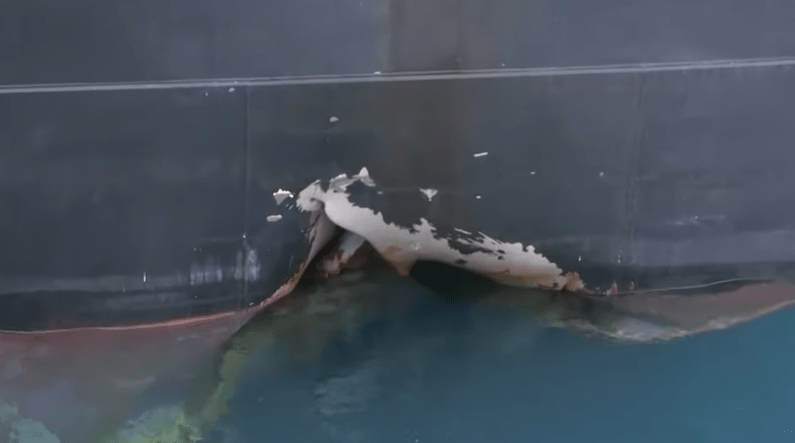
The United Arab Emirates has told the UN Security Council a “state actor” was most likely behind attacks on four tankers off its coast.

The 12 May attacks bore the hallmarks of a “sophisticated and co-ordinated operation”, according to its report.

The UAE did not say who it thought was behind the attacks, which also targeted vessels from Saudi Arabia and Norway.

The US has accused Iran of being behind the attacks but Tehran denies this and has called for an investigation.

The attacks took place within UAE territorial waters east of the emirate of Fujairah, just outside the strategically vital Strait of Hormuz, in what the UAE called a “sabotage attack”.

They exacerbated long-standing tensions between Iran, and the US and its allies in the Gulf.

What does the report say happened?

According to the UAE-led investigation, which was presented to a closed session of the UN Security Council in New York, the attacks showed a “high degree of sophistication”.

“The attacks required the expert navigation of fast boats” which “were able to intrude into UAE territorial waters”, the report’s preliminary findings say.

Divers were used to attack the ships using limpet mines in order to cause damage but not cause a major explosion, the presentation says.

There were no casualties but Saudi Arabia has said two of its ships suffered “significant” damage. Another tanker was Norwegian-registered, while the fourth was UAE-flagged.

Why is Iran being accused?

The attacks happened at a time of escalating tension between the US and Iran, long-time foes.

They took place days after the US sent warships and bombers to the region in response to what it said was an unspecified plan by Iran to attack US forces in the area.

While it is unclear why Iran would carry out a relatively low-level attack on the multinational tankers, observers have speculated that it could have been to send a signal to forces ranged against it that it is capable of disrupting shipping there without triggering a war.

Responding to the UAE report, the Saudi Ambassador to the UN, Abdallah Y al-Mouallimi, said the kingdom believed “that the responsibility for this action lies on the shoulders of Iran. We have no hesitation in making this statement,” Reuters news agency reported.

US National Security Adviser John Bolton previously said “naval mines almost certainly from Iran” were to blame for the damage, although he provided no evidence to support the allegation.

However, Mr Bolton, long known for his hawkish stance on Iran, denied the Trump administration was seeking to overthrow the Iranian government.

“The policy we’re pursuing is not a policy of regime change,” he told reporters last week during a visit to London. “That’s the fact and everybody should understand it that way.”

Iran’s foreign ministry has rejected the US accusations as “ludicrous” and accused Mr Bolton of being a “warmonger”.

What are the underlying tensions?

At the start of May, Washington ended exemptions from sanctions for countries still buying oil from Iran.

The decision was intended to bring Iran’s oil exports to zero, denying the government its main source of revenue.

US President Donald Trump reinstated the sanctions a year ago after abandoning the landmark 2015 nuclear deal that Iran agreed with six nations – the five permanent members of the UN Security Council and Germany.

Iran has now announced it will suspend several commitments under the deal.

Source: bbc.co.uk

Fmr Abu Sayyaf hostage blames Dutch man’s death on lack of gov’t effort

By Janene Pieters

Ewold Horn‘s death in the Philippines can be blamed on the Dutch government, according to Warren Rodwell from Australia, a former hostage of terrorist movement Abu Sayyaf. The fact that the 54-year-old Dutch man was still a hostage of Abu Sayyaf after seven years shows that the Dutch government did not put enough effort into getting him released, Rodwell said to Dagblad van het Noorden.

Horn was abducted by members of Abu Sayyaf during a bird watching trip on the Philippine islands in 2012. He was shot dead on Friday when he tried to escape during a firefight between the terrorist group and Philippine government forces. 

To continue reading, please click here for the original article.

Source: nltimes.nl

Mossad intelligence helped link Iran to UAE tanker sabotage — report

US said set to present evidence on ‘pretty impressive’ attack — including materials gathered by Israel — to UN Security Council

Intelligence materials collected by Israel’s Mossad agency played a role in linking Iran to the sabotaging of four oil tankers off the coast of the United Arab Emirates last month, prompting the United States to accuse Tehran of carrying out the attack, according to a report on Monday.

The US is slated to present the intelligence — including evidence gathered by Israel — in the coming days, likely before the UN Security Council, the Kan public broadcaster said, as tensions between Washington and Tehran continued to simmer.

To continue reading, please click here.

Source: imesofisrael.com

Dutch hostage killed while trying to escape from militants in Philippines

MANILA (Reuters) – A Dutch photographer held hostage by Islamic State-linked militants in the Philippines since 2012 was killed on Friday by his captors when he tried to escape during a firefight on a remote southern island, the military said.

Ewold Horn, a wildlife photographer, was shot by his guards from the Abu Sayyaf group when he tried to flee during a clash between government troops and the militants, said Brigadier General Divino Rey Pabayo, commander of a Joint Task Force on Sulu island.

To continue reading, please click here.

Source: reuters.com

Maritime Security News: You may recall that only ten days ago, a Philippine National Police commander had claimed that Horn had joined the group. More here:
https://maritimesecurity.news.blog/2019/05/21/dutch-hostage-joins-abu-sayyaf/

AFP to deploy 1st Brigade Combat Team in Sulu for anti-ASG ops

By Priam Nepomuceno

MANILA — The military will deploy the 1st Brigade Combat Team (1BCT) to Sulu in line with ongoing efforts to neutralize the Abu Sayyaf Group (ASG) terrorists.

“Now that the election period is over and national candidates have been proclaimed, we are redeploying forces to security challenged areas like Sulu Archipelago for focused military operations,” Armed Forces of the Philippines (AFP) spokesperson, Marine Brig. Gen. Edgard Arevalo said in an interview with reporters Thursday.

To continue reading, please click here.

Source: pna.gov.ph

Iranian naval mines likely used in UAE tankers attacks: Bolton

ABU DHABI (Reuters) – U.S. National Security Adviser John Bolton said on Wednesday that attacks on oil tankers off the coast of the United Arab Emirates this month were the work of “naval mines almost certainly from Iran”.

The UAE has not yet blamed anyone for the sabotage of four vessels, including two Saudi tankers, which was followed two days later by drone strikes on oil pumping stations in Saudi Arabia.

To continue reading, please click here.

Source: reuters.com

Piracy and pilfering at sea

By LLOYD GREEN

From Southeast Asia and the Indian Ocean to Latin America and the Caribbean, the developing world is paying a price for maritime piracy and pilfering. Southeast Asia was home to two-fifths of the world’s pirate attacks between 1995 and 2013, while the waters off Africa remain a watery version of the Wild West.

To put things into perspective, Somali pirates cost East Africa more than US$24 billion between 2010 and 2017, the Horn of Africa remains a pirate hotspot, and West Africa’s Gulf of Guinea has witnessed an explosion in hostage-takings and kidnappings.

To continue reading, please click here.

Source: asiatimes.com

The Deadly Evolution of Abu Sayyaf and the Sea

By Meghan Curran

On the morning of January 27, 2019, two bombs exploded inside the Cathedral of Our Lady of Mount Carmel, in Jolo on the Sulu Province in the southern Philippines. Tearing a hole through the cathedral during a Sunday service, the bombs claimed 20 lives, injured dozens more, and propelled Islamist extremism in the Philippines back into international headlines. In the aftermath of the blast, Philippine president Rodrigo Duterte promised to “pursue to the ends of the Earth the ruthless perpetrators behind [the] dastardly crime,”as the Abu Sayyaf Group (ASG), the country’s notoriously violent Islamic separatist group, claimed responsibility for the attack. While President Duterte may not need to go to the “ends of the Earth” to put an end to the ASG-fueled terror, his government will certainly need to act beyond its own shores. Illicit maritime activities are at the root of ASG funding and operations, and ensuring the group’s defeat will require focused government efforts to improve maritime security in its area of operations.

To continue reading, please click here.

Source: cimsec.org

Dutch hostage joins Abu Sayyaf


SULU:
 Philippine National Police (PNP) Sulu Provincial Commander Pablo Labra reported Saturday that a Dutch hostage abducted by the Abu Sayyaf militants seven years has joined the terrorist group.

Identified as 57-year old Ewold Horn, Labra said the kidnap victim turned outlaw together with Swiss national Lorenzo Vinciguerra were adopted by Abu Sayyaf militants and suspected MNLF members in Tawi-Tawi in 2012.

To continue reading, please click here.

Source:dailyexpress.com.my

Abu Sayyaf Group.

GCC navies begin security patrols in Arabian Gulf amid US-Iran tensions

Saudi Arabian foreign ministry reiterates that it does not want war with Iran, but is prepared for one if need be, as GCC navies step up Arabian Gulf patrols.

GCC countries have begun “enhanced security patrols” in the international waters of the Arabian Gulf, according to the US Navy’s Fifth Fleet.

GCC members were “specifically increasing communication and co-ordination with each other in support of regional naval co-operation and maritime security operations in the Arabian Gulf”, the Bahrain-based fleet said in a statement.

To continue reading, please click here.

Source: logisticsmiddleeast.com