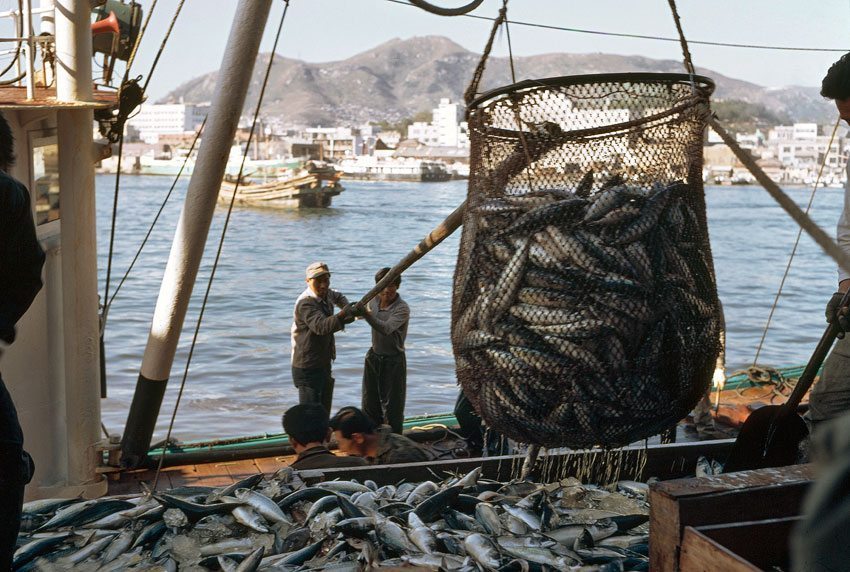
Comprising one-fifth of the earth’s population, China consumes more than a third of the fish pulled from the planet’s waters. With its demand outpacing supply, fisheries from China have joined other nations and set their eyes and their nets on African waters without concern for sovereignty or law.
Africans struggling to emerge from poverty are paying the price for these predations. Mozambique alone has lost 300,000 badly-needed jobs and as much as $3.3 billion in revenue – 10 times the amount East African nations make in legally licensing fishing by foreign vessels, according to the non-profit Stop Illegal Fishing.
DUBAI (Reuters) – The two oil tankers crippled in attacks in the Gulf of Oman last week that Washington and Riyadh have blamed on Iran are being assessed off the coast off the United Arab Emirates before their cargos are unloaded, the ships’ operators said on Sunday.
Damage assessment on Japan’s Kokuka Courageous and preparation for ship-to-ship transfer of its methanol cargo would start after authorities in Sharjah, one of the UAE’s seven emirates, complete security checks, Bernhard Schulte Shipmanagement said.
Western commercial oil exploration in disputed areas of Somalia and discrepancies over which authorities can issue licenses to companies could spark further conflict in the African nation, U.N. monitors warned in a confidential report.
In the U.N. Monitoring Group’s latest annual report to the Security Council’s sanctions committee on Somalia and Eritrea, the experts said the Somali constitution gives considerable autonomy to regional governments to enter commercial oil deals.
By Tope Templer Olaiya, Sulaimon Salau, Gloria Ehiaghe (Lagos) and Rotimi Agboluaje (Ibadan)
Director General of the Nigerian Maritime Administration and Safety Agency (NIMASA), Dakuku Peterside, has said the agency was taking strategic steps to deal with maritime piracy.
He disclosed that the anti-piracy bill, sponsored by NIMASA, has been passed by the National Assembly and as soon as it is signed into law, it would help tame piracy in and open up more opportunities in the sector.
Naval forces from 33 countries came together for exercise Obangame Express to work on countering piracy, drug trafficking, and illegal fishing, which are common in the Gulf of Guinea.
Andréa Barretto
The Brazilian Navy (MB, in Portuguese) participated in the multinational exercise Obangame Express, on the African Coast, for the sixth time. Since 2010, the training gathers naval forces from Africa, Europe, and the Americas. The objective is to boost regional cooperation and promote maritime domain awareness.
The African Coast faces issues such as drug, arms, and human trafficking; illegal fishing, and piracy. During the two-week exercise, Obangame also develops information sharing standards and vessel interdiction expertise, to counter illegal activities at sea.
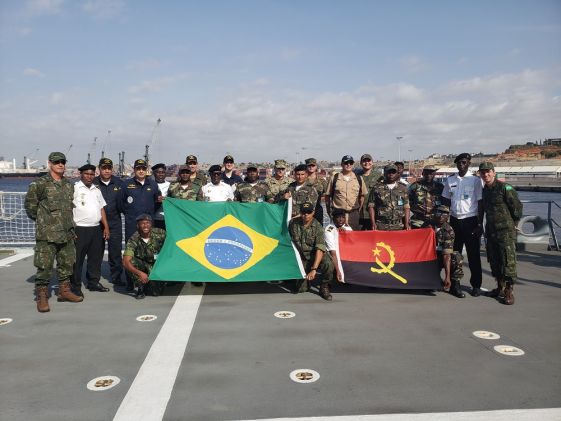
Brazilian Navy and Angolan Navy service members raise their country flags, on board the Brazilian ship Araguari, deployed for exercise Obangame Express 2019. (Photo: Brazilian Navy)
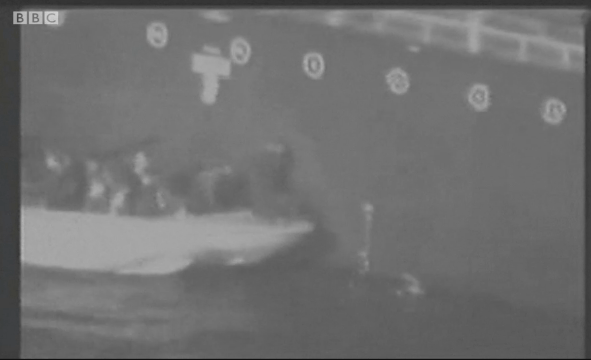
The US military has released a video which it says shows Iran’s Revolutionary Guard removing an unexploded mine from the side of an oil tanker damaged in an attack in the Gulf of Oman on Thursday.
US officials also shared a photo of the Japanese tanker, apparently showing the unexploded mine before it was removed.
A Norwegian tanker was also damaged.
The US accused Iran of being behind the mine attacks. Iran said it “categorically rejects” the allegation.
The blasts came a month after four oil tankers were damaged in an attack off the coast of the United Arab Emirates. The US blamed Iran for that attack, but did not produce evidence. Iran also denied those accusations.
Tensions between the two countries have escalated significantly since US President Donald Trump took office in 2017. He abandoned a nuclear deal that was brokered by the Obama administration and imposed heavy sanctions on Iran.
Oil prices jumped as much as 4% after Thursday’s incident. The Gulf of Oman lies at one end of a vital shipping lane through which a third of the world’s transported oil – worth hundreds of millions of dollars – passes every year.
What we know about the explosions
According to the US account of events, US naval forces in the region received distress calls from the Norwegian-owned Front Altair at 06:12 local time (02:13 GMT) and from the Kokuka Courageous at 07:00, following explosions, and moved towards the area.
It said the USS Bainbridge observed Iranian naval boats operating in the area in the hours after the explosions, and later removing the unexploded mine from the side of the Kokuka Courageous.
The crews of both vessels were evacuated to other ships nearby. Both Iran and the US later released pictures showing rescued crew members on board their vessels.
The operator of the Kokuka Courageous, BSM Ship Management, said its crew abandoned ship after observing a fire and an unexploded mine.
The Kokuka Courageous was about 20 miles off the Iranian coast when it sent its emergency call.
The Front Altair was carry naphtha, a petrol product, from the United Arab Emirates to Taiwan. The Kokuka Courageous was carrying methanol from Saudi Arabia to Singapore.
What did the US say?
US Secretary of State Mike Pompeo said at a news conference in Washington: “It is the assessment of the United States that the Islamic Republic of Iran is responsible for the attacks.
“This assessment is based on intelligence, the weapons used, the level of expertise needed to execute the operation, recent similar Iranian attacks on shipping, and the fact that no proxy group operating in the area has the resources and proficiency to act with such a high degree of sophistication.”
UK Foreign Secretary Jeremy Hunt said his country’s “starting point” was to “believe our US allies”.
“We are taking this extremely seriously and my message to Iran is that if they have been involved it is a deeply unwise escalation which poses a real danger to the prospects of peace and stability in the region,” Mr Hunt said.
How did Iran respond?
In a statement released on Friday, the Iranian mission to the United Nations said it rejected what it called an “unfounded” and “Iranophobic” allegation by the US.
“Iran categorically rejects the US’ unfounded claim with regard to 13 June oil tanker incidents and condemns it in the strongest possible terms,” the statement said.
Foreign Minister Javad Zarif on Twitter accused the US of making an allegation “without a shred of factual or circumstantial evidence” and attempting to “sabotage diplomacy”.
The alleged attacks took place as Iran’s Supreme Leader Ayatollah Ali Khamenei was meeting Japan’s Prime Minister Shinzo Abe during a two-day visit by Mr Abe to Iran.
Oil major, Chevron Nigeria Limited has said crude oil theft, illegal oil refining and pipeline vandalism are major threats to Nigeria’s economy.
Chevron in a position paper presented at a one-day seminar on advocacy against crude oil theft in Warri, Delta State, said these challenges have continued to make it difficult for the country to meet its revenue projection, and at the same time have polluted the environment in the Niger Delta region.
The Ghana Navy and the Marine and Railways Unit of the Ghana Police Service have assured the public of continues service to safeguarding the port space and Ghana’s territorial waters.
This was said when, the Flag officer in charge of the Eastern Naval Command, Commodore James Kontoh and the Commander of the Marine, Port and Railways Unit of the Ghana Police Service, Chief Superintendent Joseph Ababio participated in Eye on Port’s live broadcast on national television, that seeks to bring port and maritime activities more closer to the public.
Issues related to human and drug trafficking, maritime piracy and the legal aspects of combating these challenges are being discussed by experts at the Maritime Information Sharing Workshop, (MISW).
Stressing on the need for greater maritime collaboration, Deputy Chief of the Naval Staff Vice Admiral MS Pawar said there is a need to forge bonds based on trust, between partner countries in the region.
The Norwegian-owned Front Altair had been “attacked”, the Norwegian Maritime Authority said, leading to three explosions on board.
Wu I-fang, a spokesman for Taiwan’s state oil refiner CPC Corp, which chartered the Front Altair, said it was carrying 75,000 tonnes of naphtha and was “suspected of being hit by a torpedo”, although this has not been confirmed. Other unverified reports suggested a mine attack.
The ship’s owner, Frontline, said the Marshall Islands-flagged vessel was on fire but denied reports on Iran media it had sunk.
The operator of the Panama-flagged Kokuka Courageous, BSM Ship Management, said its crew abandoned ship and were rescued by a passing vessel.
The tanker was carrying methanol and was not in danger of sinking, a spokesman said.
It is currently located about 80 miles from Fujairah in the UAE and 16 miles from Iran. The cargo remains intact.
Who came to the rescue?
Iranian state media said Iran had rescued the crew members and they had been taken to the port of Jask.
Iranian Foreign Minister Mohammad Javad Zarif tweeted that the incident happened as Japanese PM Shinzo Abe was meeting Iran’s supreme leader, Ayatollah Ali Khamenei, adding: “Suspicious doesn’t begin to describe what likely transpired this morning.”
The vessels were carrying what Japan trade officials said was “Japan-related cargo”.
The US 5th Fleet, based in Bahrain, said it had sent the USS Bainbridge to assist.
Spokesman Josh Frey said in a statement: “US naval forces in the region received two separate distress calls at 06:12 local time (03:12 GMT) and a second one at 07:00.”
Why is this so sensitive?
The Gulf of Oman lies at one end of the strategic Strait of Hormuz, and this incident will further increase tension in a vital shipping lane through which hundreds of millions of dollars of oil pass.
The US sent an aircraft carrier strike group and B-52 bombers to the region at the start of May in response to what it said was an unspecified plan by Iran-backed forces to attack US forces in the area.
President Donald Trump has taken a hard line towards Iran, accusing it of being a destabilising force in the Middle East.
Iran rejected the claims and has accused the US of aggressive behaviour.
Those tensions rose markedly after the 12 May limpet mine attacks on four tankers off the UAE.
While it is unclear why Iran would carry out a relatively low-level attack on the multinational tankers, observers have speculated that it could have been to send a signal to forces ranged against it that it is capable of disrupting shipping there without triggering a war.





 Maritime Security News