Lift for maritime sector in Kenya and Djibouti after fall in piracy

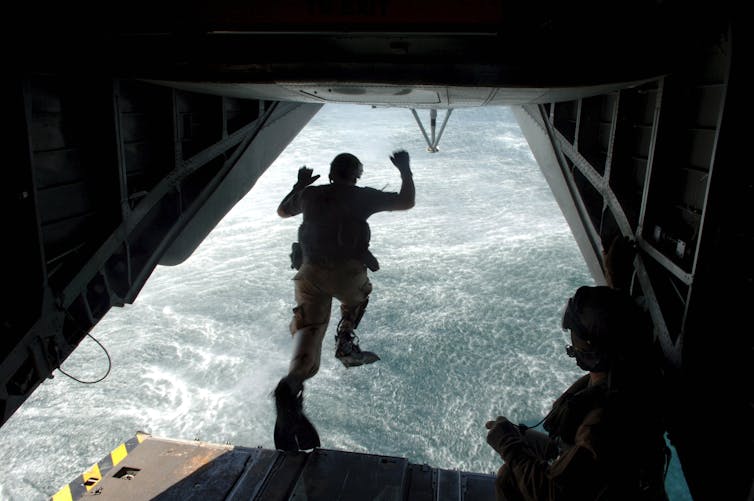
US service members practising water rescue techniques during a routine training exercise off the coast of Djibouti in 2007.
EPA/US NAVY/MC1 MICHAEL R. MCCORMICK

Robert McCabe, Coventry University

The upsurge of Somali piracy after 2005 led to significant international activity in the Horn of Africa. Naval missions, training programmes, capital investment and capacity building projects were among the responses to the threat. States in the region also started to focus on the dangers and opportunities associated with the sea.

Kenya and Djibouti, two states directly affected by piracy, achieved widespread reform of their domestic maritime sectors through new national initiatives and assistance from external partners. Djibouti’s President Ismail Guelleh recently commented during talks with Kenya on security and trade links that

What happens in Somalia has an immediate impact on all of us.

At its height, between 2008 and 2012, it is estimated that Somali piracy cost the Kenyan shipping industry between US$300 million and $400 million every year. This was as a result of increased costs (including insurance) and a decline in coastal tourism. It also damaged Djibouti’s maritime industry, financial sector and international trade.

The upsurge of piracy after 2005 had a number of causes. It grew from poverty and lawlessness in Somalia alongside opportunity and a low risk of getting caught. By 2013 the threat had been reduced. This was due to a combination of naval patrols, private armed guards, self defence measures on board ships and capacity building efforts ashore.

Historically, most states in the Horn of Africa have struggled with limited capacity to address maritime insecurity. Their naval assets, training, human resources, institutional and judicial structures, monitoring and surveillance have all been critically underfunded.

But the international response to piracy – and the investments and partnerships that emerged – have helped some states to improve in these areas.

More importantly perhaps, since the decline in piracy attacks, Kenya and Djibouti have been paying more attention to policies around maritime governance and “blue” economic development. This relates to sustainable use of ocean resources for economic growth, job creation and ocean ecosystem health. The refocus marks a shift from traditional investments related to land based conflict and land borders.

In a recent article, I examine how Kenya and Djibouti reformed their domestic maritime sectors following a decline in acts of piracy. The study sheds new light on the limitations and challenges facing domestic maritime sectors in Africa as well as some of the innovative approaches taken.

A key point is that blue economic growth is not possible without addressing security threats at sea. This includes building a robust maritime security sector, improving ocean health and regulating human activity at sea in a more sustainable way.

International partnerships

Many of the new developments in the region have been supported by international partners. The Djibouti Navy and Coastguard work closely with the US Navy. Together, for example, they are developing capacity for stopping and searching suspicious vessels. This is important in countering the illicit trafficking in people and smuggling of migrants through Djiboutian waters.

Djibouti has also benefited from Chinese direct investment, which accounts for nearly 40% of the funding for its major investment projects. Chinese state-owned firms have built some of Djibouti’s largest maritime related infrastructure projects. These include the Doraleh Multipurpose Port, a new railway connection between Djibouti and Addis Ababa, and the opening of China’s first foreign military facility.

This is a clear example of Beijing prioritising its growing economic and security interests in Africa. And advancing its “massive and geopolitically ambitious” Belt and Road Initiative.

Kenya, too, has received international assistance and investment. This includes support to set up the Regional Maritime Rescue Coordination Centre in Mombasa. Organisations like the International Maritime Organisation have led training for staff from the centre and for the Kenyan Navy.

The United Nations Office on Drugs and Crime has provided law enforcement training for the Kenyan Maritime Police Unit. It also opened a new high-security courtroom in Shimo La Tewa, Mombasa, for cases of maritime piracy and other serious criminal offences.

National refocus

At a national level, there is evidence of a fundamental shift towards building a more secure and sustainable domestic maritime sector.

For example, Kenya has created a new coastguard service. Its job is to police the country’s ocean territory and to ensure that Kenya benefits from its water resources. The country has new naval training partnerships, maritime capacity building projects and an implementation committee to coordinate “blue economic” activities. These include fisheries, shipping, port infrastructure, tourism and environmental protection.

For its part, Djibouti has rapidly developed its maritime sector and recognised the financial benefits of leasing coastal real estate. The country has an ambitious development plan titled “Djibouti Vision 2035”. This sets out its aspiration to become a maritime hub and the “Singapore of Africa”. It’s trading on the fact that it has a similar strategic position along one of the world’s busiest shipping lanes.

All of these approaches require robust laws and regulations governing human activities at sea. They also call for a capable and flexible coastguard and navy to enforce these regulations and secure coastal waters against threats such as piracy, fisheries crime and the illicit smuggling of drugs, weapons and people.

The way forward

There are lessons in the Horn of Africa experience for other regions of Africa facing similar maritime insecurities. One example is the Gulf of Guinea.

The first lesson is that there’s a need to convince coastal states with weak maritime capacities of the untapped potential of the blue economy. Even reputational damage can harm tourism, development and investment in coastal regions. This was clearly illustrated in the case of Kenya.

Blue economic growth needs a safe and secure maritime environment for merchant shipping in particular. It can also help alleviate poverty in coastal regions, provide alternatives to criminal livelihoods, and allow local communities more ownership of issues that affect them.

Ultimately, maritime security and blue economic growth need to be considered as a unified policy issue.The Conversation

Robert McCabe, Assistant Professor, Coventry University

This article is republished from The Conversation under a Creative Commons license. Read the original article.

EU NAVFOR Somalia MPRAs Fly In Support of CTF-151 Focused Operation

This week, EU NAVFOR Somalia Operation ATALANTA’s German Maritime Patrol Reconnaissance Aircraft supported a multi-national counter-piracy operation led by Combined Task Force 151 (CTF 151) in the Gulf of Aden.

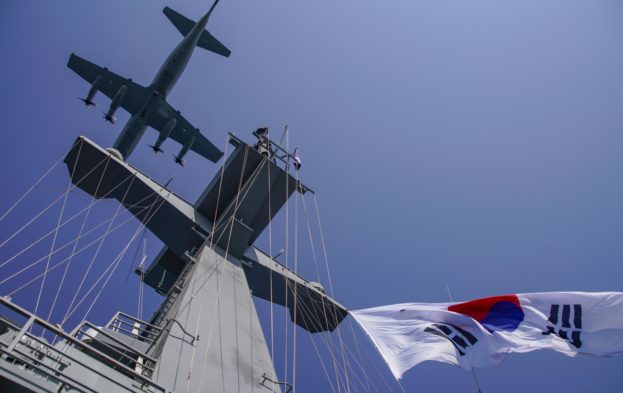
The assets involved in Focused Operation “King Crab” were from nine different nations, and included the Republic of Korea Ship (ROKS) Kang Gam Chan; the Japanese Ship (JS) Sazanami and the Royal Navy of Oman Vessel (RNOV) Al-Dhafreh in support.

The operation was a concentrated effort that spanned over four days and saw the counter-piracy task force and its partners undertake increased counter-piracy patrols and maritime engagement visits to merchant vessels and local dhows. The participating assets also partook in joint training and boarding exercises.

The exercises also reinforced the importance of information-sharing amongst the wide combination of counter-piracy partners.

“Ultimately we all have the same goal of promoting security and stability in the region to legitimate seafarers by defeating piracy and criminal attacks,” said Commander CTF 151, Rear Admiral Byeong-Ju Yu, ROKN. “Focused Operations such as King Crab greatly increase our ability to do this.”

Operation ATALANTA’s MPRAs have now returned to regular operations, patrolling the Indian Ocean, Gulf of Aden, Red Sea and Arabian Sea alongside other EU NAVFOR naval Assets.

Source: eunavfor.eu

Sri Lanka- Head of Avant-Garde’s Maritime Security Division arrested

(MENAFN – Colombo Gazette) The head of Avant-Garde’s Maritime Security Division, Vishwajith Nandana Diyabalanage, was arrested by the Criminal Investigations Department (CID) at the Bandaranaike International Airport (BIA) today.

He was arrested when he returned to the country from Singapore. Diyabalanage was wanted over ongoing investigations into Avant-Garde.

To continue reading, please click here.

Source: menafn.com

Pakistan Maritime Security Agency Recovers 130 Kg Heroin From Boat

Sumaira FH

The Pakistan Maritime Security Agency (PMSA) intercepted a vessel on suspicion of carrying contraband items.

The boat was brought to Karachi where PMSA along with Pakistan Customs inspected the boat and recovered 130 kg of heroin from specially built compartments in the boat, said a statement. The approximate value of the recovered drugs in the international market was Rs. 1300 million.

To continue reading, please click here.

Source: urdupoint.com

The future of Philippine maritime enforcement

Michael van Ginkel

Illicit activity in the Sulu and Celebes Seas continues to pose a daunting maritime security challenge for the Philippines. The recent kidnapping of nine fishermen off the coast of Borneo and the increasingly violent modus operandi of the militant Abu Sayyaf Group (ASG) have raised safety concerns amongst Philippine policy makers and local communities. Although the Philippines has initiated several maritime enforcement initiatives, including the extensive National Coastal Watch System (NCWS), the government needs to enhance cooperation between land-based and maritime operations and increase engagement between military and civilian agencies to improve regional maritime stability.

To continue reading, please click here.

Source: theaseanpost.com

Gulf of Guinea must look east to solve its pirate problem

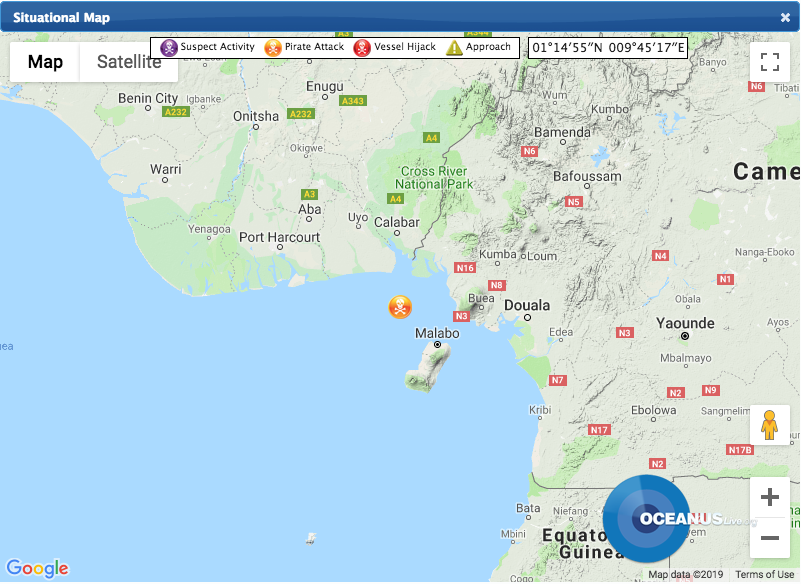
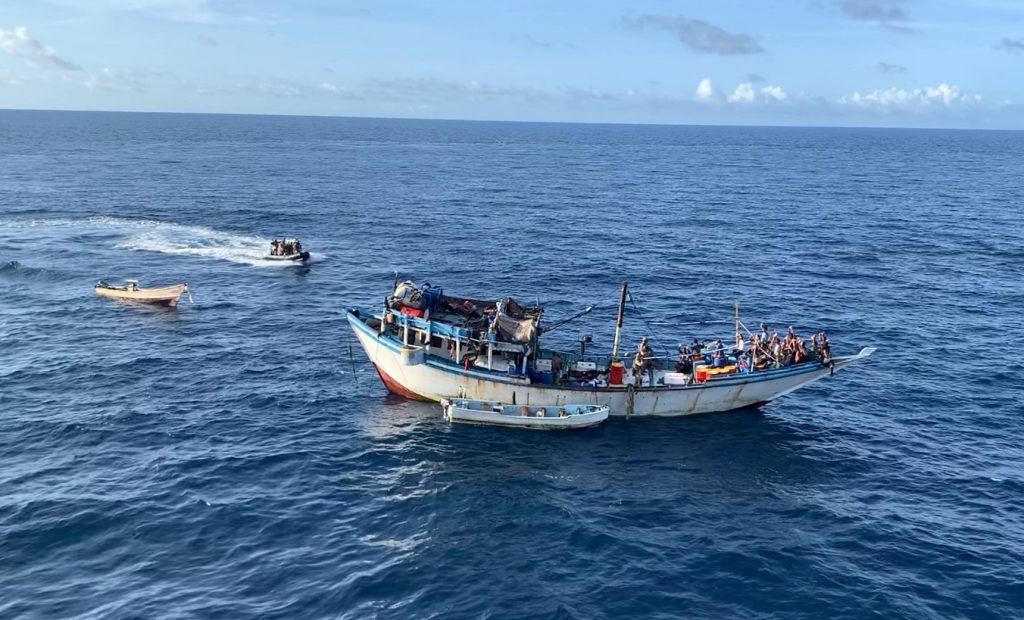
File image of an approach on a dhow

Why has piracy off Somalia’s coast plummeted while in West Africa pirates remain undefeated?

BY PETER FABRICIUS

A few years ago piracy off the east coast of Africa, focusing on Somalia, was a major crisis, attracting extensive international attention. Now it has plummeted. Meanwhile across the continent in the Gulf of Guinea, the piracy problem, which never attracted quite the same attention, has persisted at much the same high levels.

The reasons are numerous, though the greater prioritisation of Western Indian Ocean sea routes to the international community is probably near the heart of it. Another reason seems to be the relatively greater capacity of individual West African states to fight piracy.

Pirate attacks off Somalia’s coast have dropped dramatically over the past eight years – from 237 incidents in 2011 to nine in 2017 and just three attempted attacks in 2018, Denys Reva reported in a June ISS Today article.

So much so that the Contact Group on Piracy off the Coast of Somalia has started discussing broadening the group’s mandate to include combating other maritime security problems like trafficking. This complements similar changes occurring in other prominent maritime security initiatives such as the Djibouti Code of Conduct.

By contrast, on 8 July this year the International Maritime Bureau Piracy Reporting Centre (IMB-PRC) said the seas around West Africa remained ‘the world’s most dangerous for piracy.’ Of the 75 seafarers taken hostage on board or kidnapped for ransom worldwide so far this year, 62 were captured in the Gulf of Guinea – off the coasts of Nigeria, Guinea, Togo, Benin and Cameroon. 

The bureau said 73% of all kidnappings at sea, and 92% of hostage takings, happened in the Gulf of Guinea. It nonetheless notes ‘a welcome and marked decrease’ in attacks in the gulf for the second quarter of 2019, commending the Nigerian navy in particular for actively responding to reported incidents by dispatching patrol boats. While recognising that many attacks go unreported, the maritime bureau recorded 21 incidents around Nigeria so far in 2019, down from 31 in the same period of 2018.

Timothy Walker, Senior Researcher and specialist in maritime issues at the Institute for Security Studies, says however that despite the improvement recorded by the IMB-PRC, the general incidence of piracy in the Gulf of Guinea seems to have remained fairly constant over the past decade.

He suggests this is because the high seas off Somalia generally carry shipping heading to and from the Suez Canal and linking the huge markets of Europe, India and East Asia. They are also of greater global interest as they carry ships of almost every flag state and generally of greater size.

While there is also a huge volume of international shipping in the Gulf of Guinea, most attacks are happening in territorial waters, against localised shipping to and from West Africa. Because of this geographic difference, a larger international operation was mobilised to counter Somali-based piracy, pulling in powerful navies from the United States, China, Russia, India and France, among others, and notably the European Union’s Operation Atalanta.

These nations have coordinated their efforts through the Contact Group on Piracy off the Coast of Somalia and the Shared Awareness and De-confliction (SHADE) Conference. Their success seems to have been enhanced by natural competition among themselves for the greatest competence in combating piracy and projecting national maritime power. It was precisely the absence of a functioning national authority in relatively ungoverned Somalia that brought these international navies into the fight against piracy.

Walker notes that the many West African nations with shores on the Gulf of Guinea could better fight piracy through pooling their capacity and strengthening their law enforcement institutions. Such cooperation between and within the economic communities of West African States and Central African States is improving maritime security to a degree.

There is also an Interregional Coordination Centre in Yaoundé steering many of these efforts, complementing national and regional actions. But such efforts struggle with capacity shortages and the low political priority many governments still attach to maritime security.

One manifestation of the need for coordination is that while private security guards on ships have been an effective, albeit controversial, means to combat pirates off Somalia, this hasn’t worked in the Gulf of Guinea. Countries such as Nigeria insist on shipping companies manning their vessels with Nigerian naval teams in their national waters.

Another downside of the many different national jurisdictions fighting piracy in the west is that pirates can shift to different national maritime jurisdictions when one country steps up the pressure against them. This displacement of piracy could be a major factor in maintaining high overall piracy rates, Walker suggests.

He also notes that those fighting Somali piracy have been able to institutionalise their efforts more effectively than their Gulf of Guinea counterparts. However the institutions in the west are working as well as their member states empower them to, he says.

Reva notes that companies sailing off Somalia have together developed effective safety guidelines for ships travelling through a well-defined High Risk Area. For example, ships navigating through the region are urged to increase their speed and install protective systems on board. They are also asked to follow the protected Maritime Security Transit Corridor, making it harder for pirates to attack. These guidelines were key to bringing down piracy off Somalia’s coast, Reva said.

Another difference is the east’s legal approach. Walker says at the height of piracy in the Western Indian Ocean many were caught off Somalia and brought to court in countries such as Kenya and the Seychelles. They were then incarcerated in Somalia itself or its semi-autonomous Puntland region to be prosecuted, convicted and imprisoned. This has been a strong deterrent to piracy in the east.

By contrast there is little record of incarceration, prosecution or conviction of pirates in the Gulf of Guinea, he says. Through this ‘lack of legal finish’, as Walker puts it, the west is missing an opportunity to visibly deter piracy.

Overall, the problem in the east has now become how to avoid complacency in the face of success. In the west, the problem remains the need to reduce the incidence of piracy. It would seem that greater regional coordination – if necessary with international assistance, including guidance from those who have succeeded on the other side of the continent – is called for.

Peter Fabricius, ISS Consultant

Source: issafrica.org

5 battalions of police commandos to fight Abu Sayyaf

By Aaron Recuenco

The five battalions of the police’s elite Special Action Force (SAF), which President Duterte early in his term had ordered to be formed, may see action in Mindanao as part of the effort to wipe out the extremist Abu Sayyaf Group (ASG).

Gen. Oscar Albayalde, chief of the Philippine National Police (PNP), said the five battalions of SAF commandos are nearing completion of their commando training and would graduate as soon as they pass the test mission.

To continue reading, please click here.

Source: news.mb.com.ph

U.S. Navy Sends Second Ship to Gulf of Guinea

NAVAL STATION ROTA, Spain —

USNS Carson City (T-EFP 7), a Military Sealift Command Spearhead-class expeditionary fast transport ship, departed Rota, Spain, on July 2, as part of the Navy’s second deployment to the Gulf of Guinea this year.

Sailors and embarked personnel will work alongside regional partners on an Africa Partnership Station (APS) mission to provide small boat maintenance assistance, maritime law enforcement engagement, and medical and community relations outreach.

“The deployment of USNS Carson City to the Gulf of Guinea enables our partners to improve maritime security along their coastlines, territorial seas, and exclusive economic zones,” said Adm. James G. Foggo III, commander, U.S. Naval Forces Europe-Africa. “Maritime security is critical for coastal nations as seaborne trade is the lifeblood of global trade. When maritime trade freely sails across the seas, economic development and opportunities for prosperity are possible.”

U.S. Coast Guard (USCG) cutter Thetis (WMEC 910) was the first U.S. ship to deploy to the Gulf of Guinea in 2019.

“Thetis conducted training with our African partners on maritime law enforcement throughout exercise Obangame Express 2019 and continued training with our partners in the region during its deployment,” said Foggo. “Carson City’s deployment will enhance Gulf of Guinea nations’ maritime capabilities through workshops and collaboration. The presence of U.S. ships such as Thetis and Carson City helps address some of the challenges our African navies and coast guards have requested assistance with, including law enforcement and maritime resource management.”

During Carson City’s deployment, U.S. military personnel will work alongside U.S. partners in Cabo Verde, Cote d’Ivoire, Ghana, Nigeria, and Senegal to provide assistance based on host nation requests during previous APS exercise and engagements. The crew and the embarked European allies will provide host nation-requested, needs-based assistance through engagements as part of our enduring friendship and partnership with our African partners.

Mission personnel traveling with Carson City include a small boat maintenance and repair team, a medical team, United States Coast Guard Maritime Law Enforcement personnel, and the U.S. Naval Forces Europe band, who will conduct performances for local communities.

“We have a lot of experts embarked aboard Carson City to work alongside our Gulf of Guinea partners in areas they have asked for assistance such as maintenance and medical engagements,” said U.S. Navy Cmdr. Howard Gray, lead planner for Carson City deployment.

These experts include service members from other regional partners and allies, who are also joining Carson City for the deployment.

“Not only do we have U.S. service members from the Navy and Coast Guard, but we also have members of the Portuguese, Spanish, and Italian navies embarked to help ensure our African partners are getting the assistance and mentorship they need to succeed,” said Foggo. “We are also embarking members of the Ghana Navy for a brief period. Together, we are promoting progress through partnership.”

Thetis’ deployment earlier this year, like the Carson City deployment, was part of the APS program. The cutter was in Africa theater for three months, conducting training with regional countries on law enforcement tactics and techniques to combat illegal fishing, human and narcotics trafficking, piracy, and pollution.

APS is U.S. Naval Forces Africa’s flagship maritime security cooperation program focusing on maritime safety and security through increased maritime awareness, response capabilities, and infrastructure. It consists of the various exercises and operations conducted by U.S., European, and African partners and allies throughout the U.S. Africa Command area of operations.

U.S. Naval Forces Europe-Africa/U.S. 6th Fleet, headquartered in Naples, Italy, conducts the full spectrum of joint and naval operations, often in concert with allied and interagency partners, in order to advance U.S. national interests, security and stability in Europe and Africa.

Source: c6f.navy.mil

Piracy in West Africa: The world’s most dangerous seas?

The seas off West Africa’s oil-rich coastline are now the most dangerous in the world for shipping, according to a new report.

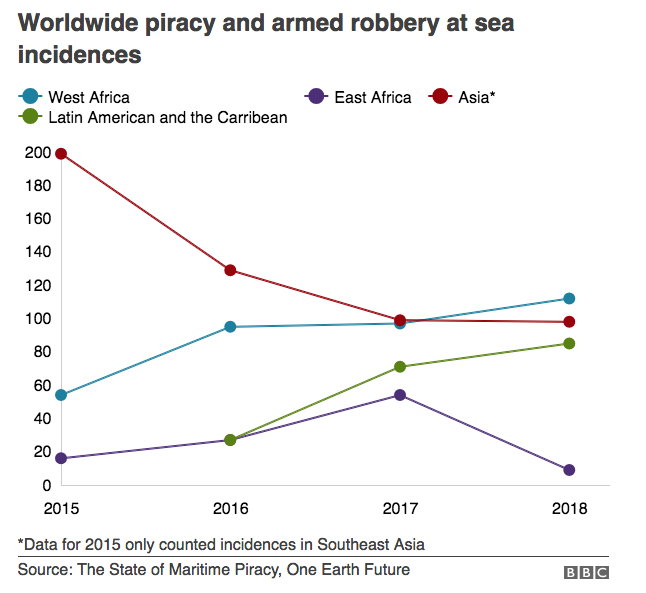
One Earth Future, which produces an annual State of Maritime Piracy, says that while attacks have been falling substantially in some regions of the world, in West Africa they’ve been on the rise and are now more frequent than anywhere else.

So why the increase in West Africa, and what shipping is being targeted?

What is piracy?

A strict definition of maritime piracy only includes attacks on shipping on the high seas – that is, more than 12 nautical miles off the coastline and not under the jurisdiction of any state.

Inside a country’s territorial waters and within port facilities, these attacks are defined as armed robberies at sea.

However, the data we’ve used from this latest report combines these two sets of data to give an overall picture of incidents at sea both inshore and offshore.

In 2018, there were 112 such incidents in West African waters.

It’s not just the huge tankers exporting oil and gas from Nigeria and Ghana that are targeted.

Commercial ships from smaller countries are also in the sights of the pirates.

At a recent event in London, President Faure Gnassingbé of Togo – a country sandwiched between these two regional giants – highlighted his own concerns at the rise in attacks on regional shipping.

“Our region is distinguished by the resurgence of transnational criminality on the high seas in the Gulf of Guinea,” said Mr Gnassingbé.

Why are attacks rising?

Most of the attacks have been against ships involved in oil and gas transportation, such as tankers, bulk carriers and tugs. Fishing vessels have also been targeted.

The coastline off Nigeria saw the most attacks in 2018. This is partly because of “petro-piracy”, targeting tankers from Nigeria’s rich oil and gas fields.

There were also incidents reported at the loading and anchorage facilities in the Nigerian port of Lagos.

Piracy in the form of hijacking and kidnapping for ransom payments was also common off the coasts of Benin, Ghana, Nigeria, Congo-Brazzaville and Cameroon.

Rich pickings at sea, political instability, the lack of law enforcement and poverty on land are all factors which have contributed to the increase in piracy.

Most of the seafarers affected are not from the region. Around half are from the Philippines, followed by India, Ukraine and Nigeria.

One of the reasons West Africa is now the number one spot for piracy is because of of the downward trends recorded elsewhere.

The East African shipping routes along the Somali coastline have been notorious for hijackings and robberies.

But since peaking in 2011, rates of piracy there have fallen off dramatically in recent years.

This is in large measure as a result of a successful multi-national effort to patrol these waters and take firm action action against acts of piracy.

Local efforts on land in Somalia to change attitudes towards permitting piracy and building legal capacity to prosecute criminals have also helped improve the situation.

In Asia, the Malacca Strait, a busy, commercially important stretch of water between Malaysia and Indonesia, experienced a high number of attacks in 2015.

Concerted action by regional naval forces has reduced the problem there, but piracy still persists.

Attacks against shipping in the Caribbean and off the coast of Latin American have, however, risen.

Venezuela in particular has become a hotspot for piracy.

“Political and economic instability is a big factor there,” says Lydelle Joubert, an expert on piracy at One Earth Future.

Source: bbc.co.uk