GENEVA/DUBAI (Reuters) – U.S. President Donald Trump said he was prepared to take military action to stop Tehran from getting a nuclear bomb but left open whether he would back the use of force to protect Gulf oil supplies that Washington fears may be under threat by Iran.
Worries about a confrontation between Iran and the United States have mounted since attacks last week on two oil tankers near the strategic Strait of Hormuz shipping lane at the entrance to the Gulf. Washington blamed long-time foe Iran for the incidents.
It recently stepped up production in response to the US tightening sanctions. The 2015 deal, from which the US has withdrawn, curbed Iran’s nuclear programme in exchange for the lifting of sanctions.
Iran’s President Hassan Rouhani said his country did not seek to wage war with any nation and had remained “loyal” to its international obligations.
Meanwhile, on Monday night three rockets hit a military base housing US troops north of Baghdad, the Iraqi military said. The US said it was “indirect fire” and did not cause injuries.
No group has admitted responsibility for the attack, though it follows warnings by US officials of an increased threat to US interests in Iraq by Iran-backed militias.
What do we know about the extra troops?
The US troop deployment to the Middle East was announced by Mr Shanahan late on Monday.
In his statement, he said the “United States does not seek conflict with Iran” but the action was taken to “ensure the safety and welfare of our military personnel working throughout the region to protect our national interests”.
He said the military would continue to monitor the situation and make adjustments to troop levels accordingly.
Monday’s troop increase announcement comes on top of 1,500 extra announced by President Donald Trump last month.
Secretary of State Mike Pompeo said on Sunday that the US did not want war with Iran, but was nevertheless “considering a full range of options”.
What do the latest images show?
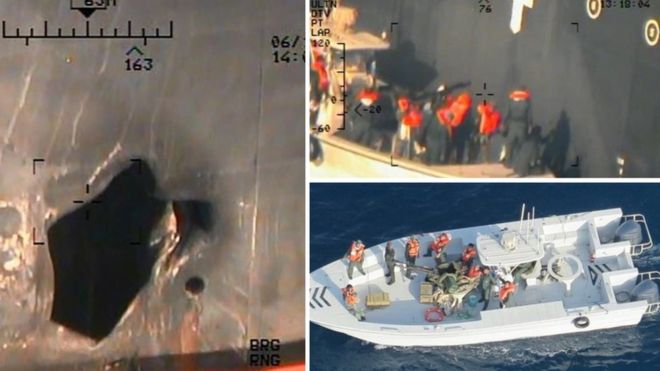
Shortly before the announcement, the Pentagon released new images including some purporting to show the remnants of an unexploded mine on a Japanese-owned oil tanker.
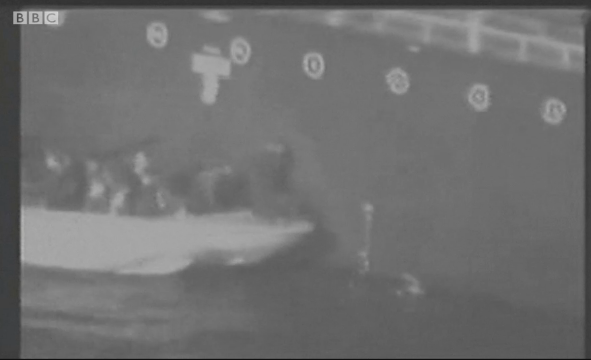
The photos appear to show it being removed by members of the Iranian Revolutionary Guard Corps. The Pentagon has already released grainy video said to show the same episode.
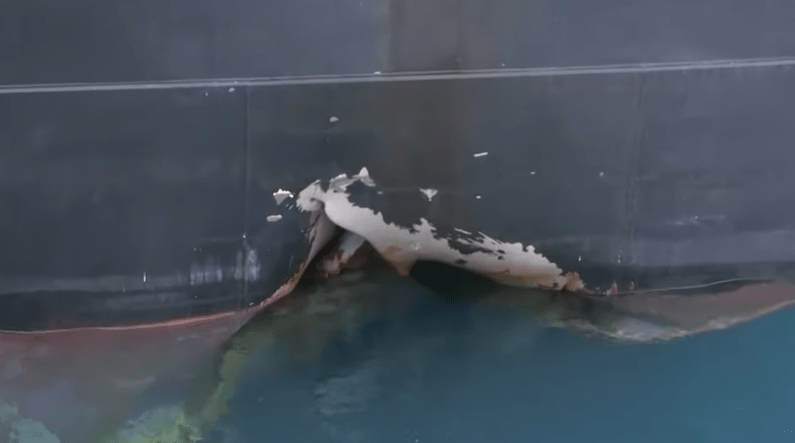
Also seen in the latest images is apparent damage – a hole – above the waterline on the hull of the Kokuka Courageous vessel.
Another image claims to show the Iranian Revolutionary Guard Corps vessel shortly after it was involved in removing the limpet mine.
A Norwegian-owned tanker, the Front Altair, also reported being hit by the blasts on Thursday.
The US has implicated Iran in the latest attacks and four others outside the Strait of Hormuz in May, allegations denied by Iran.
How do other sides see the situation?
China urged the US to lower the pressure and for Iran to stick to the nuclear deal, warning of a “Pandora’s box” in the region.
Russia – another party to the nuclear accord – also called for restraint, calling US actions “truly provocative”.
Saudi Arabia also blames Iran for the attacks on the two oil tankers, while the UK said it was “almost certain” Iran was responsible.
But EU foreign ministers meeting on Monday warned against jumping to conclusions and backed UN calls for an independent investigation.
Why are there new tensions?
In 2015, Iran agreed to a landmark deal with world powers to curb its nuclear development.
It agreed to limit the enrichment of uranium, which is used to make reactor fuel but also nuclear weapons, and other measures in return for relief from sanctions.
Mr Trump abandoned the nuclear accord last year and started to re-impose sanctions.
The move has crippled Iran’s economy, which relies on oil, and Iran has responded by scaling back its nuclear commitments.
On Monday, a spokesman for Iran’s Atomic Energy Organisation said it was on course to exceed agreed limits on its low-enriched uranium stockpiles by 27 June.
But, Iran said there was “still time” for European countries to act by protecting Iran from reinstated US sanctions.
The US military has released a video which it says shows Iran’s Revolutionary Guard removing an unexploded mine from the side of an oil tanker damaged in an attack in the Gulf of Oman on Thursday.
US officials also shared a photo of the Japanese tanker, apparently showing the unexploded mine before it was removed.
A Norwegian tanker was also damaged.
The US accused Iran of being behind the mine attacks. Iran said it “categorically rejects” the allegation.
The blasts came a month after four oil tankers were damaged in an attack off the coast of the United Arab Emirates. The US blamed Iran for that attack, but did not produce evidence. Iran also denied those accusations.
Tensions between the two countries have escalated significantly since US President Donald Trump took office in 2017. He abandoned a nuclear deal that was brokered by the Obama administration and imposed heavy sanctions on Iran.
Oil prices jumped as much as 4% after Thursday’s incident. The Gulf of Oman lies at one end of a vital shipping lane through which a third of the world’s transported oil – worth hundreds of millions of dollars – passes every year.
What we know about the explosions
According to the US account of events, US naval forces in the region received distress calls from the Norwegian-owned Front Altair at 06:12 local time (02:13 GMT) and from the Kokuka Courageous at 07:00, following explosions, and moved towards the area.
It said the USS Bainbridge observed Iranian naval boats operating in the area in the hours after the explosions, and later removing the unexploded mine from the side of the Kokuka Courageous.
The crews of both vessels were evacuated to other ships nearby. Both Iran and the US later released pictures showing rescued crew members on board their vessels.
The operator of the Kokuka Courageous, BSM Ship Management, said its crew abandoned ship after observing a fire and an unexploded mine.
The Kokuka Courageous was about 20 miles off the Iranian coast when it sent its emergency call.
The Front Altair was carry naphtha, a petrol product, from the United Arab Emirates to Taiwan. The Kokuka Courageous was carrying methanol from Saudi Arabia to Singapore.
What did the US say?
US Secretary of State Mike Pompeo said at a news conference in Washington: “It is the assessment of the United States that the Islamic Republic of Iran is responsible for the attacks.
“This assessment is based on intelligence, the weapons used, the level of expertise needed to execute the operation, recent similar Iranian attacks on shipping, and the fact that no proxy group operating in the area has the resources and proficiency to act with such a high degree of sophistication.”
UK Foreign Secretary Jeremy Hunt said his country’s “starting point” was to “believe our US allies”.
“We are taking this extremely seriously and my message to Iran is that if they have been involved it is a deeply unwise escalation which poses a real danger to the prospects of peace and stability in the region,” Mr Hunt said.
How did Iran respond?
In a statement released on Friday, the Iranian mission to the United Nations said it rejected what it called an “unfounded” and “Iranophobic” allegation by the US.
“Iran categorically rejects the US’ unfounded claim with regard to 13 June oil tanker incidents and condemns it in the strongest possible terms,” the statement said.
Foreign Minister Javad Zarif on Twitter accused the US of making an allegation “without a shred of factual or circumstantial evidence” and attempting to “sabotage diplomacy”.
The alleged attacks took place as Iran’s Supreme Leader Ayatollah Ali Khamenei was meeting Japan’s Prime Minister Shinzo Abe during a two-day visit by Mr Abe to Iran.
The Norwegian-owned Front Altair had been “attacked”, the Norwegian Maritime Authority said, leading to three explosions on board.
Wu I-fang, a spokesman for Taiwan’s state oil refiner CPC Corp, which chartered the Front Altair, said it was carrying 75,000 tonnes of naphtha and was “suspected of being hit by a torpedo”, although this has not been confirmed. Other unverified reports suggested a mine attack.
The ship’s owner, Frontline, said the Marshall Islands-flagged vessel was on fire but denied reports on Iran media it had sunk.
The operator of the Panama-flagged Kokuka Courageous, BSM Ship Management, said its crew abandoned ship and were rescued by a passing vessel.
The tanker was carrying methanol and was not in danger of sinking, a spokesman said.
It is currently located about 80 miles from Fujairah in the UAE and 16 miles from Iran. The cargo remains intact.
Who came to the rescue?
Iranian state media said Iran had rescued the crew members and they had been taken to the port of Jask.
Iranian Foreign Minister Mohammad Javad Zarif tweeted that the incident happened as Japanese PM Shinzo Abe was meeting Iran’s supreme leader, Ayatollah Ali Khamenei, adding: “Suspicious doesn’t begin to describe what likely transpired this morning.”
The vessels were carrying what Japan trade officials said was “Japan-related cargo”.
The US 5th Fleet, based in Bahrain, said it had sent the USS Bainbridge to assist.
Spokesman Josh Frey said in a statement: “US naval forces in the region received two separate distress calls at 06:12 local time (03:12 GMT) and a second one at 07:00.”
Why is this so sensitive?
The Gulf of Oman lies at one end of the strategic Strait of Hormuz, and this incident will further increase tension in a vital shipping lane through which hundreds of millions of dollars of oil pass.
The US sent an aircraft carrier strike group and B-52 bombers to the region at the start of May in response to what it said was an unspecified plan by Iran-backed forces to attack US forces in the area.
President Donald Trump has taken a hard line towards Iran, accusing it of being a destabilising force in the Middle East.
Iran rejected the claims and has accused the US of aggressive behaviour.
Those tensions rose markedly after the 12 May limpet mine attacks on four tankers off the UAE.
While it is unclear why Iran would carry out a relatively low-level attack on the multinational tankers, observers have speculated that it could have been to send a signal to forces ranged against it that it is capable of disrupting shipping there without triggering a war.
ABU DHABI (Reuters) – U.S. National Security Adviser John Bolton said on Wednesday that attacks on oil tankers off the coast of the United Arab Emirates this month were the work of “naval mines almost certainly from Iran”.
The UAE has not yet blamed anyone for the sabotage of four vessels, including two Saudi tankers, which was followed two days later by drone strikes on oil pumping stations in Saudi Arabia.
The Iranian Navy plans to dispatch the 62nd flotilla of warships to free waters in the next few days to protect the country’s cargo ships and oil tankers against pirate attacks. The 62nd fleet includes Bayandor destroyer and Lavan and Bushehr logistic warships.
The 61st flotilla of the Iranian Navy had set off for the high seas to safeguard maritime routes used by Iranian vessels in international waters, especially in the Gulf of Aden, in March.
Saudi Arabian foreign ministry reiterates that it does not want war with Iran, but is prepared for one if need be, as GCC navies step up Arabian Gulf patrols.
GCC countries have begun “enhanced security patrols” in the international waters of the Arabian Gulf, according to the US Navy’s Fifth Fleet.
GCC members were “specifically increasing communication and co-ordination with each other in support of regional naval co-operation and maritime security operations in the Arabian Gulf”, the Bahrain-based fleet said in a statement.
Following the 12 May sabotage attacks on four tankers off Fujairah the LMA Joint War Commission (JWC) has added the United Arab Emirates (UAE) to its listed areas for Hull War, Piracy, Terrorism and Related Perils.
The decision by the JWC was taken on Friday, following a meeting earlier in the week where it had deferred a decision on amending its list of war risk areas.
WASHINGTON (Reuters) – The commander overseeing U.S. naval forces in the Middle East told Reuters on Thursday that American intelligence showing a threat from Iran will not prevent him from sending an aircraft carrier through the vital Strait of Hormuz, if needed.
Vice Admiral Jim Malloy, commander of the U.S. Navy’s Bahrain-based Fifth Fleet, did not say whether he would send the USS Abraham Lincoln carrier strike group into the strategic waterway off Iran, through which passes a fifth of oil consumed globally.
BEIRUT, LEBANON (9:45 A.M.) – The naval forces of Iran and Russia are preparing to hold joint drills in the Persian Gulf waters, the Mehr News Agency reported.
Citing Iranian naval commander Rear Admiral Hossein Khanzadi, the Mehr News Agency reported that the joint naval drills will take place in Iran’s southern waters.