A total of 28 incidents of piracy and armed robbery against ships in Asia were reported in the first half of this year, marking the lowest number in 13 years since the first half of 2007, according to data by ReCAAP Information Sharing Centre (ISC).
While there was a year-on-year drop in first half incidents, 18 incidents were reported in the second quarter, up from 10 incidents in the first quarter.
Twenty-eight Incidents Reported to ReCAAP Information Sharing Centre from January to June 2019, Marking 32% Year-on-Year Decrease, and the Lowest in Number among 13-Year Period of January to June
The ReCAAP Information Sharing Centre (ISC) today released its Half-Yearly (January to June 2019) Report. Highlights of the report, whose information is verified by the respective government agencies, also known as Focal Points, and regional authorities, include:
Overall Summary
Total of 28 incidents reported from January to June 2019, of which 25 were actual incidents while 3 were attempted cases
Of the 28 incidents reported, 26 (93%) were armed robbery against ships and two (7%) were piracy
This marks a 32% decrease compared to the same period in 2018 in the number of incidents reported
This is also the lowest number among the 13-year period (2007-2019) of January to June
In terms of severity, there was one Category 1 incident, two Category 2 incidents, two Category 3 incidents and 20 Category 4
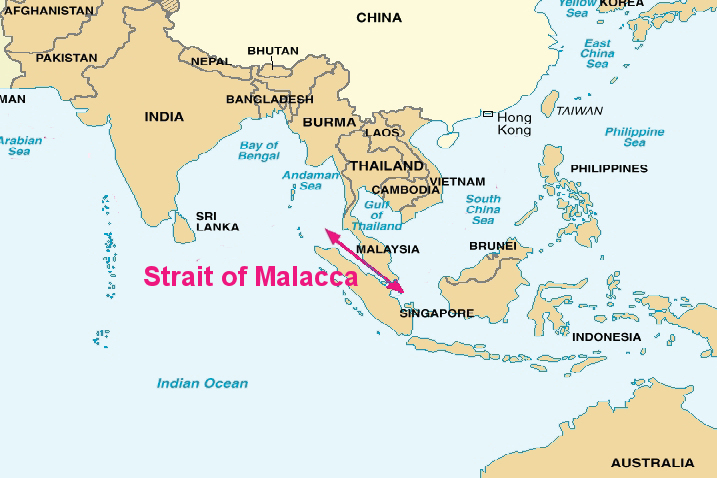
Shipping companies are asked by authorities in Beijing to increase the security level on ships transiting the Strait of Malacca, one of the world’s busiest waterways. Cosco Shipping’s tanker unit has warned its staff about possible attacks from some Indonesian gangs
‘The raising of the threat level for Chinese-flagged vessels has been unexpected, particularly as the regional dynamics within and surrounding the Malacca Strait are stable’ — maritime security intelligence company Dryad Global
BEIJING has raised the security level on Chinese-flagged vessels
transiting the Straits of Malacca, according to documents seen by
Lloyd’s List.
Shipping companies have been advised to implement Security Level 3 — the highest state of alertness under the International Ship and Port Facility Security Code — effective from 2200hrs local time July 2, the Ministry of Transport said in a notification.
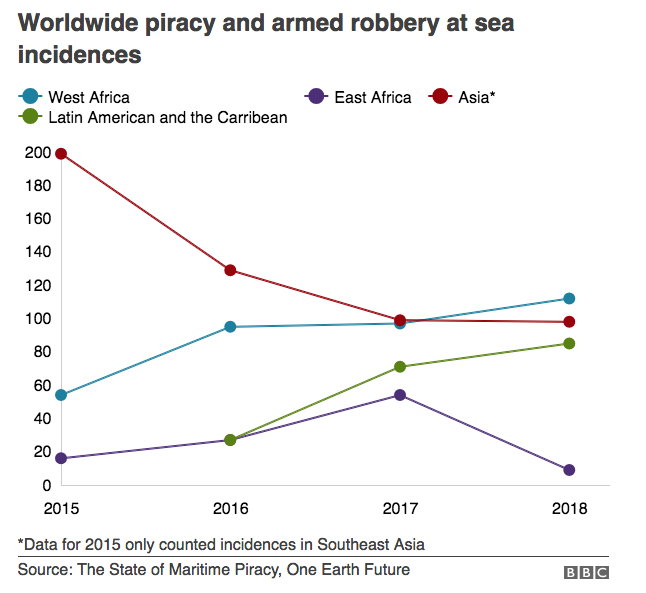
The seas off West Africa’s oil-rich coastline are now the most dangerous in the world for shipping, according to a new report.
One Earth Future, which produces an annual State of Maritime Piracy, says that while attacks have been falling substantially in some regions of the world, in West Africa they’ve been on the rise and are now more frequent than anywhere else.
So why the increase in West Africa, and what shipping is being targeted?
What is piracy?
A strict definition of maritime piracy only includes attacks on shipping on the high seas – that is, more than 12 nautical miles off the coastline and not under the jurisdiction of any state.
Inside a country’s territorial waters and within port facilities, these attacks are defined as armed robberies at sea.
However, the data we’ve used from this latest report combines these two sets of data to give an overall picture of incidents at sea both inshore and offshore.
In 2018, there were 112 such incidents in West African waters.
It’s not just the huge tankers exporting oil and gas from Nigeria and Ghana that are targeted.
Commercial ships from smaller countries are also in the sights of the pirates.
At a recent event in London, President Faure Gnassingbé of Togo – a country sandwiched between these two regional giants – highlighted his own concerns at the rise in attacks on regional shipping.
“Our region is distinguished by the resurgence of transnational criminality on the high seas in the Gulf of Guinea,” said Mr Gnassingbé.
Why are attacks rising?
Most of the attacks have been against ships involved in oil and gas transportation, such as tankers, bulk carriers and tugs. Fishing vessels have also been targeted.
The coastline off Nigeria saw the most attacks in 2018. This is partly because of “petro-piracy”, targeting tankers from Nigeria’s rich oil and gas fields.
There were also incidents reported at the loading and anchorage facilities in the Nigerian port of Lagos.
Piracy in the form of hijacking and kidnapping for ransom payments was also common off the coasts of Benin, Ghana, Nigeria, Congo-Brazzaville and Cameroon.
Rich pickings at sea, political instability, the lack of law enforcement and poverty on land are all factors which have contributed to the increase in piracy.
Most of the seafarers affected are not from the region. Around half are from the Philippines, followed by India, Ukraine and Nigeria.
One of the reasons West Africa is now the number one spot for piracy is because of of the downward trends recorded elsewhere.
The East African shipping routes along the Somali coastline have been notorious for hijackings and robberies.
But since peaking in 2011, rates of piracy there have fallen off dramatically in recent years.
Local efforts on land in Somalia to change attitudes towards permitting piracy and building legal capacity to prosecute criminals have also helped improve the situation.
In Asia, the Malacca Strait, a busy, commercially important stretch of water between Malaysia and Indonesia, experienced a high number of attacks in 2015.
Concerted action by regional naval forces has reduced the problem there, but piracy still persists.
Attacks against shipping in the Caribbean and off the coast of Latin American have, however, risen.
Venezuela in particular has become a hotspot for piracy.
“Political and economic instability is a big factor there,” says Lydelle Joubert, an expert on piracy at One Earth Future.
Under the treaty, there will be a clear boundary between the two nations, helping Filipino and Indonesian fishermen to operate peacefully and properly
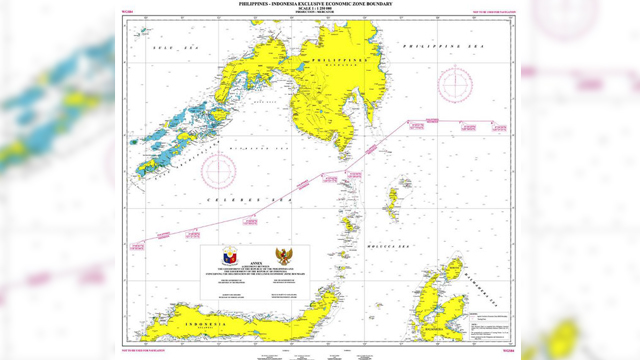
MANILA, Philippines – The Senate on Monday, June 3, concurred with the ratification of the treaty that draws a boundary between the overlapping exclusive economic zones (EEZs) of the Philippines and Indonesia.
Voting 20-0, senators adopted Senate Resolution No. 1048, which concurs with the historic agreement signed in May 2014. It was the Philippines’ first maritime boundary treaty.
MARITIME BOUNDARY DEAL. The map shows the exclusive economic zone boundary between the Philippines and Indonesia. Photo from the Department of Foreign Affairs
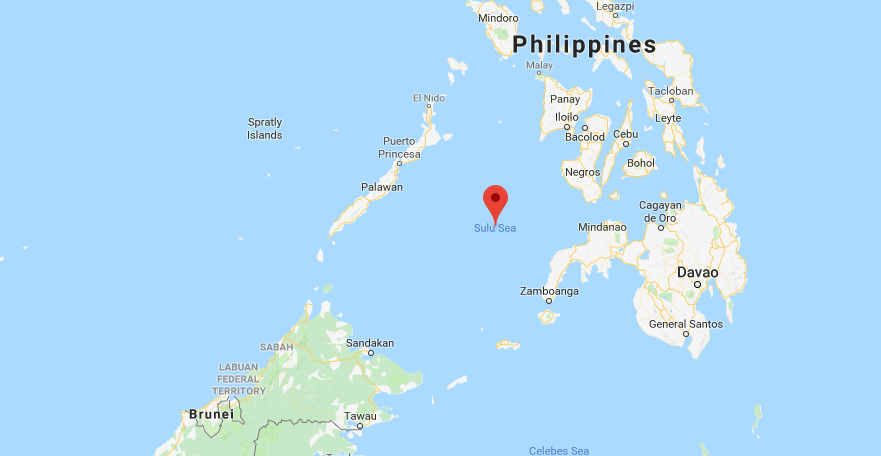
On the morning of January 27, 2019, two bombs exploded inside the Cathedral of Our Lady of Mount Carmel, in Jolo on the Sulu Province in the southern Philippines. Tearing a hole through the cathedral during a Sunday service, the bombs claimed 20 lives, injured dozens more, and propelled Islamist extremism in the Philippines back into international headlines. In the aftermath of the blast, Philippine president Rodrigo Duterte promised to “pursue to the ends of the Earth the ruthless perpetrators behind [the] dastardly crime,”as the Abu Sayyaf Group (ASG), the country’s notoriously violent Islamic separatist group, claimed responsibility for the attack. While President Duterte may not need to go to the “ends of the Earth” to put an end to the ASG-fueled terror, his government will certainly need to act beyond its own shores. Illicit maritime activities are at the root of ASG funding and operations, and ensuring the group’s defeat will require focused government efforts to improve maritime security in its area of operations.
SULU: Philippine National Police (PNP) Sulu Provincial Commander Pablo Labra reported Saturday that a Dutch hostage abducted by the Abu Sayyaf militants seven years has joined the terrorist group.
Identified as 57-year old Ewold Horn, Labra said the kidnap victim turned outlaw together with Swiss national Lorenzo Vinciguerra were adopted by Abu Sayyaf militants and suspected MNLF members in Tawi-Tawi in 2012.
The first leg of the Border Coordinated Patrol of the Philippine and Indonesian navies has ended, with the aim of securing the common border between the two countries and stop maritime and sea crimes including smuggling and piracy.
The patrol ships of both countries were expected to have reached their final point in the territorial waters of Indonesia along the Celebes Sea on Saturday.
MANILA, May 2 (Xinhua) — The Philippines and Indonesia kicked off on Thursday their joint patrol in the Sulu-Celebes Seas, a move aimed at strengthening security cooperation to combat piracy, smuggling and maritime attacks in the region.
“The main mission is to secure the common border, to curtail maritime crimes, and stop various sea crimes like smuggling and piracy,” Ezra Balagtey, spokesman for the Eastern Mindanao Command of the Armed Forces of the Philippines, said in a statement.
Malaysia will receive six ScanEagle 2 Unmanned Air Systems (UAS) later this year while Indonesia will receive an equal number in 2022 under the United States funded Maritime Security Initiative (MSI).
US Assistant Secretary of Defense for Indo-Pacific Security Affairs Randall Schriver said during a media round-table in Kuala Lumpur last week that the Philippines had received six ScanEagle 2 UAS in 2018 as part of the MSI policy.




 Maritime Security News