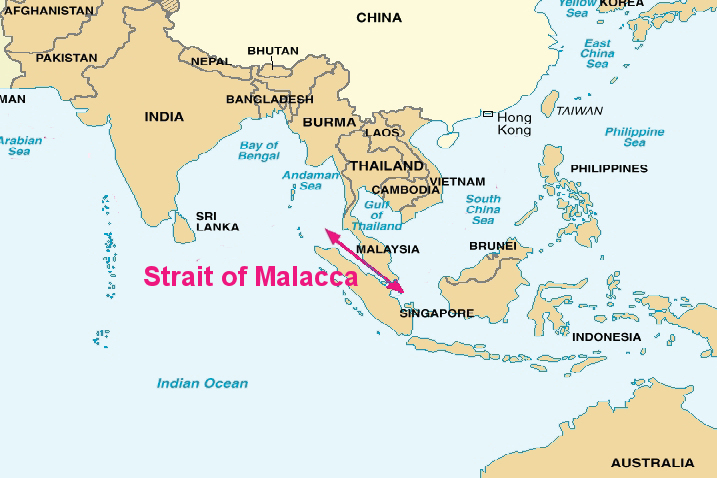
Shipping companies are asked by authorities in Beijing to increase the security level on ships transiting the Strait of Malacca, one of the world’s busiest waterways. Cosco Shipping’s tanker unit has warned its staff about possible attacks from some Indonesian gangs
‘The raising of the threat level for Chinese-flagged vessels has been unexpected, particularly as the regional dynamics within and surrounding the Malacca Strait are stable’ — maritime security intelligence company Dryad Global
BEIJING has raised the security level on Chinese-flagged vessels
transiting the Straits of Malacca, according to documents seen by
Lloyd’s List.
Shipping companies have been advised to implement Security Level 3 — the highest state of alertness under the International Ship and Port Facility Security Code — effective from 2200hrs local time July 2, the Ministry of Transport said in a notification.
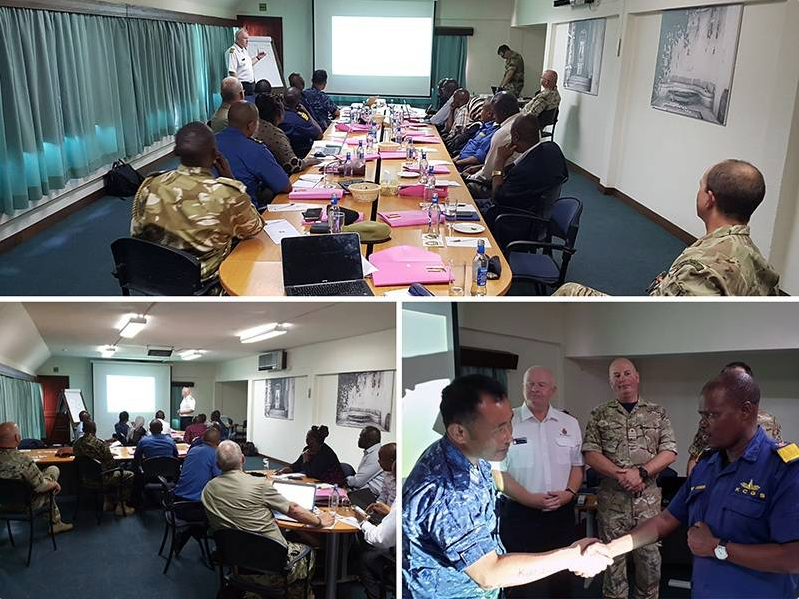
Senior officials from the newly established Kenya Coast Guard Services are undergoing training on coast guard functions at a national workshop in Mombasa, Kenya (24-28 June).
Fifteen participants are taking part in the training, which is using scenario development methodology and plenary discussions to highlight issues, identify insights and develop deeper understanding of effective ways to meet coastguard functions – with a view to enhancing maritime security in Kenya.
The training is organised by the United Kingdom and IMO, under the auspices of the Jeddah Amendment to the Djibouti Code of Conduct. It is supported by a joint team from the UK Maritime Coastguard Agency (MCA), Royal Navy International Defence Training (RNIDT), and facilitated by the British Peace Support Team Africa (BPST(A)) and IMO. Other international partners supporting the implementation of the Djibouti code of Conduct (Japan, Denmark and the International Committee of the Red Cross) are also in attendance and contributing to the discussions.
Alerting the international maritime community on Monday, the IMO stated that warnings currently being issued from the email account of the Regional Maritime Information Sharing Centre (REMISC) in Sana’a, Yemen (infoex@remisc.org) are not legitimate.
Given the current situation in Yemen, the centre has not been able to provide updated piracy incident information, and has temporarily stopped its activities.
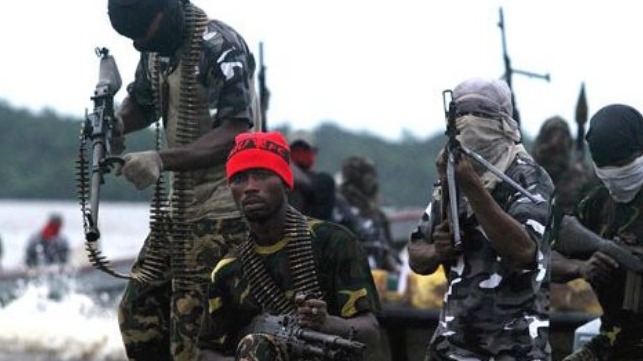
The seas off West Africa’s oil-rich coastline are now the most dangerous in the world for shipping, according to a new report.
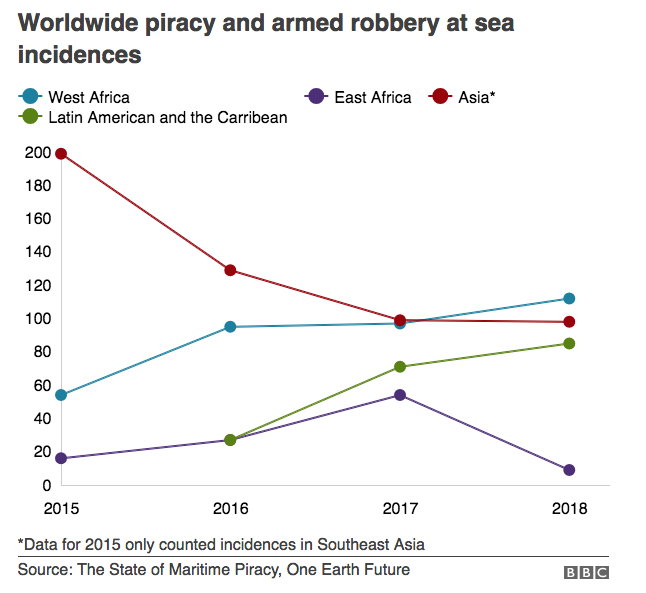
One Earth Future, which produces an annual State of Maritime Piracy, says that while attacks have been falling substantially in some regions of the world, in West Africa they’ve been on the rise and are now more frequent than anywhere else.
So why the increase in West Africa, and what shipping is being targeted?
What is piracy?
A strict definition of maritime piracy only includes attacks on shipping on the high seas – that is, more than 12 nautical miles off the coastline and not under the jurisdiction of any state.
Inside a country’s territorial waters and within port facilities, these attacks are defined as armed robberies at sea.
However, the data we’ve used from this latest report combines these two sets of data to give an overall picture of incidents at sea both inshore and offshore.
In 2018, there were 112 such incidents in West African waters.
It’s not just the huge tankers exporting oil and gas from Nigeria and Ghana that are targeted.
Commercial ships from smaller countries are also in the sights of the pirates.
At a recent event in London, President Faure Gnassingbé of Togo – a country sandwiched between these two regional giants – highlighted his own concerns at the rise in attacks on regional shipping.
“Our region is distinguished by the resurgence of transnational criminality on the high seas in the Gulf of Guinea,” said Mr Gnassingbé.
Why are attacks rising?
Most of the attacks have been against ships involved in oil and gas transportation, such as tankers, bulk carriers and tugs. Fishing vessels have also been targeted.
The coastline off Nigeria saw the most attacks in 2018. This is partly because of “petro-piracy”, targeting tankers from Nigeria’s rich oil and gas fields.
There were also incidents reported at the loading and anchorage facilities in the Nigerian port of Lagos.
Piracy in the form of hijacking and kidnapping for ransom payments was also common off the coasts of Benin, Ghana, Nigeria, Congo-Brazzaville and Cameroon.
Rich pickings at sea, political instability, the lack of law enforcement and poverty on land are all factors which have contributed to the increase in piracy.
Most of the seafarers affected are not from the region. Around half are from the Philippines, followed by India, Ukraine and Nigeria.
One of the reasons West Africa is now the number one spot for piracy is because of of the downward trends recorded elsewhere.
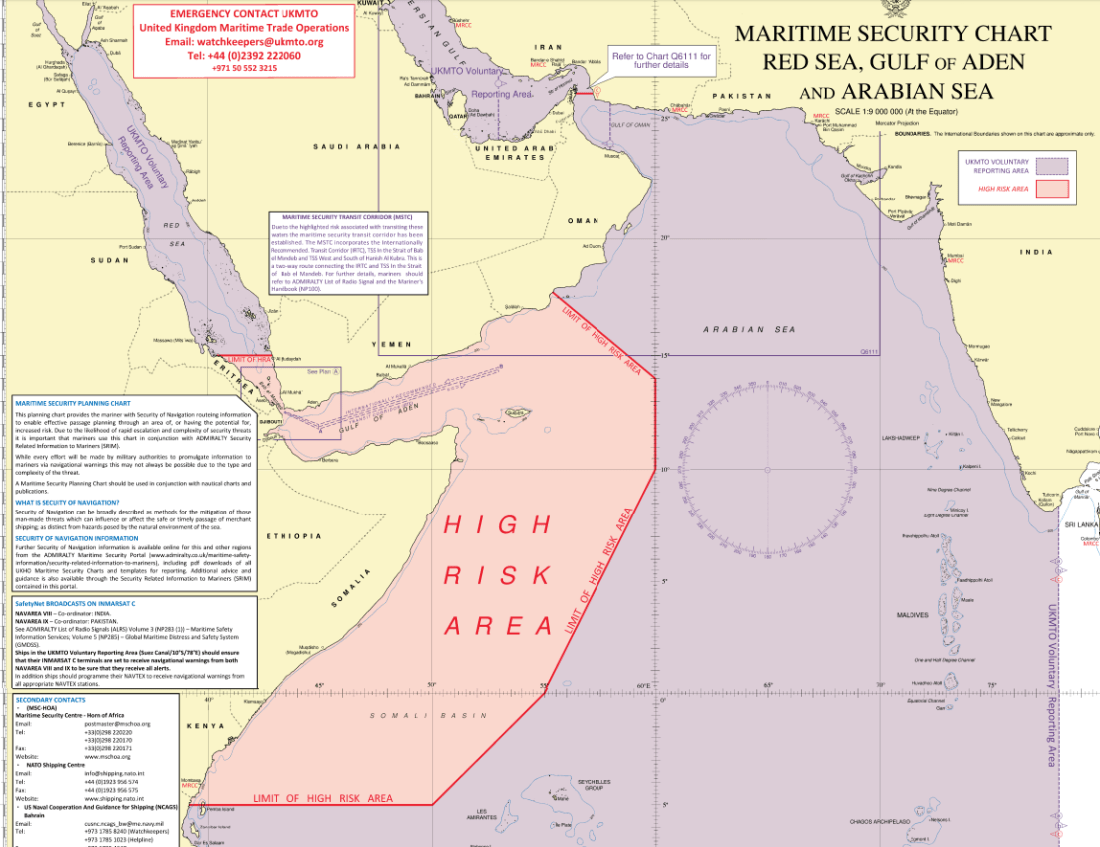
The East African shipping routes along the Somali coastline have been notorious for hijackings and robberies.
But since peaking in 2011, rates of piracy there have fallen off dramatically in recent years.
Local efforts on land in Somalia to change attitudes towards permitting piracy and building legal capacity to prosecute criminals have also helped improve the situation.
In Asia, the Malacca Strait, a busy, commercially important stretch of water between Malaysia and Indonesia, experienced a high number of attacks in 2015.
Concerted action by regional naval forces has reduced the problem there, but piracy still persists.
Attacks against shipping in the Caribbean and off the coast of Latin American have, however, risen.
Venezuela in particular has become a hotspot for piracy.
“Political and economic instability is a big factor there,” says Lydelle Joubert, an expert on piracy at One Earth Future.
Some of shipping’s top stakeholders met on Friday at the London headquarters of the International Maritime Organization (IMO) to demand action to counter the dire piracy situation off the Gulf of Guinea, which is causing severe distress for seafarers who have to transit the region.
The event, co-sponsored by BIMCO, IMCA, ICS, ITF and OCIMF, drew members of the shipping community, flag states and agencies from the Gulf of Guinea.
The United Nations Office on Drugs and Crime says the estimated economic cost of piracy to Nigeria and other West African countries between 2015 and 2017 stands at $2.3bn.
It stated that within the period under review, the sub-region lost about $777.1m to piracy on an annual basis, which it said was in addition to human costs as the Gulf of Guinea experienced an escalation of piracy, kidnapping and armed robbery at sea incidents in recent years.
Suriname is the latest country to benefit from IMO maritime security training. Participants at a workshop in Paramaribo, Suriname (7-8 May) took part in table-top contingency planning exercises involving a variety of maritime security issues. These included threats to cruise ships, border security issues involving ports, airports and land border crossing, as well as potential incidents involving proliferation of weapons of mass destruction, and arms and drugs consignments.
The main objective of the exercise was to encourage a multi-agency, whole of government approach to maritime and port facility security and related maritime law enforcement issues – with participants working to identify gaps in national procedures or legislation, opportunities for improvement, and further needs for training or technical assistance.
The exercise took place following a request by Suriname to assist the country in strengthening its implementation of UN Security Council Resolution 1540 (2004) – specifically those that fall within the scope of IMO’s SOLAS chapter XI-2 and the ISPS Code and/or the 1988 and 2005 SUA treaties (click for details of these treaties).
The workshop was organised in collaboration with the United Nations Regional Centre for Peace, Disarmament and Development in Latin America and the Caribbean (UNLIREC).


 Maritime Security News