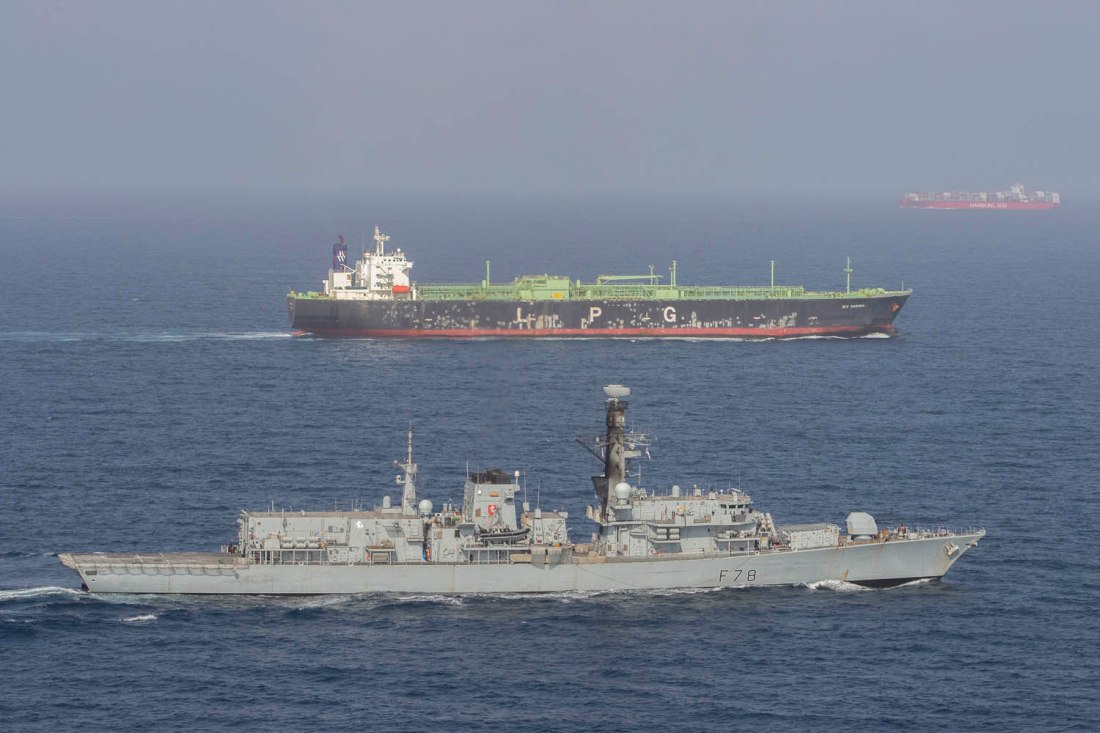
Royal Navy guardians protect 7m tonnes of shipping in Gulf

Over seven million tonnes of British shipping – the equivalent of around 20 wartime convoys – have been guided safely through the Strait of Hormuz by the Royal Navy.

HMS Montrose, her sister frigate HMS Kent and destroyers HM Ships Duncan and Defender – have accompanied British flagged and registered merchant ships in and out of the Gulf amid tensions with Iran.

Grateful seafarers have labelled the Royal Navy vessels ‘guardians of the Gulf’ for their efforts providing protection in the narrow waters separating Iran on the north shore and Oman and the UAE since the beginning of July.

The warships, plus their helicopters, have been used to accompany and watch over merchant shipping to ensure they can pass into and out of the Gulf safely, keeping international trade – especially oil and natural gas – flowing in the face of threats.

Most recently HMS Kent has borne the burden of patrols, spending three weeks in the strait, providing safe passage for in excess of 800,000 tonnes of shipping.

“We are a close-knit team and I am extremely proud of what my sailors have achieved over the last few months,” said Commander Andrew Brown, HMS Kent’s Commanding Officer.

The ship uses her Wildcat helicopter to scour hundreds of square miles of the Gulf for any signs of danger – merchant shipping needs accompanying through an area twice the size of Wales.

“Controlling our helicopter in such a busy area of the world can at times be extremely stressful,” said Leading Aircraft Controller Lewis Jackson. “The constant training we receive enables us to do our job in a calm and safe manner and at an extremely professional level.”

Beyond the physical and mental challenges of the escort mission, the 200-plus sailors and Royal Marines aboard the warships are still contending with demanding temperatures – in the high 30s Celsius by day – even at the end of September.

HMS Duncan, which returned to Portsmouth at the weekend, made 29 runs through the Strait, watching over 1,287,209 tonnes of merchant shipping.

Commander Tom Trent said his ship’s company found the mission challenging but also “very rewarding. We had emails from the ships we helped thanking us for getting them through safely.

“Protecting shipping is what the Royal Navy has done for hundreds of years. The whole operation is a reminder of how critical the Royal Navy is.”

Operations in the Strait of Hormuz to protect British shipping continues on a daily basis.

Source: royalnavy.mod.uk
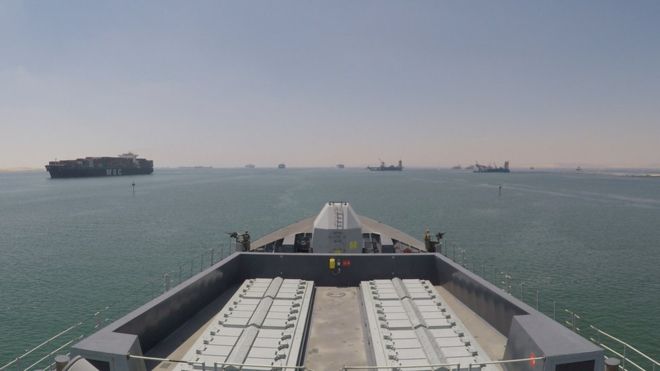
Iran tanker seizure: UK warship HMS Duncan arrives in Gulf

A second Royal Navy warship has arrived in the Gulf to protect British ships amid heightened tensions in the region.

HMS Duncan has joined frigate HMS Montrose to escort vessels sailing under the British flag through the Strait of Hormuz.

HMS Montrose has so far accompanied 35 vessels through the strait, according to the Ministry of Defence (MoD).

Defence Secretary Ben Wallace said the UK continued to push for a diplomatic resolution to the situation.

He said: “Freedom of navigation in the Strait of Hormuz is vital not just to the UK, but also our international partners and allies.

“Merchant ships must be free to travel lawfully and trade safely, anywhere in the world.”

Mr Wallace added the Royal Navy will continue to provide a safeguard for UK vessels “until this is the reality”.

HMS Duncan is a Type 45 Destroyer which the Royal Navy describes as “among the most advanced warships ever built”.

Why have tensions escalated?

Earlier this month, British Royal Marines helped seize Iranian tanker Grace 1near Gibraltar which was suspected of breaking EU sanctions, infuriating Iran.

In response, Tehran threatened to capture a British oil tanker.

On 19 July, British-flagged oil tanker Stena Impero was seized by Iran’s Revolutionary Guard in the key shipping route.

A second British-linked tanker, the MV Mesdar, was also boarded by armed guards but was released.

Tehran said the Stena Impero was “violating international maritime rules”.

HMS Montrose was alerted but it was too far away to stop the seizure.

Iran’s state-run IRNA news agency said the tanker was captured after it collided with a fishing boat and failed to respond to calls from the smaller craft.

But the then foreign secretary Jeremy Hunt said it was seized in Omani waters in “clear contravention of international law” and then forced to sail into Iran.

The tanker’s Swedish owners, Stena Bulk, said it had been complying with regulations and had been in international waters.

Stena Bulk said the 23 crew members, who are Indian, Russian, Latvian and Filipino, are in good health and have met with officials from their respective countries.

How has the UK reacted?

The then foreign secretary Jeremy Hunt called the seizure of the Stena Impero “state piracy”.

But he insisted: “Our priority continues to be to find a way to de-escalate the situation.”

Speaking to the BBC, former Cabinet minister Iain Duncan Smith described the UK-flagged ship’s capture as a “major failure” by the UK.

The then defence minister Tobias Ellwood told Sky News “it is impossible simply to escort each individual vessel”.

What has Iran said?

Iran’s foreign minister Javad Zarif said in a tweet the UK “must cease being an accessory to #EconomicTerrorism of the US”.

He said Iran guarantees the security of the Gulf and the Strait of Hormuz, and insisted its action were to “uphold international maritime rules”.

Iranian President Hassan Rouhani has indicated the Stena Imepero could be released if the UK returns the Grace 1.

In a statement on his website he said: “We are not going to continue tensions with some European countries and if they are committed to international frameworks and abandon some actions, including what they did in Gibraltar, they will receive a proper response from Iran”.

Source: bbc.co.uk