Piracy in West Africa: The world’s most dangerous seas?

The seas off West Africa’s oil-rich coastline are now the most dangerous in the world for shipping, according to a new report.

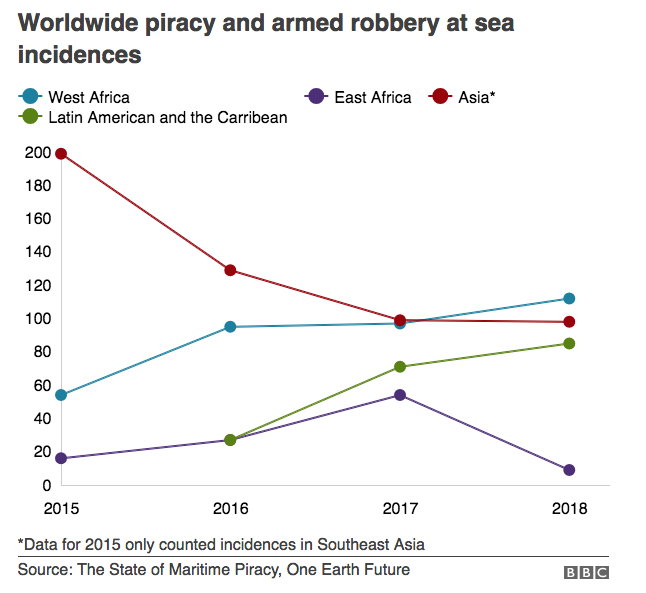
One Earth Future, which produces an annual State of Maritime Piracy, says that while attacks have been falling substantially in some regions of the world, in West Africa they’ve been on the rise and are now more frequent than anywhere else.

So why the increase in West Africa, and what shipping is being targeted?

What is piracy?

A strict definition of maritime piracy only includes attacks on shipping on the high seas – that is, more than 12 nautical miles off the coastline and not under the jurisdiction of any state.

Inside a country’s territorial waters and within port facilities, these attacks are defined as armed robberies at sea.

However, the data we’ve used from this latest report combines these two sets of data to give an overall picture of incidents at sea both inshore and offshore.

In 2018, there were 112 such incidents in West African waters.

It’s not just the huge tankers exporting oil and gas from Nigeria and Ghana that are targeted.

Commercial ships from smaller countries are also in the sights of the pirates.

At a recent event in London, President Faure Gnassingbé of Togo – a country sandwiched between these two regional giants – highlighted his own concerns at the rise in attacks on regional shipping.

“Our region is distinguished by the resurgence of transnational criminality on the high seas in the Gulf of Guinea,” said Mr Gnassingbé.

Why are attacks rising?

Most of the attacks have been against ships involved in oil and gas transportation, such as tankers, bulk carriers and tugs. Fishing vessels have also been targeted.

The coastline off Nigeria saw the most attacks in 2018. This is partly because of “petro-piracy”, targeting tankers from Nigeria’s rich oil and gas fields.

There were also incidents reported at the loading and anchorage facilities in the Nigerian port of Lagos.

Piracy in the form of hijacking and kidnapping for ransom payments was also common off the coasts of Benin, Ghana, Nigeria, Congo-Brazzaville and Cameroon.

Rich pickings at sea, political instability, the lack of law enforcement and poverty on land are all factors which have contributed to the increase in piracy.

Most of the seafarers affected are not from the region. Around half are from the Philippines, followed by India, Ukraine and Nigeria.

One of the reasons West Africa is now the number one spot for piracy is because of of the downward trends recorded elsewhere.

The East African shipping routes along the Somali coastline have been notorious for hijackings and robberies.

But since peaking in 2011, rates of piracy there have fallen off dramatically in recent years.

This is in large measure as a result of a successful multi-national effort to patrol these waters and take firm action action against acts of piracy.

Local efforts on land in Somalia to change attitudes towards permitting piracy and building legal capacity to prosecute criminals have also helped improve the situation.

In Asia, the Malacca Strait, a busy, commercially important stretch of water between Malaysia and Indonesia, experienced a high number of attacks in 2015.

Concerted action by regional naval forces has reduced the problem there, but piracy still persists.

Attacks against shipping in the Caribbean and off the coast of Latin American have, however, risen.

Venezuela in particular has become a hotspot for piracy.

“Political and economic instability is a big factor there,” says Lydelle Joubert, an expert on piracy at One Earth Future.

Source: bbc.co.uk
Anti-piracy bill will combat maritime crime as sector creates 7,000 jobs

By Tope Templer Olaiya, Sulaimon Salau, Gloria Ehiaghe (Lagos) and Rotimi Agboluaje (Ibadan)

Director General of the Nigerian Maritime Administration and Safety Agency (NIMASA), Dakuku Peterside, has said the agency was taking strategic steps to deal with maritime piracy.

He disclosed that the anti-piracy bill, sponsored by NIMASA, has been passed by the National Assembly and as soon as it is signed into law, it would help tame piracy in and open up more opportunities in the sector.

To continue reading, please click here.

Source: guardian.ng

Brazilian Navy Participates in Training to Counter Crimes at Sea on the African Coast

Naval forces from 33 countries came together for exercise Obangame Express to work on countering piracy, drug trafficking, and illegal fishing, which are common in the Gulf of Guinea.

Andréa Barretto

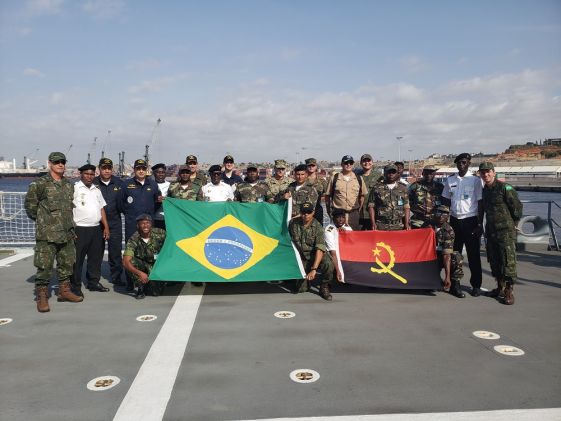
The Brazilian Navy (MB, in Portuguese) participated in the multinational exercise Obangame Express, on the African Coast, for the sixth time. Since 2010, the training gathers naval forces from Africa, Europe, and the Americas. The objective is to boost regional cooperation and promote maritime domain awareness.

The African Coast faces issues such as drug, arms, and human trafficking; illegal fishing, and piracy. During the two-week exercise, Obangame also develops information sharing standards and vessel interdiction expertise, to counter illegal activities at sea.

To continue reading, please click here.

Source: dialogo-americas.com

Brazilian Navy and Angolan Navy service members raise their country flags, on board the Brazilian ship Araguari, deployed for exercise Obangame Express 2019. (Photo: Brazilian Navy)

Nigeria ranks highest in piracy, vessel stowaways — Insurance report

Nike Popoola

Nigeria overtook Indonesia in global piracy incidents in the maritime sector, accounting for one out of every four reported cases in 2018, according to the latest report by Allianz Global Corporate & Specialty, a global corporate insurance carrier and a key business unit of Allianz Group.

The report also revealed that Nigeria’s port saw the highest number of reported cases of stowaways on commercial vessels.

To continue reading, please click here.

Source: punchng.com

Nigerian piracy levels deemed ‘unacceptable’, international solutions sought

SAM CHAMBERS

Some of shipping’s top stakeholders met on Friday at the London headquarters of the International Maritime Organization (IMO) to demand action to counter the dire piracy situation off the Gulf of Guinea, which is causing severe distress for seafarers who have to transit the region.

The event, co-sponsored by BIMCO, IMCA, ICS, ITF and OCIMF, drew members of the shipping community, flag states and agencies from the Gulf of Guinea.

To continue reading, please click here.

Source: splash247.com

Navy Recruits 1,176 To Fight Sea Pirates

The Nigerian Navy has recruited 1,176 young men and women to aid the fight against sea pirates and oil bunkers in the nation’s maritime domain.

The Chief of Defence Staff, General Abayomi Olonisakin, stated this in a statement made available to The Tide shortly after the passing out parade of Batch 28, Basic Training School in Onne. He said the trainees underwent rigorous physical and mental training for seven months to prepare them for internal security operations across the country.

To continue reading, please click here.

Source: thetidenewsonline.com

FG To Begin Deployment Of Anti-Piracy Equipment In June

By Tola Adenubi

THE Federal Government will begin the deployment of anti-piracy equipment in the nation’s Maritime sector by June 2019.

Disclosing this on Tuesday in Lagos during a stakeholders meeting tagged ‘Regulating The Maritime Industry For a Better Nigeria’, the Honourable Minister of Transportation, Rt. Hon. Rotimi Amaechi revealed that the situation as regards insecurity in the nation’s maritime sector is very bad as of now.

To continue reading, please click here.

Source: tribuneonlineng.com

Govt acquires two helicopters, 20 speed boats for maritime security

by Faith Yahaya

The Federal Government said it has taken delivery of two helicopters, 20 speed boats and other equipment needed to secure Nigerian waters.

Last year, President Muhammadu Buhari approved $195 million to boost maritime security and reduce criminal activities. To achieve its aim, the government engaged an Israeli company to train some personnel on waterways security.

To continue reading, please click here.

Source: thenationonlineng.net

Gabon gets new maritime operations centre

Gabon’s navy has accepted a new maritime operations centre (MOC), which was built by the United States Navy’s Seabees. It will support Gabon in protecting its maritime borders and countering illicit trafficking.

The US Navy this week said Seabees assigned to US Naval Mobile Construction Battalion (NMCB) 133 turned over the MOC to the Gabonese navy at a ribbon cutting ceremony at Port Gentil on 3 May.

To continue reading, please click here.

Source: defenceweb.co.za

Navy to acquire more platforms to fight crime, says CNS

by Blessing Olaifa

The Nigerian Navy (NN) yesterday said it will acquire more platforms, including helicopters and fast interceptor boats, among others, to strengthen its operations in years ahead.

The Chief of Naval Staff (CNS), Vice Admiral Ibok-Ete Ibas, stated this in Abuja, the nation’s capital, while addressing reporters on activities lined up for the 63rd anniversary celebration of the Navy.

To continue reading, please click here.

Source: thenationonlineng.net