Sri Lanka Navy trains overseas Coast Guard personnel in Search and Seizure

Sept 17, Colombo: The Sri Lanka Navy (SLN) is currently conducting a specialized ship search and seizure training for the overseas Coast Guard personnel in partnership with the United Nations Office on Drugs and Crime, (UNODC), the Navy said.

A Visit Board Search & Seizure (VBSS) course for the boarding teams of Indonesian, Malaysian and Philippine Coast Guards commenced at the Special Boat Squadron (SBS) Headquarters in Trincomalee Monday (16th September 2019).

To continue reading, please click here.

Source: colombopage.com

Nigeria: Losing war to vandals, oil thieves

With 45,347 breaks inflicted on Nigeria’s fuel pipelines in 18 years, thieves and vandals appear to be winning war against government and oil multinationals. Adeola Yusuf reports

For the umpteenth time, the Nigerian National Petroleum Corporation (NNPC) penultimate Wednesday announced collaboration with the Nigerian Navy to deepen war on crude oil theft. Describing theft and vamdalism as a menace, the two institutions declared a full-fledged war on crude oil theft and attacks on oil and gas facilities.

The duo came to the resolution when the NNPC GMD, Mallam Mele Kyari paid a courtesy visit to the Chief of Naval Staff, Vice Admiral Ibok Ekwe Ibas at the Naval Headquarters.

To continue reading, please click here.

Source: newtelegraphng.com

Private armed guards not allowed onboard vessels in Nigeria –Navy

Maritime Security News: Not entirely sure why they feel the need to restate this policy.

The Nigerian Navy has disclosed that private armed guards are still not permitted on merchant vessels in Nigeria. Rear Admiral, Begroy Enyinna Ibe-Enwo, representing the Chief of Naval Staff, confirmed this last week at the West Africa Shipping Summit in London, as part of highlight of events at the London International Shipping Week.

At the event, both NIMASA and the Navy acknowledged the challenges in securing the Nigerian maritime domain and affirmed the collaboration between both organisations to stem the incidents of piracy and armed robbery at sea.

To continue reading, please click here.

Source: sunnewsonline.com

The future of Philippine maritime enforcement

Michael van Ginkel

Illicit activity in the Sulu and Celebes Seas continues to pose a daunting maritime security challenge for the Philippines. The recent kidnapping of nine fishermen off the coast of Borneo and the increasingly violent modus operandi of the militant Abu Sayyaf Group (ASG) have raised safety concerns amongst Philippine policy makers and local communities. Although the Philippines has initiated several maritime enforcement initiatives, including the extensive National Coastal Watch System (NCWS), the government needs to enhance cooperation between land-based and maritime operations and increase engagement between military and civilian agencies to improve regional maritime stability.

To continue reading, please click here.

Source: theaseanpost.com

Examining Autonomous Ships’ Vulnerability to Piracy

By Thibaut Eude

Autonomous ships are a hot topic in the maritime sector; piracy and armed robbery too. Since the beginning of the year, according to the IMB, almost 100 attacks have been committed against ships all around the world. 2018 saw a marked increase in attacks compared to the past few years. 

Here is an attempt to describe an autonomous ship hijacking scenario.

The scenario

In 2025, an autonomous ocean-going container ship is chartered on a busy commercial line between China and Europe. The vessel is a level four autonomous ship according to the IMO classification [1] . The vessel is underway, and she is now passing through Malacca Strait. All sensors and artificial intelligence (AI) processes are working hard to avoid collision with others vessels, keep water under the keel and maintain the vessel on track [2]. 

To continue reading, please click here.

Source: maritime-executive.com

Combating Emerging Security Threats in the Maritime Domain

Aside the traditional crimes that have bedeviled the maritime domain for decades, Chiemelie Ezeobi writes that emerging security threats like attacks on shipping, sabotage of hydrocarbon infrastructure and maritime resource theft, as well as other transnational organised crimes, are some of the challenges being tackled by the Nigerian Navy in its quest to secure the nation’s  and the Gulf of Guinea waters 

World over, security threats keep evolving from traditional to conventional warfare. In the maritime domain, same rings true. In the past, the maritime domain was threatened by piracy, sea robbery, illicit trafficking, illegal unreported and unregulated fishing (IUUF) and marine pollution. Now, emerging security threats within the Nigerian maritime domain stem largely from non-military causes such as socio-economic agitations and unemployed youths within the coastal communities, which are manifested through attacks on shipping, sabotage of hydrocarbon infrastructure and maritime resource theft.

To continue reading, please click here.

Source: thisdaylive.com

CTF-151 OUTLINE OF FO ‘KING CRAB’

INTRODUCTION

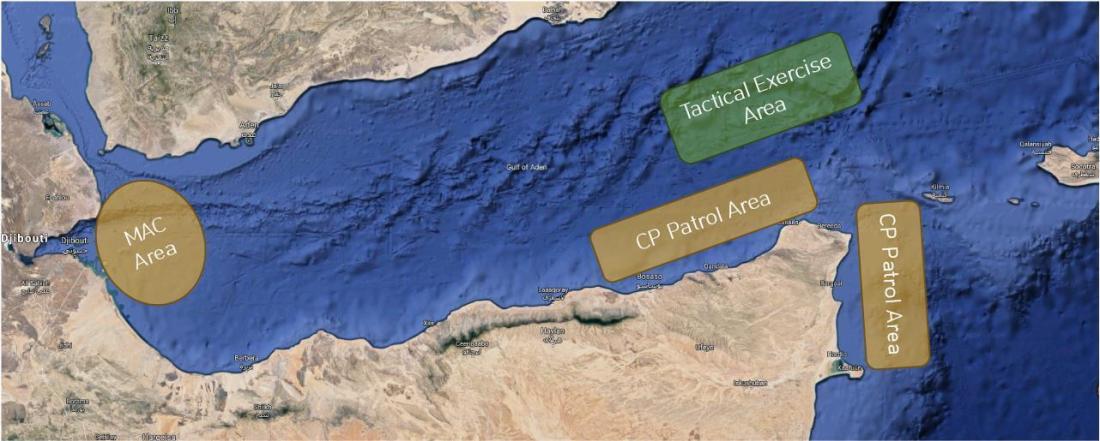
  1. A CTF 151 led Counter Piracy Focused Operation ‘KING CRAB’, will be conducted from 23rd SEP to 26th SEP 2019. The purpose of this note is to inform military forces (EUNAVFOR, Independent Deployers), regional partners and maritime communities on planned activities in order to help their understanding and to bring about cooperation.
  2. The area of operations will be the Gulf of Aden and Socotra Gap. Also CTF-151 will continue to operate along the northern coast of Somalia, providing opportunities for engagements with merchant communities and local mariners, increasing the understanding on Pattern of Life and exchanging information with partners. And merchant shipping is to be advised that during the period of Operation KING CRAB there will be increased military activities and conduct of Maritime Awareness Calls (MAC).

THE AIM OF OPERATION

  1. Between 23rd to 26th SEP, CTF151 is to deploy increased assets in the focused areas, ENSURING a visible military presence at sea for deterring piracy action, MONITORING suspicious maritime activities involved in piracy, ENGAGING with merchant community for better relationship and reassuring, and UNDERSTANDING regional and local marine activities via POL collection and Friendly Approach.

POINT OF CONTACT

  1. Plans Assistant (roknctf151n51@gmail.com) will act as the main a POC within CTF 151. For partners – military and civilian – interested in any of the outline activities, CTF151 battle watch captain (ctf151.bwo.rokn@gmail.com, +001 1 203 574 6393) will act as points of contact.

Nigeria’s Greasy, Sleazy, Billion-Dollar Oil Theft Industry

By Michael Eboh

In January 2019, security operatives conducting surveillance on oil installations in Lagos State, nabbed Mr. Shuaibu Ogunmola, an alleged kingpin of oil pipeline vandalism in Lagos State, who it claimed was responsible for loss of millions of litres of petroleum products daily.

He had operated a thriving oil theft racket for decades, hacking pipelines in some island communities in Amuwo-Odofin Local Government Area of Lagos State, along the strategic System 2B pipeline network Right-of-Way. His activities had through the years, led to loss of millions of litres of products along the Lagos Atlas Cove strip.

To continue reading, please click here.

Source: allafrica.com

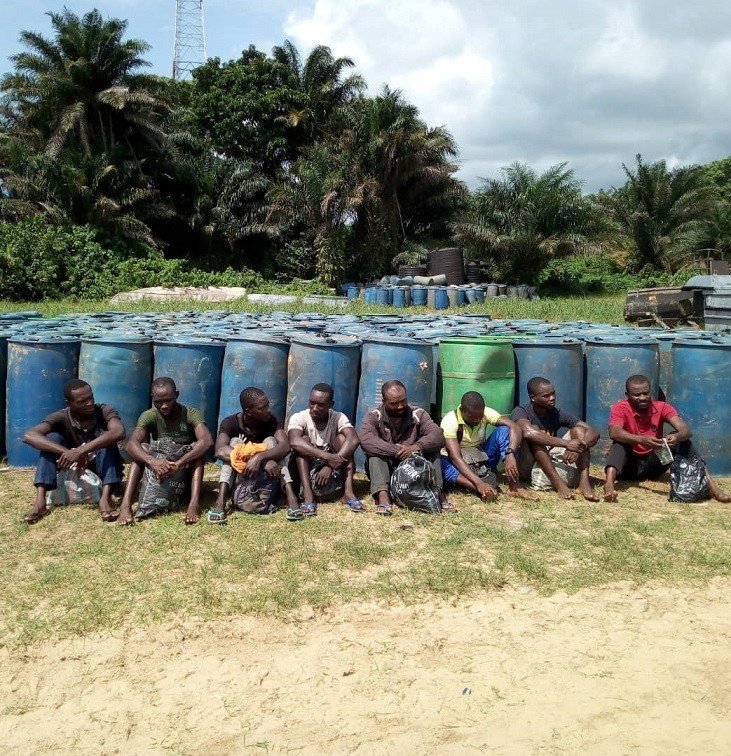
57 suspected oil thieves arrested in Nigeria

Nigerian navy troops operating in the oil rich Niger Delta region arrested 57 suspected oil thieves in its anti-oil theft operations, an officer said Friday.

They were nabbed for allegedly smuggling crude oil and illegally refining diesel, Adegoke Ebo, head of the Nigerian Navy Ship (NNS) Pathfinder, said in the southern city of Onne in Rivers state, while handing over the suspects and items to the Economic and Financial Crimes Commission (EFCC) on Friday.

To continue reading, please click here.

Source: newsghana.com.gh