Gulf of Oman tanker attacks: US says video shows Iran removing mine

The US military has released a video which it says shows Iran’s Revolutionary Guard removing an unexploded mine from the side of an oil tanker damaged in an attack in the Gulf of Oman on Thursday.

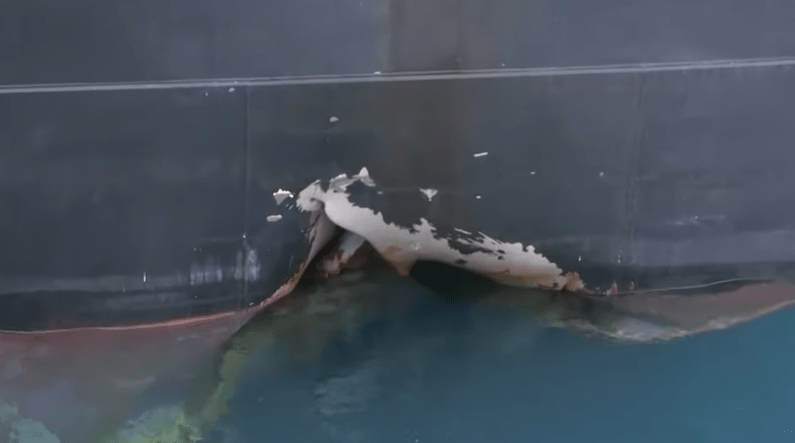
US officials also shared a photo of the Japanese tanker, apparently showing the unexploded mine before it was removed.

A Norwegian tanker was also damaged.

The US accused Iran of being behind the mine attacks. Iran said it “categorically rejects” the allegation.

The blasts came a month after four oil tankers were damaged in an attack off the coast of the United Arab Emirates. The US blamed Iran for that attack, but did not produce evidence. Iran also denied those accusations.

Tensions between the two countries have escalated significantly since US President Donald Trump took office in 2017. He abandoned a nuclear deal that was brokered by the Obama administration and imposed heavy sanctions on Iran.

Oil prices jumped as much as 4% after Thursday’s incident. The Gulf of Oman lies at one end of a vital shipping lane through which a third of the world’s transported oil – worth hundreds of millions of dollars – passes every year.

What we know about the explosions

According to the US account of events, US naval forces in the region received distress calls from the Norwegian-owned Front Altair at 06:12 local time (02:13 GMT) and from the Kokuka Courageous at 07:00, following explosions, and moved towards the area.

It said the USS Bainbridge observed Iranian naval boats operating in the area in the hours after the explosions, and later removing the unexploded mine from the side of the Kokuka Courageous.

The crews of both vessels were evacuated to other ships nearby. Both Iran and the US later released pictures showing rescued crew members on board their vessels.

The operator of the Kokuka Courageous, BSM Ship Management, said its crew abandoned ship after observing a fire and an unexploded mine.

The Kokuka Courageous was about 20 miles off the Iranian coast when it sent its emergency call.

The Front Altair was carry naphtha, a petrol product, from the United Arab Emirates to Taiwan. The Kokuka Courageous was carrying methanol from Saudi Arabia to Singapore.

What did the US say?

US Secretary of State Mike Pompeo said at a news conference in Washington: “It is the assessment of the United States that the Islamic Republic of Iran is responsible for the attacks.

“This assessment is based on intelligence, the weapons used, the level of expertise needed to execute the operation, recent similar Iranian attacks on shipping, and the fact that no proxy group operating in the area has the resources and proficiency to act with such a high degree of sophistication.”

UK Foreign Secretary Jeremy Hunt said his country’s “starting point” was to “believe our US allies”.

“We are taking this extremely seriously and my message to Iran is that if they have been involved it is a deeply unwise escalation which poses a real danger to the prospects of peace and stability in the region,” Mr Hunt said.

How did Iran respond?

In a statement released on Friday, the Iranian mission to the United Nations said it rejected what it called an “unfounded” and “Iranophobic” allegation by the US.

“Iran categorically rejects the US’ unfounded claim with regard to 13 June oil tanker incidents and condemns it in the strongest possible terms,” the statement said.

Foreign Minister Javad Zarif on Twitter accused the US of making an allegation “without a shred of factual or circumstantial evidence” and attempting to “sabotage diplomacy”.

The alleged attacks took place as Iran’s Supreme Leader Ayatollah Ali Khamenei was meeting Japan’s Prime Minister Shinzo Abe during a two-day visit by Mr Abe to Iran.

Source: bbc.co.uk
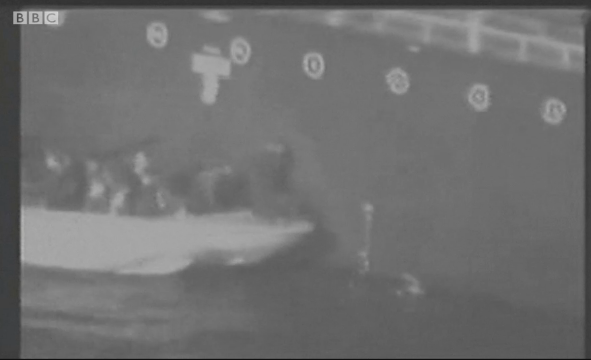
Video released by the US purports to show IRGC personnel removing a mine.

Need for greater maritime collaboration in the Indian Ocean Region: Indian Navy Deputy Chief

Issues related to human and drug trafficking, maritime piracy and the legal aspects of combating these challenges are being discussed by experts at the Maritime Information Sharing Workshop, (MISW).

Stressing on the need for greater maritime collaboration, Deputy Chief of the Naval Staff Vice Admiral MS Pawar said there is a need to forge bonds based on trust, between partner countries in the region.

To continue reading, please click here.

Source: financialexpress.com

Gulf of Oman tanker blasts: Crews rescued safely

Dozens of crew members have been rescued after abandoning two oil tankers hit by explosions in the Gulf of Oman.

Ship operators said 21 crew on board the Kokuka Courageous and 23 on the Front Altair had been evacuated.

Iran rescued the 44 after an “accident”, state media said, although the cause is unconfirmed. The US Navy said it received two distress calls.

The incident comes a month after four oil tankers were attacked off the UAE.

Oil prices rose as much as 4.5% from a near five-month low following Thursday’s incident, Bloomberg reports.

What do we know about the explosions?

The cause remains unclear.

The Norwegian-owned Front Altair had been “attacked”, the Norwegian Maritime Authority said, leading to three explosions on board.

Wu I-fang, a spokesman for Taiwan’s state oil refiner CPC Corp, which chartered the Front Altair, said it was carrying 75,000 tonnes of naphtha and was “suspected of being hit by a torpedo”, although this has not been confirmed. Other unverified reports suggested a mine attack.

The ship’s owner, Frontline, said the Marshall Islands-flagged vessel was on fire but denied reports on Iran media it had sunk.

The operator of the Panama-flagged Kokuka Courageous, BSM Ship Management, said its crew abandoned ship and were rescued by a passing vessel.

The tanker was carrying methanol and was not in danger of sinking, a spokesman said.

It is currently located about 80 miles from Fujairah in the UAE and 16 miles from Iran. The cargo remains intact.

Who came to the rescue?

Iranian state media said Iran had rescued the crew members and they had been taken to the port of Jask.

Iranian Foreign Minister Mohammad Javad Zarif tweeted that the incident happened as Japanese PM Shinzo Abe was meeting Iran’s supreme leader, Ayatollah Ali Khamenei, adding: “Suspicious doesn’t begin to describe what likely transpired this morning.”

The vessels were carrying what Japan trade officials said was “Japan-related cargo”.

The initial reports of the blasts came through the Royal Navy-linked UK Maritime Trade Operations (UKMTO) safety group, which issued a warning, urging “extreme caution” in the area.

The US 5th Fleet, based in Bahrain, said it had sent the USS Bainbridge to assist.

Spokesman Josh Frey said in a statement: “US naval forces in the region received two separate distress calls at 06:12 local time (03:12 GMT) and a second one at 07:00.”

Why is this so sensitive?

The Gulf of Oman lies at one end of the strategic Strait of Hormuz, and this incident will further increase tension in a vital shipping lane through which hundreds of millions of dollars of oil pass.

The US sent an aircraft carrier strike group and B-52 bombers to the region at the start of May in response to what it said was an unspecified plan by Iran-backed forces to attack US forces in the area.

President Donald Trump has taken a hard line towards Iran, accusing it of being a destabilising force in the Middle East.

Iran rejected the claims and has accused the US of aggressive behaviour.

Those tensions rose markedly after the 12 May limpet mine attacks on four tankers off the UAE.

The UAE blamed an unnamed “state actor”. The US said that actor was Iran, an accusation Tehran has denied.

While it is unclear why Iran would carry out a relatively low-level attack on the multinational tankers, observers have speculated that it could have been to send a signal to forces ranged against it that it is capable of disrupting shipping there without triggering a war.

Source: bbc.co.uk

Luxury cruise ships return to Sri Lanka following Easter terror explosions

COLOMBO, June 11 (Xinhua) — Sri Lanka’s leading tour operators said on Tuesday that luxury cruise ships have begun calling at Sri Lanka’s ports following the improved security situation in the island country after the Easter terror attacks on April 21 which killed over 250 people.

Aitken Spence Maritime, agents for Hapag-Lloyd, was quoted by local media as saying that the shipping groups MS Europa 2 cruise ship called at Sri Lanka’s Colombo Port in the capital and Hambantota port in the south recently with 309 passengers and 356 crew onboard.

To continue reading, please click here.

Source: xinhuanet.com

Maritime security: “The Indian Ocean has become a hub for drug trafficking,” says SAJ

File image of an approach on a dhow

BY EMILY PAYEN, BY PREITY RAMESSUR-BHOYROO

A presentation by the Ministerial Maritime Security in Eastern and Southern Africa and Indian Ocean (ESA-OI) took place at the Prime Minister’s Office (PMO) on Tuesday 11 June. The meeting was attended by Minister Mentor Sir Anerood Jugnauth and Minister of Foreign Affairs Nando Bodha.

“The Indian Ocean has become a hub of drug trafficking,” said the minister’s mentor. He explained that “we must take steps to counter this problem.”

To continue reading, please click here.

Source: defimedia.info

India spends big on Maldives security

Indian leader Narendra Modi on Saturday inaugurated a coastal radar system and military training center in the Maldives on Saturday, as New Delhi seeks to fend off Chinese influence in the strategically-placed nation

The Maldives, a low-lying archipelago of more than a thousand tiny coral islands south of the Indian subcontinent, straddles the world’s busiest east-west maritime route.

To continue reading, please click here.

Source: english.alarabiya.net

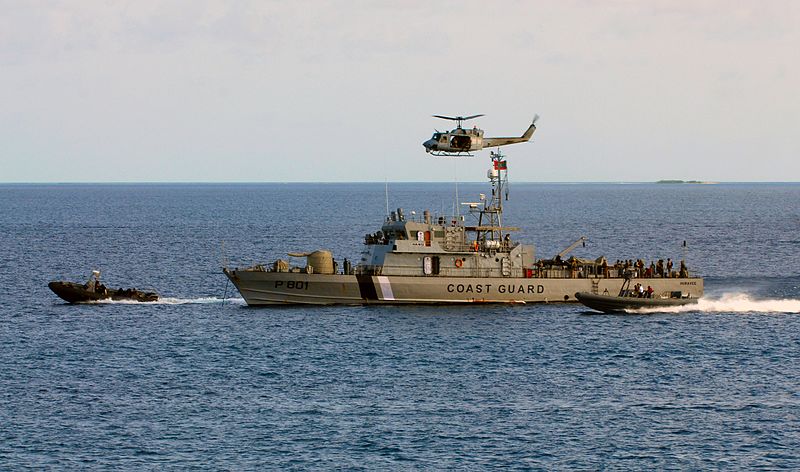
A Maldivian coast guard ship Hurawee (801) (formerly Indian Navy Ship Tillanchang T62) serves as a non-compliant vessel during an exercise for a visit, board, search and seizure team assigned to the amphibious transport dock ship USS Dubuque (LPD 8). Dubuque is participating in Operation Bungalow Breeze with the Maldives National Defense Forces. (U.S. Navy photo by Mass Communication Specialist 1st Class David McKee/Released)

Kenya wins accolades from France for establishing Coast Guard

Philip Mwakio

The French Government has commended Kenya for establishing a Coast Guard Unit to police its vast Coastal maritime waters.

President Uhuru Kenyatta late last year unveiled the Kenya Coast Guard Service (KCGS) and launched into service its first offshore patrol boat christened Doria in Mombasa.

To continue reading, please click here.

Source: standardmedia.co.ke

Is Kenya staring at fresh security threats in a maritime row?

by Carson Jnr

For the past few weeks, Kenya’s diplomatic relations with the Federal Republic of Somalia has steadily been getting worse, thanks to the ongoing maritime row pitting oil wells along the Indian Ocean.

Amid the row, it is apparent that Kenya could be staring at fresh security threats from terrorist groups as  Al-Shabaab, and to some extent, the ISIS who might be watching from a distance, hoping that Kenya gets into a war with Somalia.

To continue reading, please click here.

Source: hivisasa.com

UAE tanker attacks blamed on ‘state actor’

The United Arab Emirates has told the UN Security Council a “state actor” was most likely behind attacks on four tankers off its coast.

The 12 May attacks bore the hallmarks of a “sophisticated and co-ordinated operation”, according to its report.

The UAE did not say who it thought was behind the attacks, which also targeted vessels from Saudi Arabia and Norway.

The US has accused Iran of being behind the attacks but Tehran denies this and has called for an investigation.

The attacks took place within UAE territorial waters east of the emirate of Fujairah, just outside the strategically vital Strait of Hormuz, in what the UAE called a “sabotage attack”.

They exacerbated long-standing tensions between Iran, and the US and its allies in the Gulf.

What does the report say happened?

According to the UAE-led investigation, which was presented to a closed session of the UN Security Council in New York, the attacks showed a “high degree of sophistication”.

“The attacks required the expert navigation of fast boats” which “were able to intrude into UAE territorial waters”, the report’s preliminary findings say.

Divers were used to attack the ships using limpet mines in order to cause damage but not cause a major explosion, the presentation says.

There were no casualties but Saudi Arabia has said two of its ships suffered “significant” damage. Another tanker was Norwegian-registered, while the fourth was UAE-flagged.

Why is Iran being accused?

The attacks happened at a time of escalating tension between the US and Iran, long-time foes.

They took place days after the US sent warships and bombers to the region in response to what it said was an unspecified plan by Iran to attack US forces in the area.

While it is unclear why Iran would carry out a relatively low-level attack on the multinational tankers, observers have speculated that it could have been to send a signal to forces ranged against it that it is capable of disrupting shipping there without triggering a war.

Responding to the UAE report, the Saudi Ambassador to the UN, Abdallah Y al-Mouallimi, said the kingdom believed “that the responsibility for this action lies on the shoulders of Iran. We have no hesitation in making this statement,” Reuters news agency reported.

US National Security Adviser John Bolton previously said “naval mines almost certainly from Iran” were to blame for the damage, although he provided no evidence to support the allegation.

However, Mr Bolton, long known for his hawkish stance on Iran, denied the Trump administration was seeking to overthrow the Iranian government.

“The policy we’re pursuing is not a policy of regime change,” he told reporters last week during a visit to London. “That’s the fact and everybody should understand it that way.”

Iran’s foreign ministry has rejected the US accusations as “ludicrous” and accused Mr Bolton of being a “warmonger”.

What are the underlying tensions?

At the start of May, Washington ended exemptions from sanctions for countries still buying oil from Iran.

The decision was intended to bring Iran’s oil exports to zero, denying the government its main source of revenue.

US President Donald Trump reinstated the sanctions a year ago after abandoning the landmark 2015 nuclear deal that Iran agreed with six nations – the five permanent members of the UN Security Council and Germany.

Iran has now announced it will suspend several commitments under the deal.

Source: bbc.co.uk

Contact Group On Piracy Might Be Extended To Include Gulf Of Guinea – Russian Envoy To UN

Faizan Hashmi

The geographic mandate of the Contact Group on Piracy off the Coast of Somalia (CGPCS) might be broadened to combat piracy in the Gulf of GuineaRussia‘s Deputy Permanent Representative to the UN Dmitry Polyanskiy said during UN Security Council consultations on the situation in the Central African region.

“Our country has had a positive experience in international efforts to fight piracy in the northwestern part of the Indian Ocean as part of the Contact Group on this fight off the coast of Somalia. We hope that this experience might be useful for resolving similar issues in the Gulf of Guinea, including in the context of possibly broadening the geographic mandate of the Contact Group to include the Gulf of Guinea,” Polyanskiy said on Tuesday.

To continue reading, please click here.

Source: urdupoint.com